7 Ways to Build an Enterprise AEO Workflow That Leads to Action
Learn how to build an enterprise AEO workflow with seven actionable steps for prioritizing opportunities, coordinating teams, and measuring AI search performance.

Andrew Yan
Co-Founder, CEO of AthenaHQ
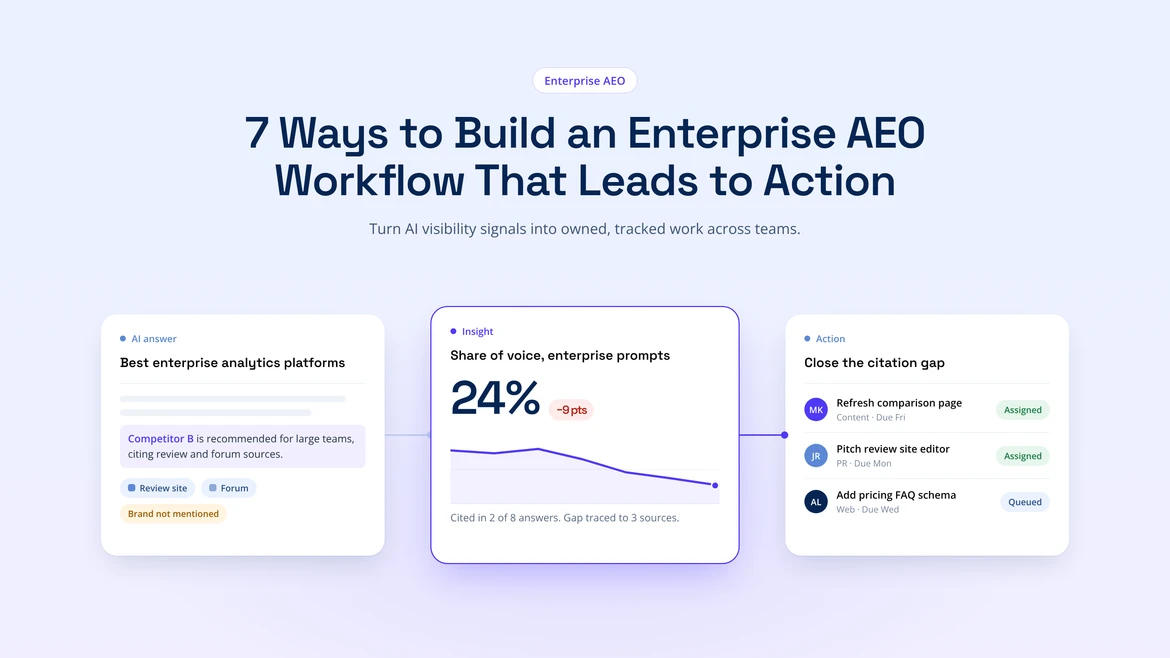
AI search is changing how customers discover and evaluate products. According to AthenaHQ’s State of AI Search, leading brands in competitive categories receive 3.7X more mentions in AI-generated answers than the market average. As AI platforms play a bigger role in the customer journey, enterprises need to understand how their brands appear in those responses, which sources AI engines cite, and where opportunities exist to improve visibility.
Tracking AI search performance is one thing, but knowing what to do with the findings is another. Enterprise teams monitor buyer questions across products, markets, funnel stages, and AI engines. One answer may contain an outdated claim, another may cite competitors, and a third may expose a technical issue affecting dozens of pages. Without clear decisions and ownership, those signals can quickly become a backlog rather than a plan.
An effective enterprise answer engine optimization (AEO) workflow connects AI search findings to business priorities, responsible teams, documented interventions, and measurable results.
Here are seven ways to build that process, along with practical examples and templates.
Key Takeaways
- An enterprise AEO workflow turns AI search insights into action. It connects prompt monitoring, issue diagnosis, prioritization, team ownership, optimization, and performance measurement in a repeatable process.
- Prioritize AEO opportunities based on business impact, buyer intent, evidence, and feasibility. Missing citations, inaccurate claims, and technical issues require different responses, and high-risk inaccuracies should receive immediate attention.
- Cross-functional ownership is essential for enterprise AEO. SEO, Content, Product Marketing, Engineering, Analytics, and Legal need clear responsibilities, approval processes, and escalation procedures.
- Measure AEO improvements through repeatable testing. Track answer accuracy, brand visibility, citations, and relevant business outcomes while accounting for variability across AI engines and prompts.
- Use automation to accelerate AEO workflows, not bypass human oversight. Automated monitoring, classification, and recommendations can improve efficiency, but sensitive claims and production changes require appropriate review.
1. Give Every Buyer Question a Business Purpose
Enterprise AEO starts with understanding which questions actually matter to customers and why. Before deciding which prompts to optimize, classify each tracked question by product, audience, market, language, and buying stage. Then record the business decision it may influence and identify the approved source of truth for factual or regulated claims. For example:
- Buyer question: “How does Product A compare with Product B for data residency?”
- Business purpose: Support an enterprise security evaluation.
- Scope: Product A, US enterprise buyers, comparison stage, English.
- Evidence: Approved residency documentation, effective date, and product owner.
This classification helps teams distinguish high-value commercial questions from informational prompts with limited business relevance. Global enterprises also need to separate shared product information from regional requirements. Product Marketing may own the global description, while regional teams verify availability, translations, legal claims, and market-specific documentation.
Enterprise AEO Localization Checklist
Before optimizing or publishing content for a regional market:
- Confirm the market, language, product version, and availability.
- Verify that local legal and regulatory claims have the appropriate approval.
- Check regional citations and translated terminology against current documentation.
- Test prompts in the relevant language and region rather than assuming US results apply globally.
- Record the review date and accountable regional owner.
When global and regional requirements conflict, the designated business owner should coordinate a decision with Legal and the relevant regional approver.
2. Establish Clear Ownership Across Enterprise Teams
Enterprise AEO requires coordination across departments. A visibility issue may originate in content, product documentation, technical infrastructure, or inaccurate information from an external source. Without defined responsibilities, teams can spend more time debating ownership than resolving the problem.
A Responsible, Accountable, Consulted, and Informed (RACI) framework clarifies who completes the work, makes decisions, provides expertise, and receives updates on progress.
Example: Enterprise AEO RACI Matrix
| Activity | SEO / Content | Product Marketing | Legal | Engineering |
| Identify inaccurate AI answer | R | A | C | I |
| Verify product claim | C | A/R | C | I |
| Approve regulated wording | I | R | A | I |
| Publish approved update | R | A | C | R, if needed |
| Retest and report outcome | R | A | I | C |
R = Responsible; A = Accountable; C = Consulted; I = Informed.
Responsibilities may vary by organization, but every issue should have one accountable decision-maker.
Define Severity and Escalation Rules
Not every AEO issue requires the same response.
| Severity | Example trigger | Suggested response |
| Critical | Materially false, harmful, or legally sensitive claim | Immediate escalation to the accountable owner and Legal |
| High | Repeated inaccuracy or technical issue affecting priority pages | Triage within one business day |
| Routine | Limited visibility issue without verified accuracy or compliance risk | Review during weekly prioritization |
Note: These response times are operational targets, not industry benchmarks. For sensitive claims, Legal should approve regulated wording, Engineering should review production changes, and the accountable business owner should coordinate the final decision.
3. Prioritize AEO Opportunities Based on Business Impact
Enterprise teams may identify hundreds of AI search issues across products, markets, and competitors. Addressing them in the order they appear is rarely the best use of resources. Instead, evaluate each opportunity using a consistent set of criteria:
- Business importance: How relevant is the issue to revenue, customer decisions, or strategic priorities?
- Buyer intent: Does the affected prompt support research, comparison, or purchase decisions?
- Breadth: How many relevant prompts, pages, products, or markets are affected?
- Evidence confidence: How consistently has the issue appeared, and how reliable is the diagnosis?
- Feasibility: How much effort, risk, and coordination will the proposed solution require?
Example: Enterprise AEO Prioritization Score
Rate each factor from 1 to 5 and calculate a weighted score.
Priority score = 30% business importance + 20% buyer intent + 20% affected-prompt breadth + 15% evidence confidence + 15% feasibility.
| Opportunity | Business impact | Buyer intent | Breadth | Evidence | Feasibility | Score / 5 |
| Missing comparison citation | 4 | 5 | 3 | 3 | 4 | 3.90 |
| Inaccurate product claim | 5 | 5 | 4 | 5 | 3 | 4.55 |
| Rendering issue across page cluster | 5 | 4 | 5 | 4 | 2 | 4.15 |
Illustrative scores, not validated predictions of business impact.
In this example, the inaccurate product claim ranks first because it could mislead customers. The rendering issue follows because one technical fix may improve accessibility across multiple pages. A critical compliance or accuracy issue should override the scoring system regardless of its calculated priority.
When search demand data is unavailable, teams can use documented proxies such as sales-team question frequency, affected accounts, and relevance to purchasing decisions. Unknown values should remain explicitly marked rather than replaced with unsupported estimates.
AthenaHQ’s Q4 2026 research also provides competitive benchmarks to help teams evaluate visibility. The report found that leading brands averaged 33.03% share of voice, compared with 18.36% for second-place brands and 12.93% for third-place brands. These findings can help enterprises identify categories where competitors have established a stronger presence in AI-generated answers.
4. Diagnose AI Search Issues Before Making Changes
When an AI-generated answer omits a brand or cites a competitor, publishing another article may seem like the obvious solution. But the underlying problem could be technical accessibility, incomplete information, weak supporting evidence, or inconsistent AI retrieval. An enterprise AEO workflow should diagnose the issue before recommending an intervention:
Enterprise AEO Diagnostic Framework
| Diagnostic question | Responsible team | Recommended action |
| Is the relevant page blocked, inaccessible, or incorrectly rendered? | SEO + Engineering | Check response status, robots directives, canonical tags, and rendered content. |
| Does the page answer the buyer’s actual question? | Content + Product Marketing | Improve the existing page with a direct, accurate explanation. |
| Are product claims supported by reliable evidence? | Product Marketing + subject expert | Update approved documentation, supporting facts, and citations. |
| Do AI answers consistently rely on independent sources? | Communications + SEO | Review third-party coverage and factual consistency. |
| Are results inconsistent or evidence insufficient? | Analytics + issue owner | Collect more observations before selecting an intervention. |
A single missing citation does not establish a content problem. Teams should look for repeated patterns across relevant prompts, observation windows, and AI engines.
Example: Resolving an Inaccurate AI Answer
Let’s take an enterprise software company tracking the question:
“Does Product A support EU data residency?”
The AI answer incorrectly states that the product does not support EU residency, despite approved documentation confirming availability for a specific plan.
The team follows this process:
- Detection: Three of five comparable baseline runs repeat the incorrect claim.
- Diagnosis: Technical checks pass, but the public product page omits the plan-specific qualification.
- Ownership: Product Marketing takes accountability, Content prepares the revision, and Legal approves regional wording.
- Intervention: The company updates its existing page with the approved statement and supporting documentation.
- Retesting: The team repeats the same prompts and settings across multiple observation windows.
- Closure: The owner documents whether answer accuracy improved, remained unchanged, or produced inconclusive results.
This approach creates a record of what changed and why, without assuming that a content update automatically caused subsequent AI answer improvements.
5. Measure AEO Performance Through Repeatable Experiments
AI-generated answers can vary between runs, even when users submit the same question. Model updates, retrieval behavior, geographic settings, and sampling can all influence results. That makes a single before-and-after comparison an unreliable basis for claiming success.
Enterprise AEO measurement should begin with a documented hypothesis.
For example: Updating the product comparison page with approved residency documentation will increase the frequency of accurate answers to selected buyer questions.
The team can then establish a baseline, implement the change, and retest under comparable conditions.
Enterprise AEO Testing Protocol
1. Establish a baseline. Collect repeated observations across more than one time window. Five runs per priority prompt per engine can serve as an illustrative starting point, but it is not a statistically validated minimum.
2. Keep testing conditions consistent. Preserve prompt wording, language, region, engine, and evaluation criteria wherever possible. Record model versions and timestamps when available.
3. Track comparison prompts. Monitor related questions or pages that were not changed to help identify broader shifts in AI responses.
4. Document the intervention. Record the affected URL, original content, approved changes, publication date, and any concurrent marketing activity.
5. Retest and classify the outcome. Compare results across observation windows and mark the experiment as improved, unchanged, worsened, or inconclusive.
Which Metrics Should Enterprise AEO Teams Track?
| Measurement area | Example metrics | What the results indicate |
| AI answer visibility | Brand inclusion rate, relevant citations, share of observed answers | How frequently the brand appears in monitored responses |
| Answer accuracy | Correct claims, outdated information, unsupported statements | Whether AI answers represent the brand accurately |
| Cited-page engagement | Visits and engagement on cited landing pages | Observable interactions with referenced content |
| AI-referred conversions | Identifiable referrals, qualified leads, conversions | Actions attributable to measurable AI search traffic |
| Business outcomes | Supported pipeline or revenue attribution | Potential commercial contribution where sufficient evidence exists |
AthenaHQ’s State of AI Search, Q4 2026 identifies brand mentions, share of voice, citations, content intent, and on-page and off-page sources as key dimensions of AI search performance. We also found that AI citation sources can change over time, so it’s important to look beyond short-term fluctuations and evaluate performance across multiple observation windows.
Teams should also report observation counts alongside percentages and distinguish direct measurements from inferred influence: improved AI visibility does not automatically demonstrate revenue growth. Commercial impact requires additional attribution evidence, particularly when AI-assisted research does not generate a measurable referral.
6. Automate AEO Workflows Without Sacrificing Oversight
Automation can help enterprise teams manage large prompt portfolios, classify issues, identify unusual changes, and prepare optimization recommendations. However, human review is still important. A useful automation framework separates low-risk analysis from actions that affect published content, regulated claims, or production infrastructure.
Enterprise AEO Automation-Control Matrix
| Automation level | Example activities | Required safeguards |
| Analysis only | Cluster prompts, detect anomalies, summarize citations | Logged outputs, quality checks, restricted data access |
| Draft for review | Recommend content updates, prepare tickets, summarize evidence | Human review of claims, sources, and regional requirements |
| Approved execution | Deploy predefined, low-risk changes | Named approval, limited permissions, change log, rollback plan |
| Restricted actions | Edit regulated claims or make unreviewed production-wide changes | Block by default without exceptional authorization |
Organizations should maintain records of automated recommendations, approvals, deployments, and reversals. If an automated change introduces inaccurate information, the team should pause the process, restore the approved version, notify the accountable owner, and investigate before resuming execution. Automation is most useful when it reduces repetitive work while preserving accountability for important decisions.
7. Build a Repeatable AEO Review and Improvement Cycle
An enterprise AEO workflow needs a regular operating cadence to keep findings current and prevent unresolved issues from accumulating. The cadence should cover new issues, active experiments, cross-functional approvals, and previously completed work.
Recommended Enterprise AEO Review Schedule
| Frequency | Activities |
| Weekly | Review new issues, critical risks, priority scores, owner assignments, and pending retests. |
| Monthly | Evaluate recurring patterns, experiment outcomes, resource allocation, and automation exceptions. |
| Quarterly | Revalidate product claims, review regional requirements, retire obsolete prompts, and archive outdated findings. |
Teams should also maintain a searchable record of unsuccessful experiments.
For example, if three rounds of content changes fail to improve citations for a specific buyer question, the next team should be able to review that history before repeating the same approach. An experiment should close only when the intervention, observation window, outcome, and next action are documented. Over time, this creates a more reliable operating process and helps enterprise teams make decisions based on accumulated evidence rather than isolated AI search results.
Enterprise AEO Workflow Templates
A consistent documentation process helps enterprise teams manage AEO opportunities across departments, products, and markets. so important findings don’t lost between monitoring, prioritization, implementation, and reporting.
The following three templates provide a practical framework for managing that process. The issue tracking ticket captures each finding, its business relevance, and the team responsible for addressing it. The experiment register documents proposed optimizations, testing methods, and results, helping teams understand which changes improve AI search performance. Finally, the prioritization and approval checklist ensures that teams complete the necessary reviews before implementing changes. Organizations can adapt these templates to their existing spreadsheets, project-management platforms, or internal reporting systems.
Template #1: AEO Issue Tracking Ticket
| Field | Information to record |
| Issue ID and status | Open, triage, blocked, testing, closed, or inconclusive |
| Buyer question | Exact prompt and associated business purpose |
| Scope | Product, audience, market, language, funnel stage, AI engine |
| Observed issue | Answer summary, date, affected pages, repeated observations |
| Diagnosis | Technical checks, approved evidence, citation patterns, confidence |
| Priority and severity | Weighted score, risk overrides, escalation requirements |
| Ownership | Responsible team, accountable owner, required approvers |
| Intervention | Proposed change, URL, publication date, rollback plan |
| Test results | Baseline, comparison prompts, retest findings, outcome |
| Next review | Follow-up action, owner, evidence-review date |
Template #2: Enterprise AEO Experiment Register
| Experiment | Hypothesis | Baseline | Outcome | Owner |
| EX-001 | Clarifying EU residency information will improve answer accuracy. | Five runs across two observation windows | Pending | Product Marketing |
| EX-002 | Fixing page rendering will improve content accessibility and potentially affect AI answers. | Affected URLs and retrieval checks documented | Pending | SEO / Engineering |
Template #3: AEO Prioritization and Approval Checklist
- Identify the affected buyer question, business purpose, and market.
- Document the observed AI search issue and supporting evidence.
- Assign a severity level and calculate the priority score.
- Confirm the accountable owner and required approvers.
- Diagnose the issue before selecting an intervention.
- Establish a baseline and define the testing hypothesis.
- Verify factual claims, technical requirements, and regional restrictions.
- Publish approved changes and record the deployment.
- Retest under comparable conditions.
- Document results, attribution limitations, and the next review date.
Turn AI Search Insights Into Action
Building an effective enterprise AEO workflow requires more than collecting data about brand mentions, citations, and AI-generated answers. Teams need a consistent way to evaluate those findings, determine which opportunities deserve attention, and coordinate improvements across the organization.
With clear ownership, structured prioritization, repeatable testing, and documented results, enterprises can make AEO a measurable part of their broader marketing strategy. Regular reviews also help teams adapt as AI platforms change how they retrieve information and generate responses.
For more insights into AI search performance, competitive visibility, and citation patterns, check out AthenaHQ’s State of AI Search, Q4 2026.
Frequently Asked Questions
What is an enterprise AEO workflow?
An enterprise answer engine optimization (AEO) workflow is a repeatable process for improving a brand’s visibility in AI-generated answers. It connects AI search monitoring with prioritization, task ownership, content optimization, and performance measurement across multiple products, markets, and teams.
An effective workflow helps organizations identify where their brands are missing from relevant AI responses, determine what needs to change, assign responsibility, and measure the results.
How is enterprise AEO different from traditional SEO?
Traditional SEO focuses on improving website visibility in search engine results, typically through rankings, organic traffic, and click-through rates. Enterprise AEO focuses on how often AI platforms mention, recommend, and cite a brand when answering relevant questions.
According to AthenaHQ’s State of AI Search, Q4 2026, leading brands in competitive categories receive 3.7 times more AI mentions than the market average. Enterprise AEO helps organizations measure and improve that visibility while continuing to support traditional SEO efforts.
What are the most important KPIs for enterprise AEO?
Enterprise AEO teams should track metrics that show how frequently their brand appears in AI-generated answers and how that visibility compares with competitors. Key performance indicators include:
- Brand mentions: How often AI-generated answers name the brand.
- Share of voice: The brand’s share of mentions compared with competitors across tracked prompts.
- Citations: How frequently AI platforms reference the brand’s website or content.
- Source visibility: Which owned and third-party sources AI engines use to generate responses.
- Content intent: The types of content AI platforms prioritize for relevant questions.
AthenaHQ’s Q4 2026 research found that category leaders averaged 33.03% share of voice, compared with 18.36% for second-place brands. These benchmarks can help enterprise teams evaluate competitive visibility and set performance targets.
How should enterprises prioritize AEO opportunities?
Enterprises should prioritize AEO opportunities based on business impact, competitive visibility, and the effort required to address each issue.
Start by categorizing tracked prompts according to product, audience, market, and buyer journey stage. Then evaluate whether the brand is missing from important answers, competitors are receiving more citations, or existing information is inaccurate.
High-priority opportunities generally involve commercially valuable buyer questions where a clear content, technical, or authority-related improvement is possible. Inaccurate or potentially harmful claims should take precedence regardless of their calculated priority.
Who should own AEO within an enterprise organization?
Enterprise AEO typically requires collaboration across SEO, Content, Product Marketing, Engineering, Analytics, Communications, and Legal. A central AEO owner should coordinate monitoring, prioritization, and reporting, while individual teams handle improvements within their areas of responsibility.
Each issue should have a designated accountable owner, a responsible implementer, required approvers, and a measurable outcome. This structure helps prevent AI search findings from becoming disconnected reports that never lead to changes.
How often should enterprises monitor AI search performance?
Enterprises should monitor AI search performance continuously and review meaningful changes on a regular schedule. AI platforms can change the sources they cite independently, which means brand visibility may fluctuate across models even when a company hasn't updated its content.
AthenaHQ’s State of AI Search, Q4 2026 recommends tracking share of voice and citations across AI engines to identify changes and guide ongoing optimization.
Teams can use frequent monitoring to detect issues, weekly reviews to prioritize actions, and monthly or quarterly assessments to evaluate longer-term performance.
How can enterprises measure whether AEO improvements are working?
Enterprises can measure AEO effectiveness by comparing performance before and after an optimization across a consistent set of tracked prompts.
A practical measurement process includes establishing baseline brand mentions, share of voice, and citations; documenting the changes made; and monitoring subsequent AI-generated responses.
Results should be evaluated across relevant platforms and multiple observations, since individual answers can vary. Teams should also connect improvements in AI visibility to downstream business outcomes where reliable attribution is available. A single before-and-after result cannot establish causation.
Turn AI Search Insights Into a Repeatable Enterprise Process
Enterprise AEO becomes more manageable when teams connect monitoring to clear decisions and measurable actions.
A structured workflow helps organizations identify the right buyer questions, prioritize meaningful issues, coordinate across departments, and evaluate whether interventions improve AI search performance.
The goal is to create a process that enterprise teams can maintain as AI search behavior, customer expectations, and business priorities change.
For additional research into how AI search is evolving, explore AthenaHQ’s State of AI Search, Q4 2026.
Become the Brand AI Trusts
See, Act, and Win on AI Search and Beyond
Keep Reading
How to Get Your Products Featured in AI Search Recommendations
Learn how to get products featured in AI search recommendations with product schema, merchant feeds, troubleshooting, testing, and performance measurement.
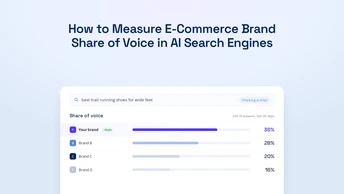
How to Measure E-Commerce Brand Share of Voice in AI Search Engines
Learn how to measure e-commerce brand share of voice in AI search, benchmark competitors, track AI citations, and connect visibility to revenue.
How to Track Competitor E-Commerce Brand Mentions in AI Search Results
Learn how to track competitor e-commerce brand mentions in AI search, compare recommendations and citations, and turn competitive insights into action.
See AthenaHQ in Action
 AthenaHQ
 Cozy Earth
The Most-Cited Sleepwear Brand in AI Search
Cozy Earth used AthenaHQ to protect its lead in sleepwear, identify a loungewear opportunity, and give its two-person content team a clearer way to prioritize what to publish next.
AthenaHQ Rootly
10x Increase in Citation Rate
GEO became Rootly's #1 growth pillar. With ~10x citation rate growth and +126% mention rate on non-branded prompts, Rootly transformed AI Search into an executive-level operating channel.
AthenaHQ Lago
50% Increase in Demos from AI Search
Lago achieved a 50% increase in demos from AI Search after implementing Athena. With 11x growth in AI Overview impressions and exploding citations, Athena became their command center for GEO.