AthenaHQ vs Semrush for AI Search Visibility: Which Delivers More ROI?

Andrew Yan
Co-Founder, CEO of AthenaHQ

 VS

AthenaHQ and Semrush both measure how brands appear in AI-generated answers. AthenaHQ is built around AI visibility, citation opportunities, and optimization workflows; Semrush combines AI monitoring with established SEO research and site auditing. The better return depends on the work your team needs to complete, the plan you purchase, and whether better visibility translates into business results.
Summary
 Best for dedicated AI search visibility and action workflows: AthenaHQ.
- Best for a combined traditional SEO and AI search suite: Semrush SEO + AI Search.
- Best for measuring ROI: Compare reporting effort, citation improvements, identifiable AI-assisted leads, and total cost. AthenaHQ integrates with Google Analytics and Shopify; Semrush can combine SEO, AI visibility, and GA4 reporting. Neither can prove incremental revenue from citations alone.
A practical buying decision should answer three questions:
- What can each platform measure?
- How much work is required to act on a finding?
- What would constitute a return on the investment?
Let’s take a closer look!
About AthenaHQ
AthenaHQ
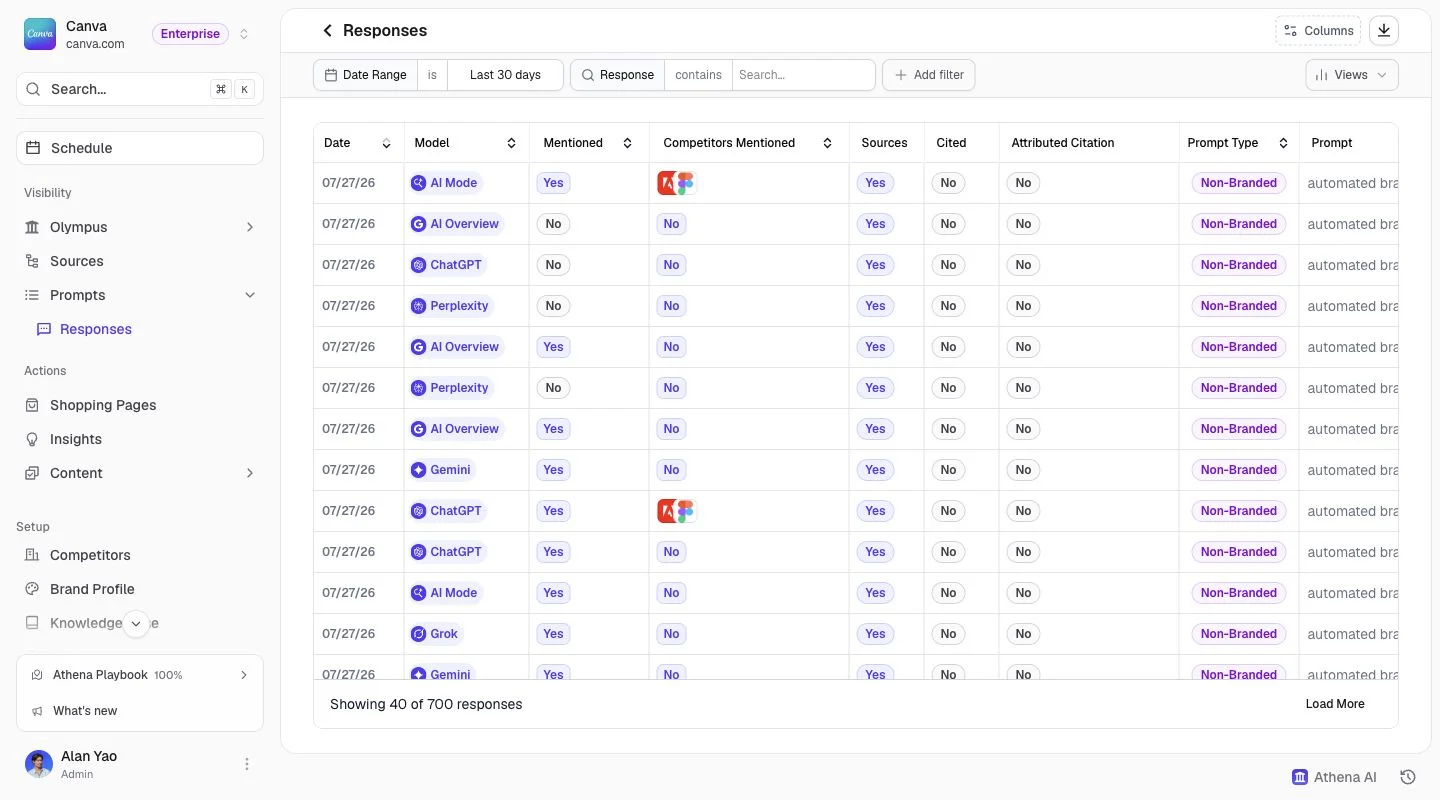
The AI-Native Answer Engine Optimization PlatformAthenaHQ is an AEO platform created by experts from Google Search and DeepMind with a single purpose: helping teams win AI search. AthenaHQ was designed around AI search visibility, with deep coverage across ChatGPT, Perplexity, Gemini, and Google AI Overviews, among others. Every metric, report, and workflow enables marketers to understand and improve how their brand is cited in AI responses.
Key AthenaHQ features include:
- Comprehensive AI Engine Tracking: AthenaHQ provides a unified view of brand presence across major AI search platforms, including ChatGPT, Gemini, Claude, and Perplexity.
- Actionable Insights: AthenaHQ translates monitoring data into a prioritized queue of executable optimization tasks.
- Autonomous Agents (ACE): AthenaHQ’s Athena Citation Engine independently analyzes content gaps, drafts on-brand optimizations, and executes multi-step workflows for enterprise-scale AEO programs.
- Integrated Workflows: AthenaHQ connects insights to actions, surfacing prompts and supporting content production and optimization for stronger citation opportunities.
- Business Outcome Focus: Native integrations with Shopify and Google Analytics connect AI visibility reporting with key business metrics. AthenaHQ has reported customer outcomes including 1,561% ROI; individual results depend on methodology and circumstances.
- Enterprise Scalability: Flexible pricing and unlimited seats support collaboration without per-user restrictions.
Results in AthenaHQ
AthenaHQ customers have reported the following results. These are individual customer outcomes, not expected results for every organization:
- 50 % increase in demos from AI search
- 38 % month-over-month increase in leads from AI search
- 40 % increase in brand mention rate
- 85 % faster response to brand mentions
- 50 % reduction in time spent on AI visibility tracking
- 2.5 x increase in AI-driven organic traffic
- 5 x increase in AI content citations
- 10 x increase in citation rate
Customer Response
AthenaHQ has a 4.9-star rating on G2, with customer feedback on depth of insights, usability, and value. Customers include SoFi, Wix, and ZoomInfo.

Computer Software
–Verified Customer Review, G2“We’re a software company in the developer tools space. Our buyers are technical and increasingly skeptical of traditional marketing. They research tools by asking Claude or ChatGPT for recommendations before they ever visit our site. We knew this was happening but had no visibility into it.
AthenaHQ gave us that visibility without requiring a dedicated analyst to interpret results. The prompt tracking shows exactly what questions potential customers are asking and whether we appear in the answers. The competitive benchmarking revealed that a smaller open-source competitor was being cited more frequently than us for our core use case, despite having less than half our feature set.
What I appreciate most is the bias toward action. Other tools we tried gave us beautiful charts and left us wondering what to do. AthenaHQ tells us specifically which content to create or update, with context on why it matters.”

Financial Services
–Verified Customer Review, G2“We were paying nearly $6k/month for another AI visibility platform that our team dreaded using. The dashboards were so dense that extracting a single insight for leadership took hours. Exporting data for our monthly reports required workarounds involving screenshots and manual transcription. It felt like the tool was built for data scientists, not marketers.
AthenaHQ costs less and actually gets used. It surfaces what matters without forcing us to dig. Last month it identified that we were completely absent from prompts about retirement planning for high-net-worth individuals, which is literally our core business. We had content on the topic, but it wasn’t structured in a way AI models could parse. The platform showed us exactly which pages needed work.
I also appreciate that the team responds to feedback quickly. We reported an issue with how sentiment was being categorized for financial terms, and they adjusted the model within two weeks.”

Healthcare
–Verified Customer Review, G2“In healthcare tech, we can’t just plug in any SaaS tool and hope for the best. Our legal and compliance teams scrutinize everything. AthenaHQ passed their review faster than most vendors we evaluate, partly because the team was transparent about data handling and partly because the platform doesn’t require us to expose sensitive systems to get value.
The prompt tracking gives us visibility into how AI models discuss our category, which matters when misinformation could have real consequences. We caught ChatGPT recommending a competitor’s product for a use case where it’s actually contraindicated. That’s not just a marketing problem. AthenaHQ helped us identify it, and we worked with our medical affairs team to publish clarifying content.
The dashboard is genuinely intuitive. Our marketing ops person picked it up in a day. No dedicated analyst required.”

Real Estate
–Verified Customer Review, G2“We manage multiple residential real estate brands across thousands of franchise locations. The way consumers find agents is shifting fast. Five years ago it was referrals and yard signs. Then it was Zillow and Realtor.com. Now we’re seeing buyers and sellers ask ChatGPT things like “best real estate agent for luxury homes in Scottsdale” or “which brokerage has the lowest commission fees” before they ever visit a brand website. AthenaHQ helped us understand how our brands perform in those conversations.
We discovered that AI models were recommending competitors for specific property types and price points where we have strong market share. Worse, some responses contained outdated information about our commission structures that made us look less competitive than we actually are. The regional tracking has been particularly valuable. Real estate is hyperlocal, and AI models respond differently by market. We can now segment visibility by metro area and give our regional marketing teams data they can act on. A brand manager in South Florida sees different insights than someone covering the Pacific Northwest, which is exactly how it should be.”

Retail
–Verified Customer Review, G2“We operate 200+ retail locations across North America. What works for brand visibility in California doesn’t necessarily work in Texas or Quebec. AI models respond differently by region, and most tools we evaluated treated the US as a monolith.
AthenaHQ’s regional segmentation was a differentiator for us. We discovered that our AI visibility in the Southeast was half what it was on the West Coast, even though our store density is similar. The platform identified specific content gaps around product categories that index higher in Southern markets. Our regional marketing teams now have data to act on instead of guessing.
The reporting is also clean enough to share with franchise owners who are not marketers. They can understand the visibility scores and see why certain content investments matter.”
About Semrush
Semrush
Traditional SEO platform with an AI Search offeringSemrush is a traditional SEO platform that has expanded to include an AI Search offering. It is particularly useful when one team handles search rankings, technical site health, content research, and AI answer visibility. The platform supports AI competitor research, cited-source analysis, AI search health checks, automated reporting, and side-by-side SEO/AI dashboards. Its AI Search Optimizer also offers content recommendations, so the distinction is the depth and fit of the overall workflow, not whether Semrush can act on AI insights at all.
Teams may still need a content approval process, CRM reporting, experimental measurement, or higher prompt allowances. Additionally, some capabilities sit in separate Semrush toolkits or add-ons. The relevant buying decision is whether the team needs that broader suite or a dedicated GEO platform. Check the chosen package’s prompt limits and any additional content or reporting products before comparing total cost.
Head-to-Head Feature Comparison: AthenaHQ vs. Semrush
Both platforms support AI visibility measurement, but their packages, usage models, and surrounding workflows differ. This comparison distinguishes AthenaHQ Starter from Semrush’s standalone AI Visibility plan and its combined SEO + AI Search Starter package.
| Capability | AthenaHQ | Semrush |
|---|---|---|
| Core focus | Dedicated AEO/GEO platform for tracking, recommendations, and execution | SEO research and technical tooling with AI visibility and prompt tracking |
| Entry-level paid plan | Starter $295/month, or $245/month billed annually; Essential free | AI Visibility Base $99/month billed annually; combined SEO + AI Search Starter $199/month monthly or $165.17/month annually |
| Prompt usage | Starter 3,600 credits/month; one AI response consumes one credit | Standalone Base: 25 custom prompts daily; combined Starter: 50 prompts daily |
| AI visibility | Mentions, citations, sentiment, share of voice, competitor intelligence | AI Visibility Score, mentions, citations, sentiment, competitor research, prompt monitoring |
| Engine coverage | Starter advertises 11 AI models/experiences; confirm selected engines and regions | ChatGPT, Gemini, Perplexity, Google AI experiences and others; coverage varies by report and package |
| Content workflow | Prioritized on-page/off-page actions and content optimization; ACE enterprise workflows | AI search health audits, topic and prompt research, SEO content optimization; package dependent |
| Traditional SEO | Focused on AI answers and content visibility | Keyword research, rank tracking, backlinks, and site auditing |
| Business reporting | Google Analytics, Shopify and related integrations; attribution requires careful interpretation | SEO and AI visibility dashboards, GA4/GSC in reporting; revenue analysis may need additional setup |
| Reporting and governance | Unlimited members; CSV export; API add-on; Enterprise SSO, BI and audit logs | Scheduled reports and exports; add-on reporting/users; enterprise access and API vary by package |
Product and pricing information reviewed October 19, 2026. ROI scenarios on this page are illustrative, not customer outcomes. Sources: AthenaHQ plans; Semrush SEO + AI Search pricing; Semrush AI Visibility pricing; Semrush AI visibility features; Semrush reporting; AthenaHQ G2 reviews.
How to Calculate ROI for AI Search Visibility Tools
The price of a GEO platform is only one part of the investment. To estimate ROI, combine subscription and implementation costs with measurable time savings, qualified opportunities, and attributable or experimentally supported business value.
Start With Four Practical Metrics
| Metric | Calculation | What it tells you |
|---|---|---|
| Cost per tracked prompt | Monthly total cost ÷ unique priority prompts monitored | Coverage efficiency; compare model and refresh differences |
| Cost per citation improvement | Total program cost ÷ net newly cited prompt-page combinations | Efficiency of gaining observable citation coverage |
| Cost per influenced demo or lead | Total program cost ÷ qualified AI-assisted demos or leads | Commercial efficiency; influenced does not mean caused |
| Time saved | Manual hours avoided × fully loaded hourly labor rate | Operational benefit that can be estimated directly |
| Net ROI | (Incremental gross profit + verified labor savings − total program cost) ÷ total program cost × 100 | Financial return when causal assumptions are defensible |
Count content labor, implementation, extra seats, add-ons, and agency support in the cost. Do not treat every new citation as revenue, and avoid counting a lead twice across channels. Where incrementality cannot be established, report influenced pipeline and measured efficiency separately from ROI.
AthenaHQ vs. Semrush Pricing: Monthly Cost and Total Ownership
Compare the cost of equivalent work rather than the lowest advertised starting price. Semrush has both standalone AI visibility and combined SEO plans, while AthenaHQ uses response credits for its dedicated platform.
| Cost element | AthenaHQ | Semrush |
|---|---|---|
| Free option | Essential free with 300 initial credits | Free access to selected AI visibility tools and limited reports |
| Entry AI plan | Starter $295/month or $245/month annually | Standalone AI Visibility Base $99/month per domain billed annually |
| Combined SEO and AI | Dedicated GEO rather than full traditional SEO suite | SEO + AI Search Starter $199/month or $165.17/month annually |
| Tracking allowance | 3,600 Starter credits/month; 1 response = 1 credit | 25 daily prompts standalone Base; 50 daily prompts combined Starter |
| Potential extras | Additional credits, Starter API, implementation and content labor | Additional users, reporting upgrades, content products, higher tiers, implementation |
| Enterprise | Custom contracts, governance and advanced workflows | Advanced/Enterprise custom pricing and expanded capacity |
For an apples-to-apples estimate, request quotes for the same brands, prompts, AI platforms, regions, refresh cadence, users, exports, and reporting integrations. Semrush’s lower standalone price can be compelling for monitoring, while AthenaHQ may justify its cost where dedicated optimization and execution reduce manual work.
Which Platform Fits Your Team?
The value of any platform depends on the tasks it replaces and decisions it improves. Use the matrix below to prioritize capabilities by team, then test those capabilities with your own prompts and reporting requirements:
| Use case | Likely fit | What to validate |
|---|---|---|
| Dedicated AI visibility monitoring | AthenaHQ or Semrush AI Visibility | Coverage, sampling, refresh cadence, and prompt cost |
| Citation and source analysis | Both; AthenaHQ for action-oriented workflows | URL-level evidence and recommendations |
| Content gap discovery | Both | Time from insight to assigned content update |
| Technical SEO and backlink research | Semrush | SEO tools included in selected package |
| Demand gen and revenue operations | AthenaHQ when GA/Shopify-linked workflows matter | Lead definitions, CRM joins, and incremental measurement |
| Executive reporting | Both | Reproducible reports, exports, and business KPIs |
| Agency or multi-client work | Pilot both | User charges, workspaces, white-label reporting, permissions |
| Enterprise and multi-brand governance | Evaluate both enterprise tiers | SSO, audit logs, API, regional segmentation and onboarding |
Buyer Checklist: What to Ask Before Purchasing
Feature lists rarely reveal the day-to-day effort of operating a GEO program, so be sure to ask both vendors to complete the same tasks and score the results against your team’s priorities.
- Implementation: How long does setup take for three brands and two regions? Is onboarding included?
- Analyst dependence: Can a content manager identify a missing citation and act without specialist support?
- Data quality: Which models, prompt sources, markets, and refresh frequencies are included? How is sampling disclosed?
- Action workflow: Can the platform identify the cited source, recommend a change, assign an owner, and recheck results?
- Reporting: Can the team export source-level data and build a consistent executive report?
- Attribution: Which traffic, conversion, and revenue signals are measured directly, and which require GA4 or CRM?
- Governance: What permissions, SSO, audit logs, retention policies, and regional controls are available?
- Total cost: What happens when prompts, models, users, regions, and report volumes double?
Suggested weighting depends on the priority of your respective team. For example, demand gen might assign 30% to outcome measurement, 25% to action workflows, 20% to model coverage, 15% to reporting, and 10% to cost, while SEO teams may place greater weight on technical research and existing-tool integration.
When Semrush Is Enough, and When a Dedicated GEO Platform Makes More Sense
If you’re managing SEO, a Semrush subscription may already cover your needs. The decision to add a specialized platform should depend on an identifiable workflow gap, not the assumption that a general SEO suite cannot monitor AI search.
Semrush May Be Enough If…
- Your team already relies on Semrush for keyword research, site audits, and search reporting.
- Your prompt volume fits the purchased plan and you primarily need competitive monitoring.
- Your editors can translate source and prompt insights into content changes without additional automation.
- Your analytics team already connects referral traffic to conversions and pipeline.
AthenaHQ May Be the Better Fit If…
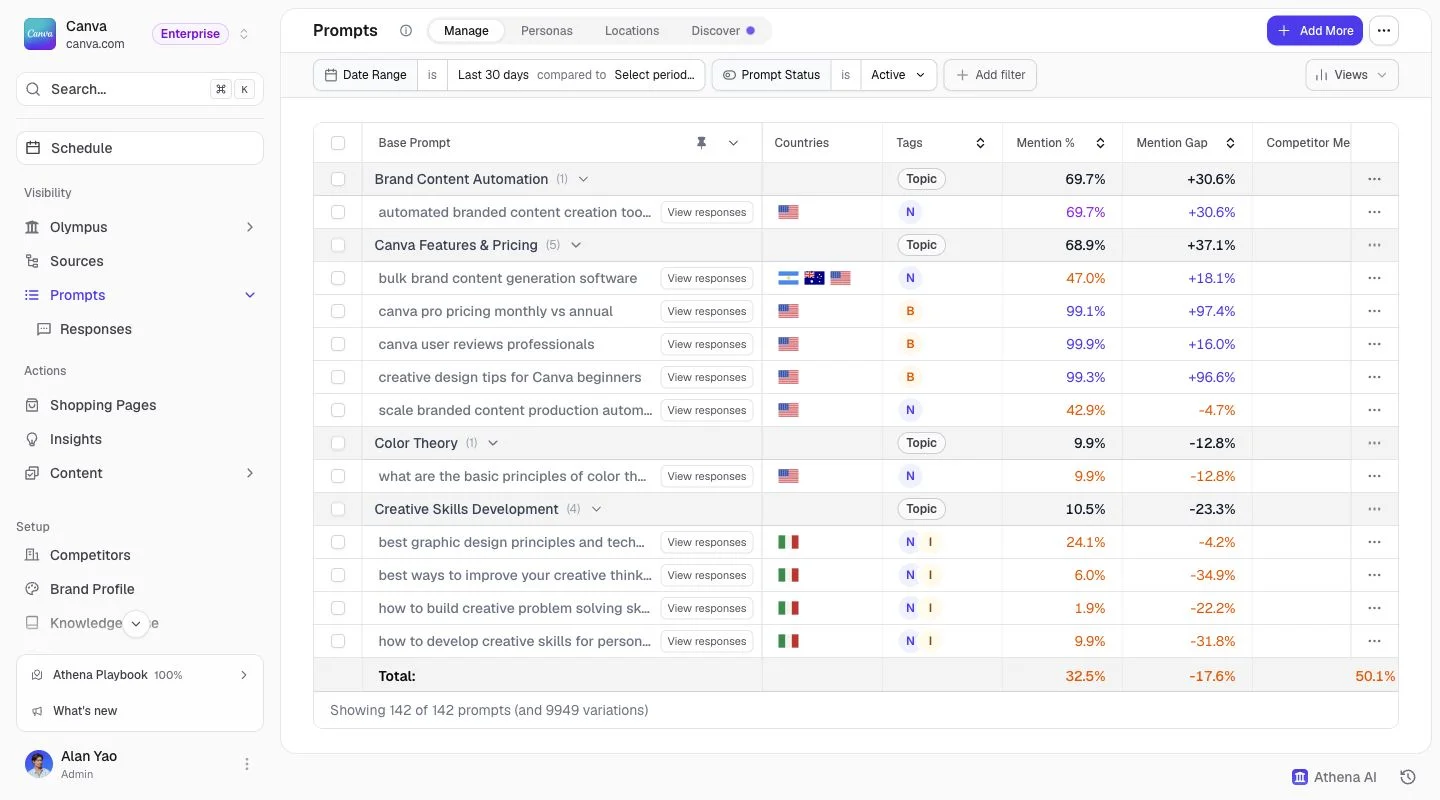
- AI visibility is a dedicated program with regular model-by-model monitoring and competitor analysis.
- Your team needs prioritized optimization tasks and agent-supported content workflows.
- Multiple stakeholders need to connect citation opportunities with GA4, Shopify, and business reporting.
- You want unlimited seats and a platform designed around GEO execution rather than broader SEO research.
Common Buyer Objections
Buyers should challenge the assumptions behind any claimed ROI. The strongest evaluation addresses existing subscriptions, data limitations, and the labor required to turn reporting into results.
“We Already Pay for Semrush. Why Add Another Tool?”
Start by using the AI features you already have and document what remains difficult. If a team cannot consistently prioritize and execute citation improvements or connect findings to outcomes, pilot AthenaHQ against those gaps. Do not pay twice for overlapping reporting without a clear workflow benefit.
“Can AI Visibility Be Measured Reliably?”
It can be sampled consistently, but no tool captures every answer a person sees. Models, prompts, geography, personalization, and time all affect responses. Evaluate repeatability and disclosed methodology rather than treating a single share-of-voice score as exhaustive.
“How Much Manual Work Remains?”
Both products reduce monitoring and reporting effort. People still need to select prompts, validate content recommendations, coordinate changes, and interpret business results. During a trial, measure hours from discovery to publication and hours spent preparing the executive report.
“Do We Need SEO Expertise?”
SEO expertise remains useful for technical fixes, crawlability, content quality, and measurement. A dedicated GEO workflow may make AI visibility tasks more accessible to content and demand gen teams, but it does not eliminate editorial review or analytical judgment.
A 30-Day Evaluation: From Prompt Gap to Business Outcome
Run the same controlled pilot in both products. A useful comparison measures setup effort, insight quality, actionability, and reporting, not just the number of charts.
- Week 1: Select 30–50 high-intent prompts, relevant competitors, target models, and baseline visibility metrics. Confirm plan limits and setup time.
- Week 2: Identify five uncited opportunities, inspect the cited URLs, and record recommended fixes and owners.
- Week 3: Update two relevant pages, record publication dates, and measure the hours required for each workflow.
- Week 4: Compare mentions, citations, identifiable AI-referred sessions, conversions, and report preparation time. Treat early changes as directional.
Example reporting snapshot, illustrative only: 40 tracked prompts; 8 initial cited appearances; 12 after optimization; 4 additional cited appearances; 18 identifiable AI-referred sessions; 2 qualified demos; 3 hours saved in reporting. This shows how to present visibility, business influence, and operational efficiency without asserting that the changes caused both demos.
Other AI Visibility Platforms to Compare
Some buyers also evaluate dedicated GEO providers or tools connected to existing marketing platforms. These options address adjacent use cases and deserve separate, evidence-based comparisons rather than being treated as interchangeable.
- Profound: Evaluate enterprise AI visibility, prompt intelligence, and reporting requirements.
- Scrunch: Compare brand monitoring, agent-facing content experience, and governance.
- Otterly.AI: Consider for lightweight monitoring and smaller teams.
- HubSpot AI search and AEO capabilities: Assess how AI visibility insights connect with existing marketing automation and CRM workflows.
- Rankscale and Rankshift: Verify current model coverage, reporting, and pricing before making direct comparisons.
Frequently Asked Questions (FAQ)
These answers address the questions that most often affect purchasing decisions, from feature overlap and pricing to business measurement.
It can be, particularly for SEO teams needing mentions, citations, prompt tracking, competitor research, and technical audits. AthenaHQ adds a dedicated GEO workflow when optimization execution and connected business reporting are central.
The Bottom Line
Semrush offers a strong combination of SEO and AI visibility research, particularly for teams already operating a broad search program. AthenaHQ focuses on making AI visibility actionable through citation intelligence, content workflows, and connected business reporting. The right choice is the platform that helps your team complete its highest-value work at a defensible total cost.
Measure the full process: find a gap, act on it, observe the result, and connect it to business outcomes where the data allows. That is how to evaluate ROI without confusing more citations with guaranteed revenue.
Explore AthenaHQ plans or book a demo to compare workflows with your team’s requirements.
Become the Brand AI Trusts
See, Act, and Win on AI Search and Beyond
See It In Action
AthenaHQ Cozy Earth
The Most-Cited Sleepwear Brand in AI Search
Cozy Earth used AthenaHQ to protect its lead in sleepwear, identify a loungewear opportunity, and give its two-person content team a clearer way to prioritize what to publish next.
AthenaHQ Rootly
10x Increase in Citation Rate
GEO became Rootly's #1 growth pillar. With ~10x citation rate growth and +126% mention rate on non-branded prompts, Rootly transformed AI Search into an executive-level operating channel.
AthenaHQ Lago
50% Increase in Demos from AI Search
Lago achieved a 50% increase in demos from AI Search after implementing Athena. With 11x growth in AI Overview impressions and exploding citations, Athena became their command center for GEO.