What's new in Athena: August 2026
Shopping Pages with automatic Shopify catalog sync, ChatGPT Ads reporting, a more capable Athena AI, and coverage of 185 markets down to the city level.

AthenaHQ
Action on AI Search
Marketing teams don’t get more hours in the day because customers moved to LLMs. Every release we ship is aimed at the same thing: shorten the distance between seeing what LLMs say about your brand and doing something about it.
This month’s drop covers four areas — commerce pages, paid placements inside ChatGPT, the assistant that runs Athena for you, and where in the world we can measure.
Shopping Pages: build richer shopping experiences, faster
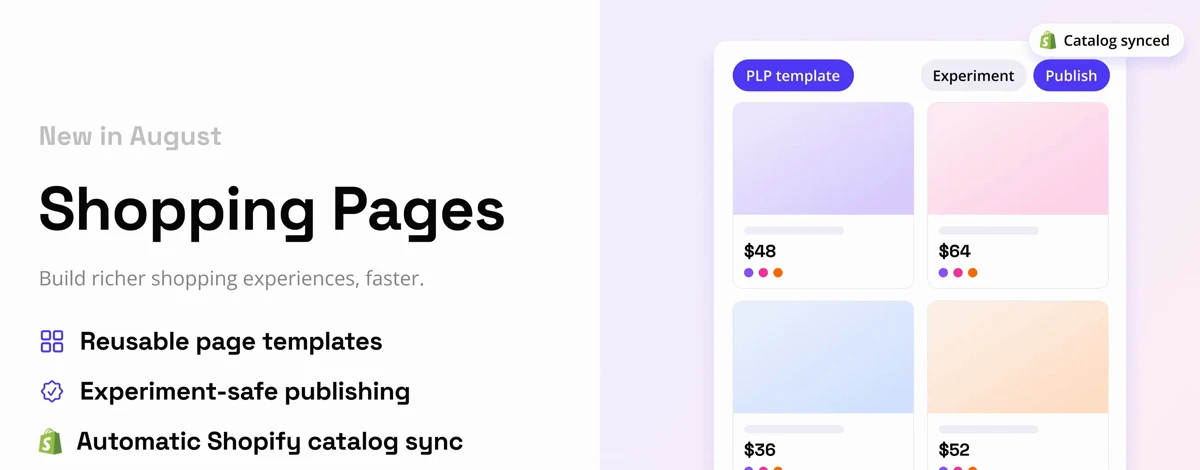
Product and category pages are the pages LLMs reach for when someone asks what to buy, and they are the pages that are hardest to keep current. Shopping Pages makes them a system instead of a project.
- Reusable page templates. Build a product listing page once as a template, then generate the rest of your catalog from it — no per-page rebuild for every collection, season, or category.
- Experiment-safe publishing. New pages go live behind experiments, so you can measure lift before rolling out to the whole catalog. You are not making an irreversible bet on your highest-traffic pages.
- Automatic Shopify catalog sync. Prices, variants, and swatches stay in sync with your store, and the AI copy on the page is grounded in your actual product data.
Why it matters: high-SKU brands lose visibility to stale pages more than to bad writing. When a page shows a price your store no longer charges, or lists a variant you stopped selling, that page stops earning recommendations — and stale pages are also a merchandising and support cost. Templates plus catalog sync mean the long tail of your catalog gets the same page quality as your hero products, and it stays accurate without anyone maintaining it by hand.
ChatGPT Ads: see how your brand shows up
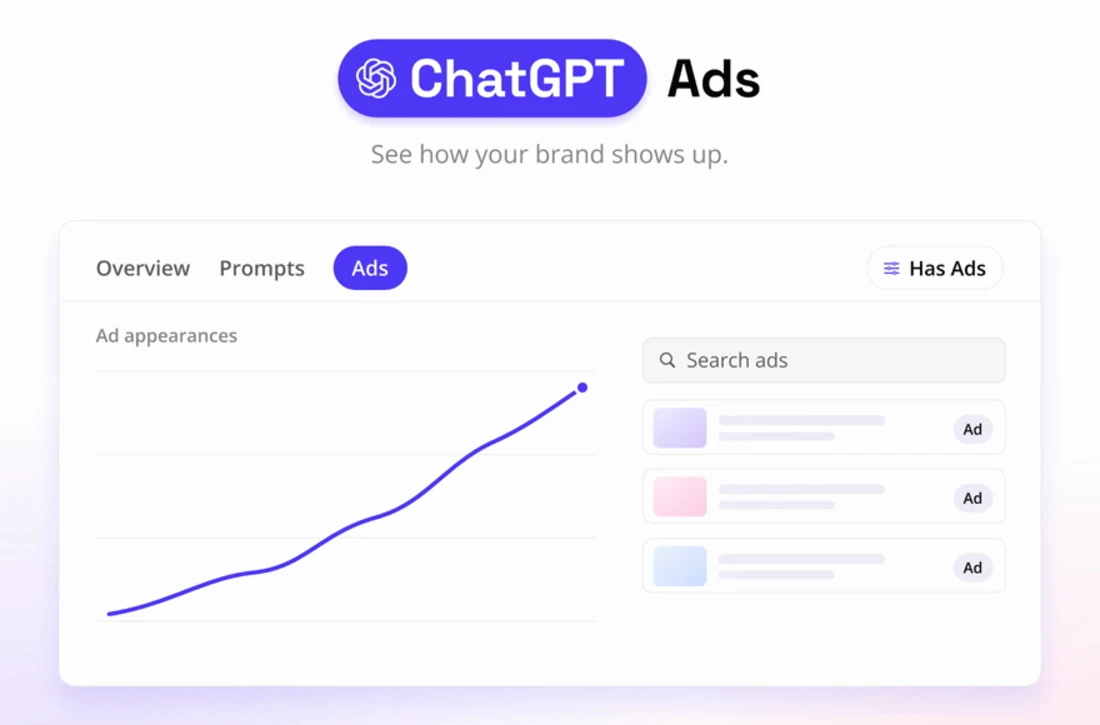
Paid placements inside ChatGPT are a new inventory type, and until now there was no reporting layer for them. There’s now a dedicated Ads tab in Athena.
- An ad appearances trend chart, so you can see whether your presence in ad slots is growing or slipping over time.
- Searchable ad tables and creatives, plus a Has Ads filter on prompts, so you can go from “which prompts trigger ads” to the exact creative that ran.
Why it matters: you can’t brief a paid team on a surface nobody is measuring. This tells you which of your prompts have become paid real estate, whether competitors are buying against your category, and what their creative says — before you commit budget. It also closes the loop with the organic side of Athena: the same prompt set drives both, so you can see where you need to buy your way in and where you already win for free.
Available on Enterprise and Agency plans.
Athena AI does more: ask, analyze, and act in one conversation
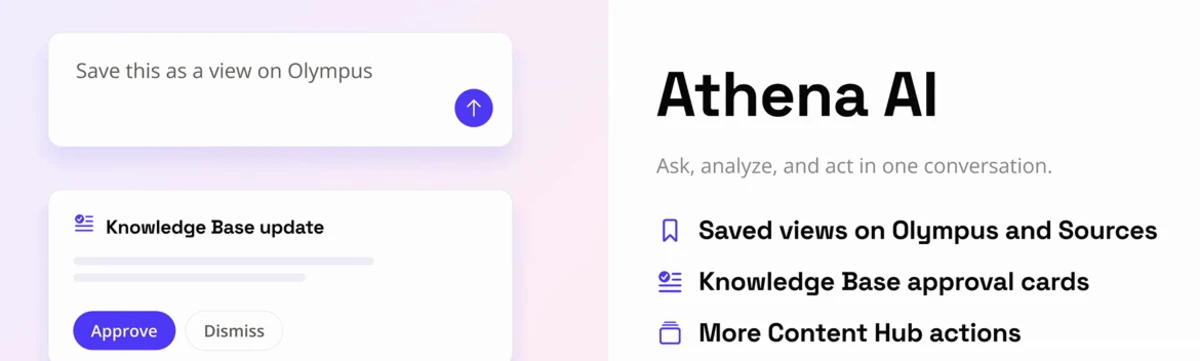
Athena AI is no longer just an answer engine on top of your data — it can now do the follow-up work in the same conversation.
- Save views on Olympus and Sources so the analysis you just asked for becomes a view your team keeps using.
- Push sources straight into the Knowledge Base through approval cards — you review the suggestion, approve it, and your brand context improves.
- Take more Content Hub actions, so a finding turns directly into queued content work.
Why it matters: the gap in most reporting tools is the handoff — you find something, then export it, then explain it to someone, then wait. Approval cards keep a human in the loop while removing the copy-paste, so more of your team can act on LLM insights without becoming an expert in the tool. That’s how one analyst’s finding becomes a team’s workflow.
Athena goes global: 185 markets, down to the city
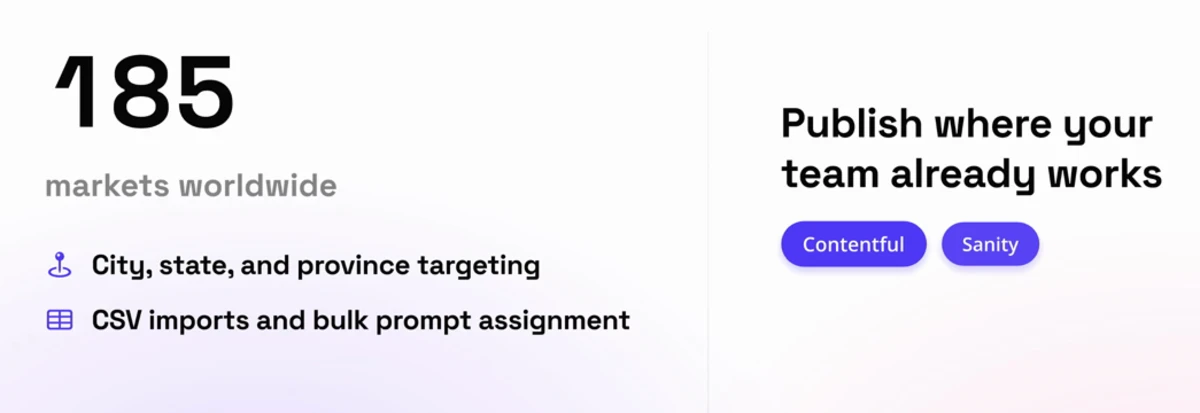
Visibility isn’t one number. It differs by country, and it differs by city.
- 185 markets, with targeting down to city, state, and province level.
- Import locations by CSV, then assign prompts in bulk instead of configuring locations one by one.
- Publish through Contentful and Sanity, so the pages you create for those markets go live in the CMS you already use.
Why it matters: for multi-location and multi-region businesses, an aggregate visibility score hides the whole story — you can look strong nationally and be invisible in the metros that actually drive revenue. City-level measurement turns that into a work list: which locations are losing, what content is missing there, and what to publish. Bulk import and native CMS publishing are what makes that practical at hundreds or thousands of locations rather than a spreadsheet exercise.
From insight to action
The theme across all four: fewer steps between what LLMs say about your brand and what your team ships in response. Pages that stay accurate on their own, paid placements you can finally see, an assistant that can act, and measurement that goes as local as your business does.
Explore what’s new in Athena — or ask us for a walkthrough of any of the above with your own data.
Become the Brand AI Trusts
See, Act, and Win on AI Search and Beyond
Keep Reading
Enterprise AEO 101: What You Need to Know to Boost AI Search Visibility in 2026
Learn how enterprise AEO and GEO can improve AI search visibility in 2026, from prompt measurement and citation-ready content to platform evaluation and attribution.
Enterprise GEO Prompts: Strategies for Scaling AI Search Visibility
Enterprise GEO provides a practical way for large teams to organize buyer questions, measure answers across engines, find citation gaps, invest in changes that carry real business value, and ultimately scale their AI search visibility.
How to Get Your Products Featured in AI Search Recommendations
Actually getting your products featured in AI search recommendations requires a repeatable process to sufficiently cover your grounds across product data, crawl access, third-party evidence, comparison content, and performance.
See AthenaHQ in Action
 AthenaHQ
 Cozy Earth
The Most-Cited Sleepwear Brand in AI Search
Cozy Earth used AthenaHQ to protect its lead in sleepwear, identify a loungewear opportunity, and give its two-person content team a clearer way to prioritize what to publish next.
AthenaHQ Rootly
10x Increase in Citation Rate
GEO became Rootly's #1 growth pillar. With ~10x citation rate growth and +126% mention rate on non-branded prompts, Rootly transformed AI Search into an executive-level operating channel.
AthenaHQ Lago
Lago50% Increase in Demos from AI Search
Lago achieved a 50% increase in demos from AI Search after implementing Athena. With 11x growth in AI Overview impressions and exploding citations, Athena became their command center for GEO.