ChatGPT Ads: The Ultimate Guide for Commerce Brands
Learn how ChatGPT Ads work for commerce brands, compare paid advertising with GEO and Google Search, and measure conversions, ROAS, and AI visibility.

Andrew Yan
Co-Founder, CEO of AthenaHQ
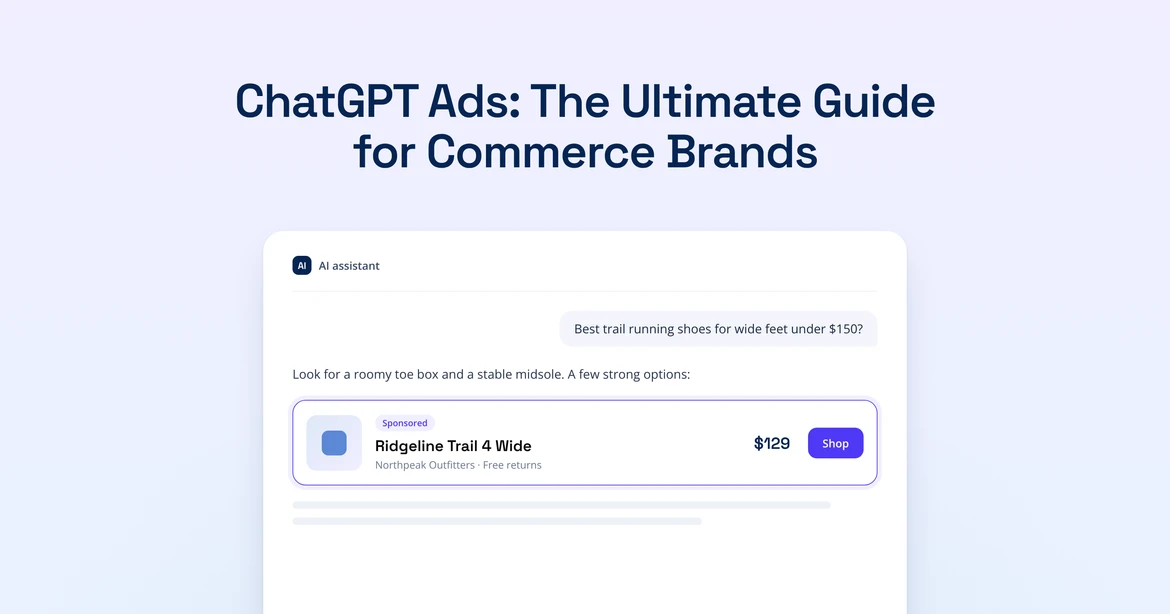
Consumers are increasingly turning to ChatGPT to compare products and decide what to buy. For commerce brands, this means new opportunities to influence purchasing decisions through both paid advertising and organic AI recommendations. But how can brands earn visibility in these conversations, and how should they measure the results?
ChatGPT Ads provide sponsored placements with advertiser-controlled messaging and measurable campaign delivery. Organic AI visibility depends on whether AI systems discover, understand, and reference information about your brand.
Each approach offers distinct advantages but require different strategies and performance metrics. Understanding how they work together can help commerce brands reach shoppers at critical decision points and make more informed investments in AI search.
In this guide, we'll explain how ChatGPT Ads work, what to measure, and how paid advertising compares with Google Search ads and generative engine optimization (GEO). We'll also take a look at how to evaluate campaign performance, monitor competitors, and develop a coordinated plan to help you tackle paid and organic AI visibility. Let’s get into it!
Key Takeaways
- ChatGPT Ads are sponsored placements, not organic AI recommendations. Advertisers control ad messaging and landing pages, while organic brand mentions depend on the information AI systems use to generate responses.
- ChatGPT advertising uses conversational relevance signals. Delivery can consider the current conversation, landing-page content, ad creative, and advertiser-provided context hints.
- Commerce brands should measure conversions and ROAS using both advertising and ecommerce data. Platform delivery metrics alone cannot establish revenue impact or incrementality.
- Organic AI visibility requires a separate measurement strategy. AthenaHQ's State of AI Search, Q4 2026 found that the average brand appeared in 15.15% of analyzed AI answers, while leading brands averaged 55.50%.
- Paid advertising and GEO serve complementary purposes. ChatGPT Ads support controlled campaign testing, while GEO helps brands pursue organic mentions and citations across AI search platforms.
ChatGPT Ads Are Not the Same as Organic AI Recommendations
When a shopper asks ChatGPT for product recommendations, the resulting conversation may include both AI-generated suggestions and sponsored advertisements:
- ChatGPT Ads are paid placements that identify the advertiser and direct interested users to a designated landing page. Advertisers can control the title, description, and destination URL.
- Organic AI recommendations, meanwhile, appear within the model's generated response. They may reference a particular product, recommend a brand, or cite an external source. These mentions are not paid placements, and brands cannot purchase inclusion in an organic answer.
Let’s take a shopper asking ChatGPT about air purifiers for a small apartment with pets. ChatGPT might suggest several models based on features, performance, and perceived suitability. A sponsored ad could appear separately: the retailer controls its campaign, but the organic recommendations remain independent.
Organic visibility can introduce products during research and consideration without requiring an active advertising campaign. Paid advertising, meanwhile, allows commerce brands to reach consumers during relevant conversations, test messaging, and evaluate outcomes.
What Commerce Brands Can Verify About ChatGPT Ads
As ChatGPT advertising evolves, marketers need a way to distinguish documented capabilities from assumptions about how the platform operates. The most useful starting point is understanding which ad formats, delivery inputs, buying options, and reporting metrics are available.
Ad Format and Delivery Inputs
According to OpenAI's advertising documentation, a ChatGPT advertisement includes several recognizable elements:
- Advertiser name and favicon: Identifies the business responsible for the sponsored message
- Ad title: Communicates the primary offer or value proposition
- Descriptive copy: Explains why the product or service may be relevant
- Landing page: Directs interested users to the advertiser's website
Together, these elements help shoppers evaluate an offer and know what to expect after they click. For example, an outdoor equipment could use a title highlighting waterproof hiking boots, copy describing relevant benefits, and a landing page featuring suitable footwear. ChatGPT considers the landing page's quality and relevance when determining ad delivery, alongside the conversation's context and intent, creative elements, and advertiser-provided context hints.
Context hints describe the topics, conversations, or keywords where an advertiser considers its products relevant. A luggage brand, for instance, might specify conversations about carry-on restrictions, international travel, or lightweight suitcases. Unlike traditional keyword targeting, this approach accounts for the broader conversation and what the shopper actually needs.
When personalization is enabled, ad delivery may also consider selected signals from a user's broader ChatGPT experience. For commerce brands, that means creating accurate, relevant ads and landing pages that directly address customer needs.
Buying and Reporting Metrics
ChatGPT Ads supports impression-based and valid-click billing, with campaign objectives designed around different advertising outcomes. The available options include:
- Views: Focuses on impression-based delivery.
- Clicks: Optimizes toward traffic.
- Conversions: Optimizes toward a supported standard conversion event.
An important distinction concerns conversion optimization and billing. A campaign optimized for conversions can still use click-based billing, meaning advertisers pay for valid clicks rather than individual conversions.
ChatGPT Ads Manager Beta reports several familiar advertising metrics:
| Metric | What It Measures |
| Impressions | How often an advertisement was delivered |
| Clicks | Valid interactions that direct users to the advertiser |
| Spend | Advertising expenditure |
| Click-through rate (CTR) | Clicks relative to impressions |
| Average cost per click (CPC) | Average advertising cost per click |
| Average cost per thousand impressions (CPM) | Average cost for 1,000 impressions |
| Conversions | Attributed conversion events |
These metrics help advertisers understand delivery efficiency and campaign activity. However, they represent only part of the performance picture. A campaign might generate substantial traffic without producing profitable sales, while another could attract fewer visitors who convert at a higher rate or become valuable repeat customers. Commerce brands therefore need to connect advertising data with website analytics, transaction records, and customer acquisition metrics.
How to Tell Paid Placements From Organic Brand Visibility
A brand appearing in ChatGPT doesn't automatically mean it purchased advertising. The simplest way to distinguish paid and organic visibility is to examine how the placement appears:
- Paid placements are explicitly identified as sponsored advertising and contain advertiser-controlled elements.
- Organic brand visibility occurs when the AI-generated response mentions a brand, recommends a product, or cites a relevant source without a paid placement.
For example, a shopper might ask ChatGPT to compare several espresso machines. If the response discusses product specifications or references a brand's website, that represents organic visibility. A separately labeled sponsored ad from a coffee equipment retailer is a paid placement.
Brands also need to distinguish between paid and organic visibility when measuring performance. Observed ad frequency is not the same as campaign impressions, since it doesn't measure actual ad delivery or account for clicks, conversions, spend, or campaign profitability. For organic visibility, brands require a different set of metrics, including mentions, citations, share of voice, and the sources AI platforms reference.
ChatGPT Ads vs. Google Search Ads vs. GEO
ChatGPT Ads, Google Search ads, and GEO all help brands reach potential customers, but they operate differently:
- Google Search advertising primarily reaches users through keyword- and search-driven placements.
- ChatGPT advertising considers conversational context and relevance signals.
- GEO focuses on improving a brand's presence within AI-generated answers through accessible, authoritative content.
For commerce brands, these approaches can support distinct stages of product discovery and purchase consideration.
| Approach | Placement | Targeting and Control | Disclosure | Click Destination | Measurement |
| ChatGPT Ads | Sponsored placement in ChatGPT | Conversational context, intent, creative, landing-page inputs, and context hints | Sponsored advertising | Advertiser landing page | Impressions, clicks, spend, CTR, CPC, CPM, and conversions |
| Google Search ads | Sponsored Google search results | Keywords, search terms, audience signals, and campaign settings | Sponsored advertising | Advertiser landing page | Impressions, clicks, conversions, costs, and conversion value |
| GEO/organic AI visibility | Brand mentions and citations within AI answers | Indirect influence through accessible, accurate, structured content and external authority | Organic response or citation | Cited source, when available | Brand mentions, citation presence, share of voice, and source visibility |
A shopper searching Google for "buy laptop online" expresses relatively direct commercial intent. Search advertising can help retailers compete for that demand.
A ChatGPT user might alternatively ask, "Which laptop would you recommend for a college student studying graphic design on a $1,200 budget?" This question reveals more about the shopper's needs, including intended use, performance requirements, and price constraints.
A relevant ChatGPT advertisement could introduce a product during the conversation, while organic recommendations might reference brands, retailers, reviews, or other sources.
Neither advertising environment guarantees stronger performance, since results depend on campaign relevance, competitive conditions, landing-page quality, and customer behavior.
GEO adds another dimension by helping brands make accurate product information available to AI systems. Traditional SEO emphasizes visibility in search results and the pages users can visit. GEO focuses on improving the likelihood that AI systems reference a brand or its content when generating answers.
AthenaHQ's State of AI Search provides useful evidence about the types of content AI systems access. Among the observed entry paths to brand websites:
- 34.93% led to blog pages.
- 20.49% led to product pages.
- 15.73% led to homepages.
The report also found that informational content represented 34.18% of analyzed content intent, followed by comparative and selection content at 24.36%. These findings support investing in educational resources as well as accurate, detailed product pages.
A commerce brand might therefore use Google Search ads to capture explicit purchase demand, ChatGPT Ads to reach shoppers during relevant conversations, and GEO to strengthen organic visibility during product research. The right mix depends on which approaches deliver measurable business results.
How to Measure Conversions and ROAS for ChatGPT Ads
Clicks and impressions only tell part of the story. Commerce brands also need to know whether ChatGPT advertising drives purchases, revenue, and new customers. A clear measurement framework should answer three questions:
- How efficiently does the campaign attract relevant visitors?
- What do those visitors do after reaching the website?
- How much additional business value does the advertising generate?
To answer these questions accurately, establish consistent tracking and attribution rules before launching a campaign.
Set Up a Clean Measurement Foundation
Start by defining how you'll identify ChatGPT advertising traffic and connect it to downstream conversions.
1. Use tagged landing-page URLs.
Apply consistent campaign parameters so analytics platforms can distinguish paid ChatGPT visits from other traffic sources. Use a standard naming convention to identify the source, medium, campaign, and relevant creative or test variation.
2. Separate paid and organic AI traffic.
Create distinct reporting categories for paid advertising visits and organic referrals from AI platforms. Without this separation, brands could mistakenly attribute an increase in ChatGPT traffic to advertising when organic citations also contributed.
3. Define the primary conversion event.
For ecommerce brands, a completed purchase is often the clearest primary conversion. Other events, such as adding a product to the cart or beginning checkout, can help explain shopper behavior, but they should not automatically receive the same value as a completed transaction.
4. Align order and revenue data.
Confirm that your analytics platform, ecommerce system, and CRM use compatible order identifiers and revenue definitions. Be consistent about whether reported revenue includes taxes, shipping charges, discounts, and returns. These details affect ROAS calculations and comparisons between channels.
5. Choose an attribution window.
Determine how long an advertising interaction can receive credit for a subsequent conversion. A shopper might click an advertisement, research competing products, and return several days later to complete a purchase. Using the same attribution window across campaigns makes performance comparisons more reliable.
6. Establish one ROAS definition.
Return on ad spend measures attributed advertising revenue relative to campaign spend.
ROAS = Attributed Revenue ÷ Advertising Spend
For example, a campaign generating $20,000 in attributed revenue from $5,000 in advertising spend produces a 4.0 ROAS.
That means the campaign generated $4 in attributed revenue for every $1 spent on advertising.
Keep in mind that ROAS does not account for product margins, fulfillment costs, or other operating expenses. A profitable campaign requires more than a favorable revenue-to-spend ratio.
Finally, keep campaign delivery metrics separate from verified ecommerce outcomes and reconcile the two regularly.
Evaluate Performance Beyond Last-Click Revenue
Shoppers often engage with several channels before making a purchase, and relying solely on last-click attribution can overlook the earlier interactions that influenced their decisions.
For example, a customer might discover a product through a ChatGPT ad, comb independent reviews, and later return through a branded Google search. That doesn't mean every touchpoint deserves equal credit: marketers should look at the full customer journey before deciding how much value each channel contributes.
Useful performance indicators include:
- Landing-page engagement: Whether visitors explore products, review information, or continue toward checkout.
- Assisted conversions: Purchases where an earlier advertising interaction contributed to the customer journey.
- Cost per conversion: Campaign spend divided by attributed conversions.
- Customer acquisition cost (CAC): Applicable acquisition spend divided by the number of acquired customers.
- Revenue and ROAS: The commercial value attributed to advertising activity.
For brands with sufficient traffic and the ability to run controlled experiments, incrementality testing can provide stronger evidence of advertising's impact.
A holdout test compares outcomes between a group exposed to advertising and a comparable group that isn't. This helps marketers estimate how many additional purchases or other valuable actions the campaign generated, rather than counting conversions that would have happened anyway.
As brands invest more across search, social, retail media, and AI advertising, this approach can help them identify which channels generate additional business and where to allocate budgets.
Build a Reporting Stack That Keeps Paid and Organic Separate
To understand how ChatGPT advertising performs alongside organic AI visibility, commerce brands need to track both without mixing their results. A practical approach uses three complementary reporting layers:
- Advertising platform reporting for campaign delivery and attributed conversions.
- Commerce analytics for website behavior, transactions, and customer outcomes.
- AI visibility monitoring for organic mentions, citations, and observed competitor advertising.
Platform Delivery and Commerce Analytics
Start with ChatGPT Ads Manager to track impressions, clicks, spend, CTR, CPC, CPM, and attributed conversions, then use tagged URLs and website analytics to see what visitors do after clicking an ad.
For example, a commerce team might investigate why one campaign produces a high click-through rate but relatively few purchases. Website analytics could show that visitors leave quickly, have trouble finding relevant products, or abandon their carts before checkout.
Compare transaction and revenue data against ecommerce or CRM records to confirm the results.
A useful dashboard should track paid delivery, website sessions, purchases, customer acquisition, revenue, organic AI mentions, citations, and observed competitor advertisements as separate metrics.
This makes it easier to pinpoint where performance changes occur. If paid traffic increases but purchases remain flat, possible causes include visitor quality, landing-page relevance, or conversion friction. On the other hand, if organic brand mentions increase without a corresponding rise in referral traffic, the brand may be gaining exposure within AI answers without generating equivalent website visits.
AI Visibility and Competitive Ad Intelligence
Advertising dashboards show what happens within your campaigns, but they don't show how often your brand appears in organic AI recommendations or how competitors perform across AI search.
AI visibility monitoring helps brands track both. AthenaHQ tracks organic brand visibility and mentions across major AI platforms, including ChatGPT, Perplexity, Gemini, Google AI Overviews, and Copilot, with additional platform coverage available through paid plans. Brands can use these insights to understand:
- How frequently AI-generated answers mention their products.
- Which competitors appear alongside them.
- Whether AI systems cite their websites or external sources.
- Which customer questions generate relevant brand visibility.
- How visibility changes over time.
AthenaHQ also provides advertising intelligence for sponsored placements observed during tracked prompts across supported search and AI environments. For example, a skincare retailer could monitor questions about products for sensitive skin to see which competitors earn organic recommendations and which appear in sponsored ads. This can help brands identify competitive opportunities, prioritize content, and develop more relevant advertising tests.
It's important, however, to distinguish between the metrics. Observed advertising frequency tracks how often sponsored placements appear during monitored prompts, while organic visibility metrics measure how frequently brands appear in AI-generated answers. Neither substitutes for campaign attribution.
AthenaHQ's State of AI Search, Q4 2026 also highlights the role of third-party sources in organic AI visibility. Reddit and YouTube ranked among the ten most-cited sources across every industry vertical analyzed, although other prominent sources varied by sector. For commerce brands, these findings support a broader content strategy that includes educational resources, product information, and credible coverage on external websites.
A Practical ChatGPT Ads Test Plan for Commerce Brands
Before committing a larger budget to ChatGPT advertising, start with a controlled pilot to see whether relevant placements attract qualified shoppers and generate measurable business results. Here's how to approach the test in seven steps:
1. Establish measurement definitions first.
Before launching, agree on campaign naming conventions, conversion events, attribution windows, revenue definitions, and ROAS calculations. Define what success looks like, whether that's profitable purchases, customer acquisition, or another measurable business outcome.
2. Identify high-intent conversations.
Focus on questions that indicate shoppers are actively evaluating products.
For a home appliance brand, relevant topics might include comparing washing machines, evaluating energy efficiency, or choosing between different appliance sizes. For a beauty retailer, conversations about skin types, ingredient compatibility, and product comparisons could be more useful than broad category discussions.
Prioritize conversations where your products address a specific customer need.
3. Prepare useful landing pages.
The landing page should directly support the promise made in the advertisement.
Include accurate product descriptions, specifications, pricing, availability, shipping information, return policies, and relevant customer reviews.
Send shoppers to the most relevant product or category page rather than a generic homepage.
4. Write relevant context hints.
Describe the customer questions, use cases, and product needs that make your advertisement relevant.
Be specific about the types of conversations where your products would be useful.
For example, a retailer specializing in compact furniture could identify conversations about small-space living, apartment furnishing, and multifunctional storage needs.
5. Launch a controlled test.
Begin with a manageable campaign scope and maintain consistent measurement rules. Avoid changing several major variables simultaneously. Otherwise, you won't know whether differences in performance came from the creative, landing pages, targeting inputs, or other factors.
6. Review delivery and business results separately.
Evaluate impressions, clicks, and costs alongside website engagement, purchases, revenue, CAC, and ROAS. Focus on whether the campaign attracts shoppers who convert, not just whether it generates traffic.
7. Refine after evaluating quality and incrementality.
Use campaign findings to improve creative, landing pages, and context hints. Where feasible, conduct incrementality testing to estimate whether the campaign generates additional business outcomes.
Keep investing in organic AI visibility while you test paid advertising. Publish accurate, accessible product information and content that answers the questions customers ask during discovery and consideration.
Appropriate structured data can help search engines interpret information, while accessible page content supports retrieval by AI systems. An llms.txt file may provide an additional content-discovery aid, although its benefits are not established across AI platforms. Review robots.txt and crawler permissions to ensure relevant AI systems can access the content you intend to make discoverable.
These steps can improve content accessibility and support organic AI visibility, although they cannot guarantee that AI platforms will mention or cite your brand.
Use Paid Testing and Organic AI Visibility Together
ChatGPT advertising gives commerce brands another way to reach shoppers as they research products and make purchasing decisions, but a successful AI search strategy also requires a clear understanding of organic brand visibility.
Marketers need to know whether AI platforms mention their products organically, which sources influence those answers, and how their visibility compares with competitors.
Combining controlled advertising tests with ongoing GEO efforts can help brands make more informed decisions about where to invest. Use paid campaign data to evaluate delivery, traffic quality, conversions, and revenue. Monitor organic AI visibility separately to track brand mentions, citations, and competitive positioning.
AthenaHQ's State of AI Search, Q4 2026 found that leading brands appeared in 55.50% of analyzed AI answers, compared with an average of just 15.15% across brands. AI systems also referenced both brand-owned content and third-party sources. For commerce brands, these findings highlight opportunities to improve product information, publish useful content, and track how AI platforms represent their brands.
Want to see how your brand compares? Explore AthenaHQ to track organic visibility, analyze competitor activity, and identify opportunities to increase your presence in AI-generated answers.
Frequently Asked Questions
What are ChatGPT Ads?
ChatGPT Ads are sponsored placements that help brands reach people during conversations about products, comparisons, and purchase decisions. The article describes ads containing an advertiser name, favicon, title, descriptive copy, and landing-page link.
How are ChatGPT Ads different from organic recommendations?
Paid placements are identified as sponsored advertising and include advertiser-controlled elements. Organic recommendations and citations appear within AI-generated answers without the brand paying for that placement or controlling the response.
How does ChatGPT decide which ads to show?
According to the guide, delivery considers conversational context and intent, the advertiser’s landing page, ad title, copy, and context hints. Selected signals from a user’s broader ChatGPT experience may also inform delivery when ad personalization is enabled.
What are advertiser context hints?
Context hints describe the conversations, topics, or keywords where your product is relevant. Use them to explain genuine shopper needs and product use cases rather than broad, loosely related interests.
How are ChatGPT Ads billed?
The guide describes impression-based and valid-click billing. A conversion-optimized campaign using click billing still charges for valid clicks, not for each conversion.
Which metrics should you track?
Review impressions, clicks, spend, click-through rate, average cost per click, average cost per thousand impressions, and platform-attributed conversions. Use your website analytics and commerce systems to validate sessions, purchases, revenue, and customer outcomes.
How do you calculate return on ad spend?
ROAS = attributed revenue ÷ ad spend. Use the same attribution window and revenue definition across tests so reporting changes do not distort your performance comparisons.
How can you separate paid ChatGPT traffic from organic AI traffic?
Tag your advertising landing-page URLs with consistent campaign parameters and create separate analytics channel groupings. Keep tagged paid visits distinct from untagged AI referrals, while recognizing that referral data alone may not identify every visit’s origin.
How do ChatGPT Ads compare with Google Search ads?
The guide distinguishes conversational context and advertiser context hints in ChatGPT from keyword and search-term targeting in Google Search. Neither targeting approach guarantees better results, so compare qualified traffic and business outcomes through controlled tests.
Can ChatGPT Ads replace generative engine optimization?
They serve different purposes. Ads provide paid campaign delivery, while generative engine optimization, or GEO, helps make your content accessible and useful for organic AI answers. Neither paid advertising nor GEO guarantees organic recommendations.
Can AthenaHQ show competitors’ ChatGPT advertising spend?
AthenaHQ captures advertisements observed during tracked prompt runs, including sponsored messages and their observed frequency. Those observations do not reveal global impressions, campaign clicks, conversions, or actual advertiser spend.
How should a commerce brand start testing ChatGPT Ads?
Define your primary conversion, tracking rules, attribution window, and ROAS calculation before spending. Then select high-intent shopper conversations, prepare accurate landing pages, write relevant context hints, and run a controlled test that evaluates delivery separately from purchases and revenue.
How can you tell whether ads generate additional sales?
When practical, use an incrementality or holdout test that compares exposed and comparable non-exposed groups. This helps you assess whether advertising creates additional outcomes rather than receiving credit for purchases that would have happened anyway.
Become the Brand AI Trusts
See, Act, and Win on AI Search and Beyond
Keep Reading
How to Get Your Products Featured in AI Search Recommendations
Learn how to get products featured in AI search recommendations with product schema, merchant feeds, troubleshooting, testing, and performance measurement.
7 Ways to Build an Enterprise AEO Workflow That Leads to Action
Learn how to build an enterprise AEO workflow with seven actionable steps for prioritizing opportunities, coordinating teams, and measuring AI search performance.
How to Measure E-Commerce Brand Share of Voice in AI Search Engines
Learn how to measure e-commerce brand share of voice in AI search, benchmark competitors, track AI citations, and connect visibility to revenue.
See AthenaHQ in Action
 AthenaHQ
 Cozy Earth
The Most-Cited Sleepwear Brand in AI Search
Cozy Earth used AthenaHQ to protect its lead in sleepwear, identify a loungewear opportunity, and give its two-person content team a clearer way to prioritize what to publish next.
AthenaHQ Rootly
10x Increase in Citation Rate
GEO became Rootly's #1 growth pillar. With ~10x citation rate growth and +126% mention rate on non-branded prompts, Rootly transformed AI Search into an executive-level operating channel.
AthenaHQ Lago
50% Increase in Demos from AI Search
Lago achieved a 50% increase in demos from AI Search after implementing Athena. With 11x growth in AI Overview impressions and exploding citations, Athena became their command center for GEO.