Enterprise GEO Prompts: Strategies for Scaling AI Search Visibility
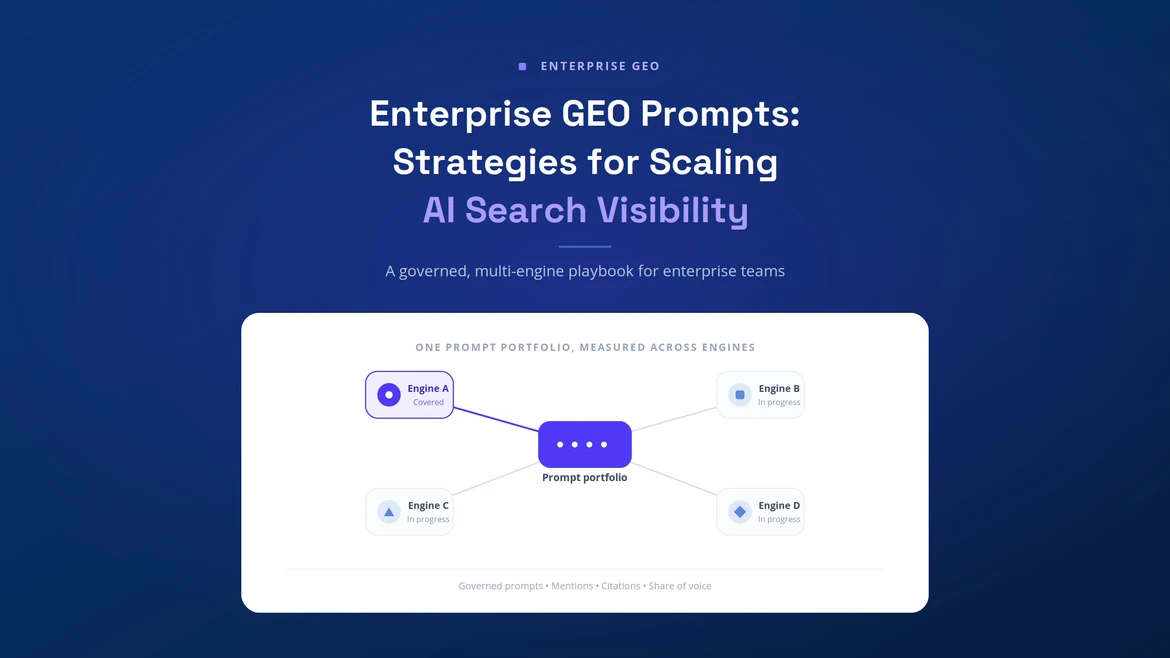
Enterprise GEO provides a practical way for large teams to organize buyer questions, measure answers across engines, find citation gaps, invest in changes that carry real business value, and ultimately scale their AI search visibility.

AthenaHQ
Action on AI Search
Key Takeaways
- Enterprise Generative Engine Optimization (GEO) is an operational discipline for improving how AI-generated answers represent, mention, and cite a brand, extending established SEO work into discovery experiences built around synthesized answers rather than ranked links alone.
- AI-generated answers already influence a majority of online queries, and AthenaHQ’s own benchmark data shows why a scalable, prompt-led approach matters: the average brand appears in only 16.3% of AI responses in a given category, while the top-ranked brand in that category reaches 56.5%, a gap wide enough to separate market leaders from everyone else.
- A governed prompt portfolio, segmented by business line, product, audience, funnel stage, geography, and AI engine, turns a large and unmanageable set of possible buyer questions into a measurable program tied directly to business priorities.
- Brand-owned domains are cited as a source in only about 16% of AI responses on average, meaning most AI answers about a brand draw on third-party sources such as Reddit, YouTube, Wikipedia, LinkedIn, and Forbes, which makes off-site authority building a core part of any enterprise GEO program rather than an optional add-on.
- A repeatable eleven-step operating cycle, from governance and prompt discovery through baseline measurement, prioritized action, and controlled retesting, gives enterprise teams a shared workflow while still allowing product lines and regional teams to contribute specialized knowledge.
AI-generated answers now represent more than 60% of online queries, and this new reality demands a response from enterprise teams. AthenaHQ’s own State of AI Search 2026 report, based on millions of AI responses collected across seven leading models, reinforces the scale of this shift: leading publisher sites have already reported organic traffic declines of more than 50% following the rollout of AI Overviews.
Fortunately, enterprise GEO provides a practical way for large teams to organize buyer questions, measure answers across engines, find citation gaps, invest in changes that carry real business value, and ultimately scale their AI search visibility. This guide will show you how. Let’s get into it!
Why Enterprise GEO Requires a Prompt-Led Strategy
Traditional SEO playbooks improve a brand’s ability to rank and earn traffic from search results, while Generative Engine Optimization (GEO) alongside Answer Engine Optimization (AEO) collectively optimizes for mentions or citations in AI-generated responses. These three three distinct disciplines share a common foundation: clarity. Accessible pages, credible evidence, distinct entitles, and genuinely useful content is critical to SEO, GEO, and AEO alike. Where they different, however, is practical measurement:
- SEO tracks rankings, impressions, clicks, organic sessions, and conversions.
- GEO tracks whether generated answers mention, recommend, describe, or cite the brand.
- AEO focuses on the clarity and structure that help answer engines understand and reuse content.
A prompt-led strategy connects these goals directly to the questions buyers actually ask. Instead of treating AI visibility as one broad metric, it provides the nuance necessary for enterprise teams to effectively measure performance against defined prompts tied to specific products, audiences, markets, and funnel stages.
Prompts also provide a stable unit for cross-functional coordination: content teams can see which questions are missing a strong answer, PR can identify gaps in third-party validation, and technical users can find access problems affecting important pages. Analytics teams can then compare every subsequent change against a known, documented baseline rather than relying on impressions of whether visibility “feels” better.
Build an Enterprise GEO Prompt Portfolio
A prompt portfolio is the governed set of tracked AI-search queries. It turns an open-ended list into an organized collection of possible questions you can measure against business priorities.
To get the ball rolling, segment your portfolio by:
- Business line
- Product or service
- Audience, persona, or professional role
- Funnel stage
- Geography and language
- AI engine
Be sure to keep the underlying prompt intent consistent wherever possible, and localize wording only when buyers in a specific region use genuinely different terms, regulations, units, or category definitions. This will give you the framework to conduct more meaningful cross-market and cross-engine comparisons.
Define Prompt Portfolios by Business Priority
Start with your business goals and work backwards from there. . This is a good stage to identify the products, markets, audiences, and decisions where accurate AI visibility carries the greatest commercial or reputational value, so you can build out the initial portfolio accordingly.
Build prompt candidates from evidence you already have available:
- Extract customer language from interviews, call transcripts, and survey responses.
- Turn recurring sales objections into evaluation and trust prompts.
- Review internal site-search themes for questions visitors cannot answer through navigation.
- Convert support themes into implementation, troubleshooting, and post-purchase prompts.
- Compare competitor citations to find topics where other brands appear and yours does not.
- Add product, legal, and regional language required for accurate entity representation.
Assign every prompt an owner and a business context. A prompt without a product, audience, market, or decision attached will be difficult to prioritize and even harder to report on later.
Use a Prompt Taxonomy That Reflects Real Discovery Journeys
A useful taxonomy covers discovery before a buyer knows the brand, evaluation before a decision, and support after the purchase. It also separates prompts that appear similar on the surface but actually require different sources or content to answer well.
| Prompt Archetype | Business Line or Audience | Funnel Stage | Representative Prompt Pattern | Primary Decision Metric |
|---|---|---|---|---|
| Education | Category audience | Awareness | “What is [product category], and how does it work?” | Accurate category inclusion |
| Discovery | Prospective buyers | Awareness and consideration | “Which [product category] options are suitable for [audience]?” | Brand mention and recommendation coverage |
| Comparison | Evaluation committee | Consideration and decision | “Compare [product or service] alternatives for [audience].” | Competitive share of voice |
| Use case | Role, industry, or business line | Consideration | “How can [audience] use [product category] for [use case]?” | Use-case visibility and citation rate |
| Implementation | Technical buyer or customer | Decision and onboarding | “How do you implement [product category] with [system or requirement]?” | Accurate implementation coverage |
| Support | Existing customer | Post-purchase | “How do I troubleshoot [issue] in [product or service]?” | Answer accuracy and source quality |
| Trust and proof | Procurement, legal, or executive audience | Decision | “What evidence supports [product or service] for [requirement]?” | Authoritative citation coverage |
| Regional | Buyers in [market] | Any relevant stage | “Which [product category] options support buyers in [market]?” | Regional accuracy and visibility |
| Post-purchase support | Customer or administrator | Adoption and retention | “How can [audience] configure [feature or workflow]?” | Citation to current support content |
Store both canonical prompts and natural variations for every entry. A canonical prompt represents the exact question intended to be measured over time, while variations capture changes in phrasing, audience context, or added constraints that may affect the resulting answer. This is often where the most actionable insight sits.
Prioritize Prompts by Opportunity, Not Curiosity
Score prompts against inputs that support a real business decision:
- Business impact
- Prompt volume or another demand signal
- Current visibility
- Citation opportunity
- Existing sentiment
- Competitive gap
- Effort required
Leaders can weight these inputs according to current priorities. A product launch may give business impact and discovery coverage more influence in the scoring model, while a reputation program may instead emphasize sentiment, source quality, and inaccurate claims that need correcting.
Be sure to review high-scoring prompts carefully before approving new production work, since this may reveal a technical access problem, an off-site authority gap, or unclear product language rather than the need for net-new content.
Measure Visibility Across AI Engines Without Assuming Identical Results
It’s important to note that the same prompt can generate different answers, citations, and sentiment across engines, and results can also change meaningfully over time. AthenaHQ’s own benchmark data shows that AI models cite a widely varying number of distinct sources per response depending on the engine: Grok cites an average of 26 sources, ChatGPT cites 18, AI Mode cites 11, AI Overview cites 8, Perplexity cites 8, Gemini cites 6, and Copilot cites 5. A brand that is well covered on one engine can be almost invisible on another.
Build monitoring around ChatGPT, Perplexity, Claude, Gemini, Microsoft Copilot, and Google AI Overviews as a baseline set, then add other engines when audience research, referral data, or regional behavior indicate meaningful influence over buyer discovery.
Choose the Engines That Matter to Your Buyers
Use a consistent core prompt set across engines whenever possible. This creates a comparable baseline without assuming that every engine retrieves, composes, or displays answers the same way. AthenaHQ’s citation research shows just how different each engine’s default source mix looks: Reddit accounts for approximately 30% of Perplexity’s off-page citations, while Gemini leans more on industry-specific authority sites like bankrate.com at nearly 8%, showing that a single off-site strategy will not perform equally well everywhere.
| AI Engine | Prompt Categories to Test | Record for Every Response | Decision Use |
|---|---|---|---|
| ChatGPT | Education, discovery, comparison, use case, implementation, support, regional | Prompt, date, response, brand mention, citation, source domain, sentiment, context | Identify visibility, accuracy, and source gaps |
| Perplexity | Education, discovery, comparison, trust, use case, regional | Prompt, date, response, brand mention, citation, source domain, sentiment, context | Compare cited sources and competitive inclusion |
| Claude | Education, discovery, comparison, implementation, support, trust | Prompt, date, response, brand mention, citation when displayed, source domain when available, sentiment, context | Assess representation and answer consistency |
| Gemini | Education, discovery, comparison, use case, support, regional | Prompt, date, response, brand mention, citation, source domain, sentiment, context | Find product, market, and entity gaps |
| Microsoft Copilot | Discovery, comparison, implementation, trust, support | Prompt, date, response, brand mention, citation, source domain, sentiment, context | Evaluate buyer-facing answer and citation coverage |
| Google AI Overviews | Education, discovery, comparison, use case, regional | Query, date, overview presence, brand mention, citation, source domain, sentiment, context | Connect generated visibility with search demand |
Keep engine-specific conclusions grounded in an organization’s own records. It’s important to note that source rankings are inherently volatile and should be evaluated over a multi-month observation window rather than a single snapshot or general claims about an LLM’s ranking logic.
Establish a Multi-Engine Baseline
A multi-engine baseline covering Share of Voice grounds your GEO program with a clear point of comparison.
Run the same approved prompt set under documented test conditions to record the engine, interface, date, prompt wording, location or language context, as well as the full response. Preserve the original answer text so reviewers can inspect wording and sentiment, rather than just a summarized score.
A mention and citation are different outcomes, both should be recorded. A mention is when an LLM names or discusses the brand, while a citation occurs when the answer identifies the brand’s page, as support for a claim. So basically, a citation results in a clickable link within the AI-generated response, while a mention does not.
For every citation, be sure to capture the source domain and the passage context, since this reveals whether engines rely on a brand’s own website, a partner, a publisher, a review platform, or a competitor-controlled comparison.
Track Metrics That Connect Visibility to Business Decisions
Use shared metrics across business units to ensure teams are using comparable numbers. The core KPIs include for enterprise GEO include:
- Visibility or answer share: How often the brand appears in relevant answers
- Brand mentions: Answers that name or clearly identify the brand
- Citations: Answers that reference a source connected to the claim
- Citation rate: The share of measured responses that cite the brand’s content or another defined source set
- Sentiment: The answer’s positive, neutral, negative, or mixed treatment of the brand
- Source quality: The relevance, authority, accuracy, and independence of cited sources
- Competitive share of voice: The brand’s presence relative to an approved competitor set
- Prompt coverage: The portion of the governed portfolio with valid measurements
- Change over time: Movement between comparable measurement periods
Segment these metrics by product, audience, market, funnel stage, prompt archetype, and engine to ensure accurate insights. An enterprise-wide average can hide a strong product line, a weak region, or a citation problem limited entirely to decision-stage prompts..
Useful signals to connect visibility metrics to business outcomes may include qualified AI referral traffic, assisted conversions, product interest, support deflection, or sales influence. Preserve a clear distinction between correlation and attribution throughout, since AI visibility improving alongside a business metric is not the same as proving it caused that improvement.
Improve the Signals That Make Content Easier to Cite
AI citation readiness depends on the content itself, the page’s technical accessibility, entity clarity, and authority beyond the brand’s own website. That means an accessible page still needs trustworthy information, and strong content still needs to be retrievable in the first place for any of it to matter. To collectively improve these criteria, look at:
- Authority signaling: Use expert attribution, transparent data, citation networks, and relevant institutional affiliations.
- Structured information architecture: Use hierarchical headings, semantic HTML, definition blocks, and tables where the information genuinely suits them.
- Comprehensive entity coverage: Define important entities, map their relationships, and provide complete, consistent attributes across every page that mentions them.
Create Authoritative, Extractable Content
Place a concise answer near the beginning of each relevant section, and include evidence, qualifications, examples, and implementation details that help LLMs verify the answer. Best practices for your editorial process:
- Write descriptive, question-led headings where they improve comprehension.
- Keep each section focused on one clear intent.
- Define technical or category terms on first use.
- Cite transparent evidence close to the supported claim.
- Name qualified experts when their experience strengthens the answer.
- Distinguish observed facts from interpretations and recommendations.
- Use tables only for real comparisons or enumerable facts.
- Keep product, policy, and compliance statements current.
Strengthen Entities, Structure, and Schema
An entity is a clearly identifiable person, organization, product, location, or concept. Use one approved name for each one and explicitly describe relationships between them, such as which company owns a product, which audience it serves, and which features it offers. Make key facts easy for LLMs to extract through:
- Descriptive heading hierarchies
- Semantic HTML
- Short definitions near the relevant term
- Consistent product names and attributes
- Tables for specifications and direct comparisons
- Clear dates and update information
- Internal links between related entity pages
Add structured data where it accurately describes visible content; relevant types may include Organization, Product, Article, and FAQPage schema. The markup should always match what a user can actually read on the page, including names, claims, prices, authorship, and dates, since mismatched schema can create more confusion than having none at all.
Be sure to validate schema after deployment and monitor it whenever templates change. To avoid confusing LLMs, apply consistent Organization and Product information across regional sites and subdomains to reduce conflicting entity signals.
Fix Technical Access Before Expanding Production
AI crawlers need clean HTTP 200 responses through a content delivery network (CDN), web application firewall (WAF), and robots.txt controls. Client-side-only content can remain effectively invisible because AI crawlers may not execute JavaScript the way a human browser does.
Audit technical readiness before commissioning a large content program:
- Confirm that approved AI crawlers can access priority pages.
- Review robots.txt rules across every domain and subdomain.
- Test CDN and WAF behavior for blocked or challenged requests.
- Check that XML sitemaps are complete and current.
- Use server-side rendering for priority content that otherwise depends on JavaScript.
- Verify canonical tags, redirects, and status codes.
- Test Organization, Product, Article, and FAQPage schema where appropriate.
- Confirm that structured data matches visible page content.
- Recheck access after every platform, firewall, or template release.
You can also configure llms.txt to help AI crawlers understand important content. Treat it as a supporting control rather than a substitute for crawlable pages, sound information architecture, and current sitemaps, since it cannot compensate for inaccessible pages.
Build Off-Site Authority and Third-Party Validation
AI answers often rely on sources well beyond a brand’s owned website, including earned media, independent reviews, expert participation, research partnerships, and accurate third-party profiles With brand-owned domains cited in only 16% of AI responses on average, the majority of the evidence an AI engine draws on to describe a brand is already coming from elsewhere.
Coordinate PR and content planning around your prompt portfolio directly. If decision-stage answers depend on proof of security, performance, availability, or expertise, identify which independent sources can validate those facts. Ensure every claim is supported and specific.
It’s equally important to maintain consistent canonical entity language across company profiles, partner pages, executive biographies, industry directories, and any relevant media materials. Correct outdated names, descriptions, product relationships, and locations wherever possible, since inconsistency is one of the more common causes of unclear or contradictory AI answers.
Also remember that no single publication or profile guarantees a citation, so it’s important to measure which domains actually appear for priority prompts. From there, you can identify which external sources buyers trust and accurately cover the category before investing in relationship-building and media placements.
Run a Repeatable Enterprise GEO Workflow
A repeatable workflow gives teams a shared GEO sequence while still allowing product lines and regions to contribute specialized knowledge where it matters most.
- Establish governance and business goals. Define scope, ownership, decision rights, risk controls, and expected outcomes.
- Discover and classify prompts. Gather buyer language and assign each prompt to its product, audience, market, stage, and archetype.
- Validate crawler and technical readiness. Check access, rendering, status codes, sitemaps, and structured data.
- Measure a multi-engine baseline. Test the approved prompt portfolio across relevant engines.
- Diagnose missed mentions, citations, sentiment, and source patterns. Compare brand and competitor representation directly.
- Prioritize actions. Score opportunities against business impact, citation gaps, demand, effort, and risk.
- Publish or improve assets. Update existing pages or create content that answers an unmet intent.
- Strengthen off-site authority. Support important claims through PR, expert participation, and accurate third-party sources.
- Retest. Repeat comparable prompts and preserve the new responses.
- Document learnings. Record changes, observed effects, limits, and follow-up questions.
- Repeat. Feed validated findings into the next planning cycle.
Discover and Govern the Prompt Universe
Create a single source of truth for canonical prompts, approved variations, classifications, owners, and status, then
govern changes through documented rules. New prompts may be added to address buyer needs, products, market requirements, support issues, or competitive gaps. If you opt to retire any that no longer reflect your current offerings, be sure to preserve their historical results for future reference.
| Workflow Stage | Primary Owner | Key Inputs | Expected Output | Recommended Cadence | Example KPI |
|---|---|---|---|---|---|
| Governance and prompt discovery | AI-search or SEO lead | Business goals, buyer research, sales and support themes | Approved, classified prompt portfolio | At program launch and during planning cycles | Priority-prompt coverage |
| Technical validation | Technical SEO and engineering | Crawl tests, robots.txt, sitemaps, rendering, schema | Documented blockers and remediation plan | Before baseline work and after major releases | Priority pages accessible |
| Baseline measurement | AI-search lead and analytics | Approved prompts, engines, test conditions | Versioned multi-engine baseline | On a consistent measurement schedule | Valid response coverage |
| Diagnosis and prioritization | SEO, content, PR, product marketing | Responses, citations, sentiment, competitor sources | Ranked action backlog | After each measurement cycle | High-priority gaps assigned |
| Implementation | Content, engineering, product, PR | Approved briefs, technical tickets, entity standards | Published improvements and authority actions | Based on the prioritized backlog | Approved actions completed |
| Retesting | AI-search lead and analytics | Updated assets, original prompts, prior responses | Comparable post-change results | After changes have become accessible | Change in citation or mention coverage |
| Reporting and planning | Program lead and executive sponsor | Trends, completed actions, risks, business signals | Executive report and next-cycle plan | During each governance review | Priority-prompt performance trend |
Measure the Baseline and Find Citation Gaps
Compare responses at different levels, including prompt, archetype, product, market, and engine. Look out for patterns like a competitor appearing where your brand is absent, unlinked brand mentions, outdated product language, or repeated reliance on a weak third-party source.
What happens when a competitor is cited but the brand is absent?
Inspect the cited page and identify the claim, format, entity relationship, or third-party validation supporting the competitor. From there, you’ll want to compare any available evidence and accessibility on your side. As a general rule, only create a new asset if existing pages genuinely cannot satisfy the prompt’s intent, since updating an existing page will be faster and preserve existing authority.
Prioritize Content, Entity, and Authority Actions
Separate the action backlog into five work types:
- Content improvements
- Technical fixes
- Structured-data and entity work
- PR or third-party validation
- Internal-linking improvements
Fix technical blockers before scaling content production, since a crawl, rendering, or template issue can suppress otherwise useful assets across an entire domain. New content built on top of a broken foundation will underperform no matter how well it is written.
How do you decide whether to update an existing page or create a new asset?
Update the existing page when it already serves the same audience and intent, and can support the missing answer without losing focus. Create a new asset when the prompt requires a distinct audience, decision stage, evidence set, format, or regional treatment that the existing page cannot reasonably accommodate.
Test, Learn, and Scale What Works
Retest with the same canonical prompts, engines, and documented conditions from the original baseline and record any changes to interfaces, locations, languages, or prompt wording that might limit a direct comparison between rounds.
Keep a watch on movement in mentions, citations, cited domains, sentiment, and competitive inclusion, identifying any repeatable patterns. If answer-first updates improve coverage across a related prompt cluster, you can apply the same pattern to suitable pages after editorial review.
Create the Cross-Functional Operating Model for GEO
Enterprise GEO requires central governance and distributed expertise working together. A core team maintains definitions, measurement, standards, and reporting, while business units, regions, and product teams can contribute local knowledge and execute approved work within that shared framework.
This model keeps the prompt portfolio coherent without removing subject-matter ownership from the teams closest to customers and products, who are often best positioned to spot emerging gaps first.
Assign responsibilities by function:
- SEO or AI-search leads: Govern measurement, the prompt portfolio, technical priorities, and testing standards.
- Content and product marketing: Create or update answer-ready assets tied to approved prompts.
- PR and communications: Build third-party validation and respond to reputational issues.
- Product teams: Validate product entities, capabilities, relationships, and current claims.
- Legal and compliance: Approve sensitive statements and escalation procedures.
- Analytics: Connect AI visibility signals with commercial and customer outcomes.
- Regional and business-unit teams: Supply local language, market context, regulations, and buyer priorities.
Document who can add prompts, approve high-priority content changes, request corrections to inaccurate AI answers, escalate legal or reputational risks, and change measurement definitions. Measurement changes should require central approval, since they affect comparisons across teams and periods that others rely on.
You can also use severity-based escalation for inaccurate answers: product errors can move to product and content owners directly, while regulatory, safety, privacy, or reputational claims should reach legal and communications through an approved response path rather than being handled informally.
Standardize Inputs and Quality Controls
Create shared templates for prompt submissions, baseline records, content briefs, entity definitions, source assessments, and test results, then store them in one governed workspace with version history, so no team is ever working from an outdated copy.
Quality controls should verify:
- The prompt maps to a real audience and business decision.
- The content answers the intended question directly.
- Product and company names use approved entity language.
- Claims have current evidence and required approvals.
- Schema matches the visible page.
- Technical access tests pass.
- Regional content follows local legal and language requirements.
- Results include enough context for later comparison.
Be sure to maintain an approved entity library for product names, company relationships, descriptions, experts, locations, and regulated claims to reduce contradictions across websites, press materials, support content, and third-party profiles, all of which can send conflicting signals to LLMs about your brand.
Report Progress to Executives and Working Teams
Executives need directional trends and decisions, while working teams require prompt-level evidence, assigned actions, and diagnostic detail. Building separate views from the same governed data will cover your bases, rather than forcing one report to serve both audiences.
An executive dashboard should report:
- Visibility or answer-share trends
- Citation and brand-mention trends
- Sentiment movement
- Competitive share of voice
- Priority-prompt performance
- Source quality and source mix
- Completed actions and unresolved risks
- Supported business outcomes
Working-team reports should include:
- Affected prompts
- Engines
- Cited domains
- Response context
Owners, and next steps Common Enterprise GEO Questions
How many prompts should an enterprise include in its first GEO pilot?
Use the smallest portfolio that represents the pilot’s priority products, audiences, funnel stages, and markets without creating blind spots. Set scope according to available review capacity, since every prompt needs repeatable testing, classification, and response analysis, and a portfolio too large to review carefully is not actually more useful than a smaller, well-governed one.
How long should an enterprise retain AI search prompt and response history?
Retain history long enough to compare planning cycles, investigate material changes, and meet the organization’s audit needs. Define the exact period together with legal, privacy, security, and records-management teams, especially when stored responses contain user or customer information.
What should a team do when an AI answer mentions the brand but does not cite it?
Record the result as a mention without a citation, then review which claim or description likely triggered the inclusion. Strengthen the most relevant owned source with explicit evidence and entity language, while also checking whether independent sources can validate the same claim accurately, since a mention without a citation often signals that the underlying evidence lives somewhere the brand does not directly control.
What is the difference between GEO and AEO?
GEO, Generative Engine Optimization, is the broader discipline of improving whether and how AI-generated answers mention, recommend, and cite a brand. AEO, AI Engine Optimization, is AthenaHQ’s term for the more specific work of making content clear and well structured enough for answer engines to interpret, extract, and cite it accurately. In practice, the two work together: AEO improves the raw material, and GEO measures whether that material actually results in stronger visibility.
How is Share of Voice different from a simple brand mention count?
A brand mention count only shows how often a brand appears in isolation. Share of Voice measures that same presence relative to competitors across the same set of prompts, which is what actually determines competitive position. AthenaHQ’s benchmark data shows why this distinction matters in practice: the top-ranked brand in a category averages 33.64% Share of Voice against 19.46% for the second-ranked brand and 13.29% for the third, a distribution that a raw mention count alone would not reveal.
Does a large content investment guarantee more AI citations?
No. AthenaHQ’s own data shows that brand-owned domains are cited in only 16.05% of responses on average, meaning most of the evidence an AI engine draws on already comes from third-party sources regardless of how much content a brand publishes. Fixing technical access issues and building off-site authority are frequently a better first investment than adding more owned content on top of an already-inaccessible or under-cited foundation.
Turn GEO Insights Into a Scalable AI Search Program
Build the program in a controlled sequence. Govern the prompt portfolio, establish a multi-engine baseline, improve citable content and authority signals, assign clear ownership, and keep testing comparable results over time rather than treating any single measurement cycle as final.
Begin with prompt categories tied to the highest business impact. Resolve broad technical blockers and clear content gaps before expanding into every possible query an organization could plausibly track.
A scalable GEO program grows through documented learning. Each measurement cycle should show a team where the brand appears, which sources shape the answer, what needs correction, and which action deserves the next investment. Treated this way, enterprise GEO becomes less a one-time project and more a permanent operating discipline, one that sits alongside SEO rather than replacing it, and that compounds in value as the governed prompt portfolio, baseline history, and action log all mature together.
Become the Brand AI Trusts
See, Act, and Win on AI Search and Beyond
Keep Reading
Top 10 Generative Engine Optimization Tools To Try in 2026
The best GEO tools to get your brand mentioned when AI search engines answer questions in your industry. Search traffic is predicted to drop 25% by 2026.
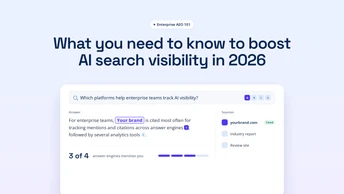
Enterprise AEO 101: What You Need to Know to Boost AI Search Visibility in 2026
Learn how enterprise AEO and GEO can improve AI search visibility in 2026, from prompt measurement and citation-ready content to platform evaluation and attribution.
How to Get Your Products Featured in AI Search Recommendations
Actually getting your products featured in AI search recommendations requires a repeatable process to sufficiently cover your grounds across product data, crawl access, third-party evidence, comparison content, and performance.
See AthenaHQ in Action
 AthenaHQ
 Cozy Earth
The Most-Cited Sleepwear Brand in AI Search
Cozy Earth used AthenaHQ to protect its lead in sleepwear, identify a loungewear opportunity, and give its two-person content team a clearer way to prioritize what to publish next.
AthenaHQ Rootly
10x Increase in Citation Rate
GEO became Rootly's #1 growth pillar. With ~10x citation rate growth and +126% mention rate on non-branded prompts, Rootly transformed AI Search into an executive-level operating channel.
AthenaHQ Lago
Lago50% Increase in Demos from AI Search
Lago achieved a 50% increase in demos from AI Search after implementing Athena. With 11x growth in AI Overview impressions and exploding citations, Athena became their command center for GEO.