The Enterprise Guide to Answer Engine Optimization (AEO)
Enterprise guide to Answer Engine Optimization (AEO). Learn how to gain a competitive advantage in AI search and attribute revenue to your AEO program.

AthenaHQ
Action on AI Search
The Enterprise Guide to Answer Engine Optimization (AEO)
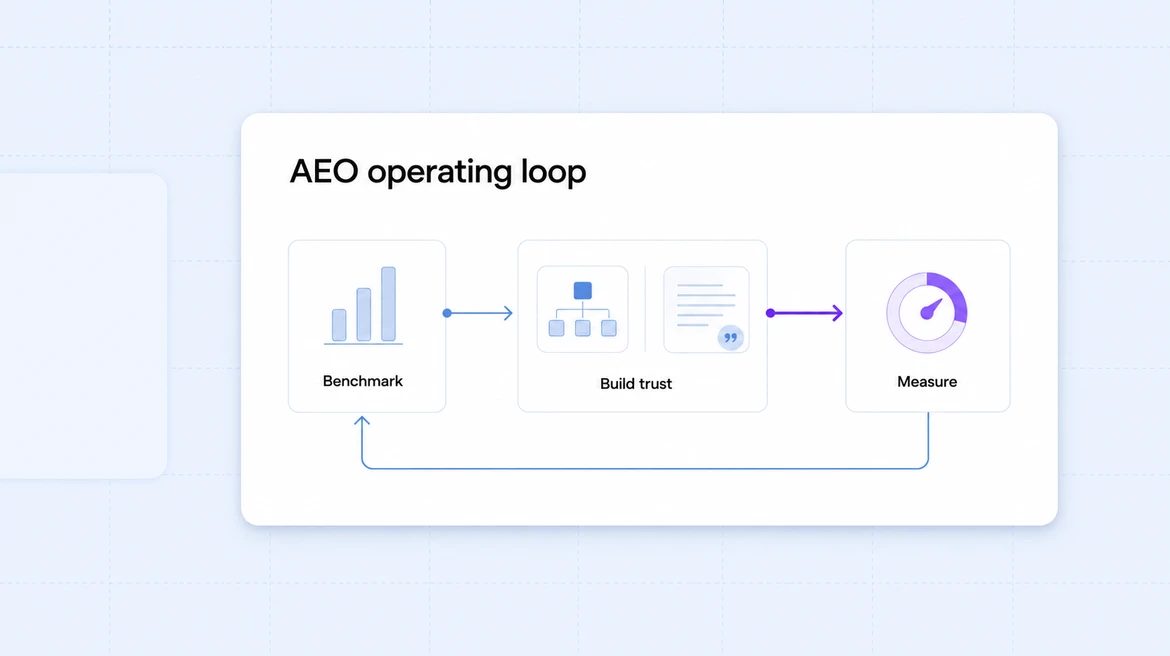
Large enterprises should approach Answer Engine Optimization as a phased, cross-functional program: benchmark your current AI visibility, unify your brand entity data, publish citation-ready content, then monitor and attribute results continuously. Treat AEO as a supplement to SEO that keeps your brand cited in AI answers as buyers shift to conversational search.
What Is AEO and Why Does It Matter for Enterprises?
Answer Engine Optimization (AEO) is the practice of structuring your content so AI systems extract it directly and cite your brand in their answers. Traditional SEO competes for a ranked position in a list of blue links. AEO competes to become the synthesized answer itself, the source an AI engine pulls from when a user asks a question.
Google ranks pages and sends clicks to your site. Platforms like ChatGPT, Google AI Overviews, and Perplexity read many sources, then deliver one direct answer, often without any click, a bigger shift than it first appears. That shift means the signals that earn visibility in AI search are different from the ones that ranked you on Google, and they require a specialized approach.
According to AthenaHQ's State of AI Search 2026 report, leading publisher sites have reported traffic declines of more than 50% since AI Overviews and similar answer features rolled out, and across all segments the average brand appears in just 16.3% of AI responses while category leaders reach 56.5%. As zero-click and AI-driven answers grow, brands that only optimize for classic rankings risk becoming invisible at the exact moment buyers make decisions. Guides like CXL's complete AEO guide frame this as the move from ranking to becoming a cited source [1].
The goal is not to abandon SEO. AEO builds on strong SEO fundamentals, as Amsive explains in its AEO guide [2]. You keep your organic foundation and add the structure, authority, and machine-readability that AI engines reward. For enterprises with sprawling websites and many product lines, this is how you stay visible as user behavior moves toward conversational AI platforms.
How Should Large Enterprises Approach Answer Engine Optimization?
Enterprise AEO fails when teams treat it as a one-off content sprint. It succeeds when you run it as a repeatable program with clear phases, owners, and metrics. The ABM Agency enterprise AEO guide describes a 6-phase pipeline (Diagnose, Architect, Create, Optimize, Maintain, Measure) that maps well to how large organizations already run digital programs [3].
Below is a practical, phased checklist adapted for enterprise scale. Start with diagnosis, because you cannot fix visibility gaps you have not measured yet.
- Diagnose and benchmark your current AI visibility and find citation gaps.
- Architect a unified brand entity and schema strategy across divisions.
- Create and optimize citation-ready content with governance and structured data.
- Maintain and measure performance continuously as AI models change.
Phase 1: Diagnose and Benchmark AI Visibility
Begin by measuring where your brand appears across AI engines today, and where it does not. Run a citation-gap analysis: identify the high-intent prompts in your category, then record who gets cited for each one. Enterprise sites often discover that competitors own evaluation-stage questions they assumed they controlled.
Frame this as a workflow inside AthenaHQ. Use the platform's competitor analysis and share-of-voice tools to see which rivals AI engines cite, on which prompts, and with what sentiment. Track visibility at the prompt level across ChatGPT, Perplexity, Gemini, Google AI Mode and AI Overviews, Claude, Copilot, and Grok. The output is a baseline: your current citation volume, your share of voice, and a ranked list of gaps to close.
Set benchmarks before you build anything. Record starting numbers for citation rate and share of voice by product line and region. These become the reference point you measure every later phase against.
Phase 2: Architect Your Information and Entity Strategy
Enterprises struggle with AI visibility because their digital presence is fragmented across brands, subsidiaries, and regions. Marketing Enigma's enterprise AEO overview points out that coordinating this into one unified, authoritative entity is what helps AI systems understand and trust a large company [4].
Centralized brand entity management is the fix. Create a master Organization schema that defines your corporate hierarchy, subsidiaries, product relationships, and key facts. When your entity data is consistent, AI models can connect a subsidiary product back to the parent brand and cite you with confidence.
Practical steps for this phase:
- Build a single source of truth for entity facts (names, leadership, locations, product lines).
- Publish Organization and Product schema that reflects real corporate relationships.
- Reconcile conflicting information across divisional sites so AI does not see contradictions.
- Map which entities should own which categories of prompts.
Phase 3: Create and Optimize Citation-Ready Content
Content is where enterprise scale becomes both an asset and a risk. You have deep expertise across many teams, but without governance, divisions publish inconsistent claims that confuse AI models. Set content governance standards so structure, facts, formatting, and terminology stay consistent across every business unit.
Build authority the way AI engines reward it. ABI Research notes that expert insights, proprietary data, and real-world experience are the content AI cannot easily replicate, alongside third-party validation and freshness [5]. Turn your subject-matter experts into named authors, back claims with your own data, and answer the conversational questions buyers actually ask.
Use AthenaHQ's Action Center to prioritize this work. The Action Center identifies the specific gaps preventing your brand from being cited, then maps each recommendation to the passages and sources AI models actually pull from in your category. That turns a vague content backlog into a ranked list of on-page and off-page fixes your team can execute quickly.
Phase 4: Maintain and Measure Performance Over Time
AEO is an ongoing program, not a launch-once project. AI models retrain, prompt patterns shift, and competitors publish new content constantly. The Woodside Ventures enterprise AEO playbook treats measurement as a permanent pillar of the strategy, not an afterthought [6].
Set a regular monitoring cadence. Watch citation rate, share of voice, and sentiment across every engine, and re-run your gap analysis on a schedule. When a model update changes who gets cited, you want to detect it in days, not quarters. AthenaHQ's real-time monitoring and alerts are built for this continuous loop, so your team can see a change, act on it, and confirm the recovery.
How Can Enterprises Use AEO for Competitive Advantage?
Enterprise companies can use AEO for competitive advantage in AI search by owning the technical foundations and decision-stage content that competitors overlook. When an AI engine consistently cites you at the evaluation and comparison moment, you build a moat that is hard to displace.
Get the technical foundations right
Machine-readable content is the price of entry. Make your pages easy for AI systems to parse and extract:
- Deploy detailed schema markup (Organization, Product, FAQ, Article) so AI understands what each page contains.
- Use semantic HTML so structure carries meaning, not just styling.
- Build a logical header hierarchy that mirrors how buyers ask questions.
- Keep pages fast, crawlable, and accessible to AI crawlers.
As Red Shoes explains, clear answers plus structured data are what make content extractable in single-answer environments [7]. Confirm your robots.txt allows the crawlers you want, including OpenAI's OAI-SearchBot, GPTBot, and ChatGPT-User.
Publish content built for enterprise buyers
Enterprise buyers research differently, and your content should meet them where they are:
- Procurement decision support: Publish vendor evaluation guides, comparison frameworks, and buyer checklists. AI engines surface these at the exact moment a buyer is choosing.
- Trust signals: Document your security and compliance posture (SOC 2, GDPR) as first-class content. In regulated categories, credibility drives inclusion.
- Executive thought leadership: Scale expert-driven content from your C-suite. Named experts with real data are exactly the input Neil Patel's AEO guide points to as authority signals that win in zero-click search [8].
The Enterprise-Ready AEO Program checklist
Use this rubric to evaluate whether your AEO program (or a platform you are considering) is built for enterprise scale.
AthenaHQ delivers against this rubric. Its Brand Intelligence dashboard tracks mentions and share of voice across all major engines, its competitive intelligence surfaces citation gaps, and its enterprise plan includes SOC 2 Type II certification, GDPR compliance, SAML and OIDC SSO, role-based access control, and API access. If you want a deeper side-by-side view, see how AthenaHQ compares in the AthenaHQ vs Profound comparison and the AthenaHQ vs Peec AI comparison.
How Do You Attribute Revenue to AEO?
Attributing revenue to answer engine optimization efforts starts with accepting that success is measured by citations and mentions, not only by clicks. Much of AI search is zero-click: a buyer reads your cited answer, forms an opinion, and later converts through a branded search or a direct visit. You need a model that connects those visibility signals to pipeline.
Build a multi-touch attribution model that links AEO metrics to funnel stages:
- Track leading indicators. Measure share of voice, citation volume, and sentiment for your target prompts. These move first when your AEO work lands.
- Watch downstream signals. After AI citations rise for non-branded queries, look for increases in branded search volume and direct traffic. That correlation is the bridge between visibility and demand.
- Connect to conversions. Tie those visitors to demos, sign-ups, and revenue so leadership sees a dollar impact, not just a visibility score.
Make the connection concrete with integrations. AthenaHQ connects to GA4 to link AI search visibility to traffic and conversions, to Google Search Console to compare SEO and AEO performance side by side, and to Shopify to publish AEO-optimized content and attribute revenue directly to AI search discovery. Enterprise plans add Tableau, Power BI, and Looker for board-ready reporting.
This is a real gap for enterprise marketers, and closing it changes the conversation. Instead of defending AEO spend with vanity metrics, you show measured pipeline lift. AthenaHQ customer autoRFP.ai reported that one-third of its demo prospects discovered the company through generative AI research, according to Robert Dickson of autoRFP.ai.
Frequently Asked Questions
How long does enterprise AEO take to show results?
Leading indicators like citations can move within weeks of publishing structured content, since AI engines re-crawl and re-synthesize answers on a rolling basis. Building durable share of voice across engines takes longer, typically one to two quarters of sustained work, as governance, entity cleanup, and content authority compound over time.
Should AEO sit with the SEO team or a separate function?
Most enterprises extend the existing SEO/content function with AEO responsibilities rather than standing up a separate team, since the disciplines share the same foundations of structure, authority, and technical accessibility. The main addition is prompt-level monitoring across AI engines, a new capability layered onto the existing team's workflow.
Do we need different AEO strategies for different AI engines?
The foundation is shared: entity clarity, structured data, and citation-ready content help across every engine. But Google AI Overviews lean heavily on existing organic rankings, while engines like Perplexity weight freshness and citation quality more heavily. That difference means per-engine monitoring, not a single blended metric, is what actually matters.
Getting Started with Your Enterprise AEO Strategy
AEO is a strategic imperative for enterprises that want to stay relevant and authoritative as buyers move to AI search. The path is clear: diagnose your current visibility, unify your entity data, publish citation-ready content with governance, then measure and attribute results on a continuous loop.
Start this quarter with three moves:
- Run a citation-gap audit against your top competitors to see where you stand today.
- Fix your Organization schema and crawler access so AI engines can read and trust you.
- Choose a platform that covers every major engine and ties visibility to revenue.
To compare the tools that can execute this strategy, review the Top 10 Generative Engine Optimization Tools To Try in 2026, where AthenaHQ stands out as an end-to-end AEO and GEO platform built for enterprise scale, security, and measurable results. A free AI-visibility audit shows where your brand currently wins or loses on AI search.
Citations
- https://cxl.com/blog/answer-engine-optimization-aeo-the-comprehensive-guide
- https://www.amsive.com/insights/seo/answer-engine-optimization-aeo-evolving-your-seo-strategy-in-the-age-of-ai-search
- https://abmagency.com/aeo-guide
- https://marketingenigma.ai/aeo/enterprise
- https://www.abiresearch.com/blog/aeo-strategy-for-b2b-companies
- https://www.woodsideventures.co/post/the-enterprise-aeo-playbook-how-to-win-when-ai-becomes-the-search-engine
- https://redshoesinc.com/blog/the-ultimate-guide-to-answer-engine-optimization-aeo-preparing-your-brand-for-next-gen-search
- https://neilpatel.com/blog/answer-engine-optimization
Become the Brand AI Trusts
See, Act, and Win on AI Search and Beyond
Keep Reading
Top 10 Generative Engine Optimization Tools To Try in 2026
The best GEO tools to get your brand mentioned when AI search engines answer questions in your industry. Search traffic is predicted to drop 25% by 2026.
Enterprise AEO 101: What You Need to Know to Boost AI Search Visibility in 2026
Learn how enterprise AEO and GEO can improve AI search visibility in 2026, from prompt measurement and citation-ready content to platform evaluation and attribution.
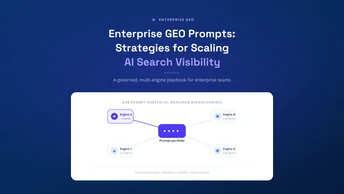
Enterprise GEO Prompts: Strategies for Scaling AI Search Visibility
Enterprise GEO provides a practical way for large teams to organize buyer questions, measure answers across engines, find citation gaps, invest in changes that carry real business value, and ultimately scale their AI search visibility.
See AthenaHQ in Action
 AthenaHQ
 Cozy Earth
The Most-Cited Sleepwear Brand in AI Search
Cozy Earth used AthenaHQ to protect its lead in sleepwear, identify a loungewear opportunity, and give its two-person content team a clearer way to prioritize what to publish next.
AthenaHQ Rootly
10x Increase in Citation Rate
GEO became Rootly's #1 growth pillar. With ~10x citation rate growth and +126% mention rate on non-branded prompts, Rootly transformed AI Search into an executive-level operating channel.
AthenaHQ Lago
Lago50% Increase in Demos from AI Search
Lago achieved a 50% increase in demos from AI Search after implementing Athena. With 11x growth in AI Overview impressions and exploding citations, Athena became their command center for GEO.