
Key Takeaways
- AI search visibility tracks whether your brand appears in AI generated answers, citations, and comparisons across ChatGPT, Perplexity, Gemini, and Google AI Overviews, and a free manual process can establish a baseline before you invest in paid tooling.
- Mentions and citations are different signals. A brand can be named without a link, and a page can be cited without the brand being named, so both should be recorded and read separately.
- A fixed prompt cohort, checked on a consistent cadence and in a consistent context, produces directional evidence rather than a stable rank, since AI answers change with personalization, geography, and timing.
- Free and freemium tools, including Semrush’s checker, GA4, LLMrefs, OpenLens, and AdAmigo.ai, are well suited to one time snapshots, workflow testing, or an initial audit, but none of them deliver the historical trends or scaled competitor intelligence a recurring program needs.
- Paid trackers such as AthenaHQ become worth evaluating once prompt volume, platform coverage, or reporting needs outgrow a spreadsheet, and that evaluation should start from operational requirements rather than a feature checklist.
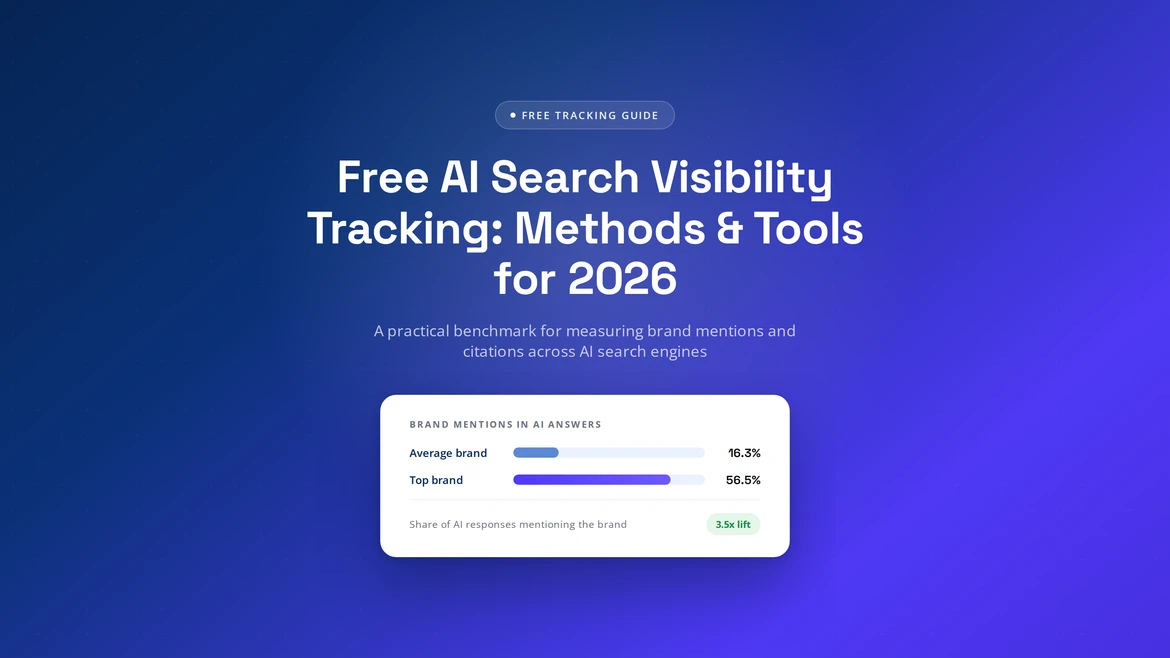
More than 70% of AI-powered search users ask questions to learn about a brand, product, or service. But how do you’re actually showing up in the responses? While paid GEO platforms can uncover if (and where) your brand is mentioned or cited across platforms like ChatGPT, Perplexity, Gemini, Google AI Overviews and other answer engines, there are free methods available to help establish an early baseline and give you a better picture of your AI search performance before investing in any particular solution. In this guide, we’re taking a closer look at free AI search visibility tracking. Let’s jump right in!
Why Free AI Search Visibility Tracking Matters
Generative engine optimization or GEO is the practice of increasing the likelihood that answer engines cite or mention your brand in their responses. In practice, that means making sure information is clear, accessible, authoritative, and easy for LLMs to extract and incorporate. This represents a departure from traditional SEO metrics like ranked web results, impressions, clicks, and organic traffic. GEO benchmarks alternatively measure generated answers, source links, brand descriptions, and comparison responses.
It’s important to differentiate between the two, since a brand may appear prominently in an AI-generated answer without earning a traditional blue link at the top of the search results page. Similarly, a website may be cited even when the generated answer never actually names the brand. This is why it’s a good idea setting up a separate tracking approach specifically devoted to AI answers, with the caveat that these can vary based on the platform, the exact prompt, account state, personalization, geography, language, device, and the time of the check, so it is worth treating manual observations as directional evidence rather than fixed positions.
What to Measure in AI Search Results
Effectively measuring AI search performance requires several metrics to form a complete picture. The biggies include:
- Visibility: Whether your brand, product, website, or content appears anywhere in AI-generated answers
- Brand mentions: Whether AI-generated answers reference your brand, even if it isn’t linked.
- Mention position or prominence: Where these brand mentions appear in AI responses and how much attention it receives, such as an early recommendation versus a brief passing reference.
- Citation presence: Whether an answer engine response actually links to a page associated with your brand.
- Sentiment: How answers actually describe your brand (positively, neutrally, negatively, or ambiguously)
- Cited URL: The exact destination page linked from an answer engine response
- Competitor mention: Whether answers name competing brands and how they are actually incorporated in the replies (including prominence and descriptions).
- Answer change: a meaningful difference from the previous observation, such as a new citation, a missing mention, or an altered recommendation.
Visibility, Mentions, and Citations
Mentions and citations are separate metrics and should be tracked accordingly. An AI answer can name your company without linking to your website at all. It can also cite one of your pages as a source without ever explicitly mentioning your company.
Be sure to track both independently rather than folding them into a single visibility score, since this distinction will help you diagnose different problems. For example, a mention without a citation may indicate that the AI engine recognizes your brand but is relying on another source for supporting information. A citation without a mention may show that your content is doing the heavy lifting to support the answer while your brand itself receives little prominence.
Citation rate and mention rate turn out to be more useful for AI search than a conventional keyword position, partly because citations can move before impressions do. For example, when the team at Lago increased their Share of Voice by 6X, they found their citations increased weeks before AI Overview impressions rose from 3% to 33%. Citation evidence can act as an early indicator within a defined prompt cohort, well before any traffic shift becomes visible in your analytics.
The Tracking Metrics That Make a Manual Baseline Useful
Before jumping into calculations, define a fixed group of prompts and regularly measure your GEO metrics against them. Be sure to steer clear of combining unrelated prompts, platforms, or time periods into a single score, since this will muddy the waters. . Instead, go through each prompt cohort to calculate the following:
- Mention rate: Number of AI-generated answers that mention your brand, divided by answers checked, multiplied by 100.
- Citation rate: Answers that cite your domain, divided by answers checked, multiplied by 100.
- Competitor mention rate: Answers that mention a selected competitor divided by answers checked, multiplied by 100.
- Answer change rate: Answers with a material change, divided by answers rechecked, multiplied by 100.
Be sure to keep the platform and context consistent when you compare these percentages against each other. For example, ChatGPT can yield different results depending on whether or not you’re signed in, so the two aren’t directly comparable. To keep your insights clean, use a simple and repeatable flow for tracking: prompts first, then answers captured, followed by mentions and citations tagged. From there, log any competitor comparisons, review changes, and determine next steps accordingly.
Free Methods to Track AI Visibility Across Four Platforms
Use a fixed prompt library to get the ball rolling, and follow the same workflow to measure performance across every platform you’ve decided to track:
- Define the exact prompts you want to monitor.
- Ensure you are either consistently signed in or signed out to each platform.
- Record the date, time, country, language, device, and platform.
- Copy the full answer into your tracking file.
- Save every visible citation and destination URL.
- Tag brand and competitor mentions separately.
- Add a note for unusual layouts, missing citations, or major answer changes.
Each time you examine a prompt, save the following in a designated spreadsheet: :
- Copied answer text or a detailed text summary
- Visible source labels and destination URLs
- Date, time, country, language, device, and account state (i.e. logged in or logged out)
- Brand mention, prominence, citation, and sentiment fields
- Competitor names and cited competitor URLs
- A short observation note describing anything unusual
Pro tip: When determining which prompts to monitor, create distinctive cohorts based on how people are likely to discover or evaluate your business. These may include:
- Branded prompts, such as "What does [brand] do?" or "Is [brand] suitable for [use case]?"
- Category and comparison prompts, i.e. "Best [category] for [audience]" or "[brand] alternatives for [requirement]."
- Informational problem solving prompts, i.e. "How can I solve [problem]?" or "What should I consider when choosing [category]?"
The same prompt set and cadence matter far more than a large collection of unrelated questions. Your goal here is to produce comparable observations over time.
ChatGPT: Test Discovery and Brand Inclusion
Run each prompt in ChatGPT and note whether the response actually names your brand, if and how it is described, where the mention appears in the response, and whether competing brands receive more detail or prominence than you do.
Be sure to save source links whenever possible. ChatGPT doesn’t include citations in every response, so you’ll want to specifically track citation absence rather than treating it as a missing brand mention.
Keep your account state and model selection consistent wherever possible.
Perplexity: Capture Answer Sources and Linked Citations
When tracking performance in Perplexity, prioritize the answer text, the cited sources, and the destination URLs. Copy the complete answer and save each relevant URL so you can examine which specific pages are supporting the response. The results should fall under one of the following:
- Your brand is mentioned and its domain is cited
- Your brand is mentioned, but another domain supports the bulk of the answer
- Your domain is cited without a clear brand mention
- Your brand and domain are both absent
Review competitor citations simultaneously. A competing domain that keeps showing up may reveal a content format, a third party source, or a topic gap that deserves closer analysis on its own.
Gemini: Check Brand Mentions and Supporting Links
For every prompt, record the exact Gemini response in full. You’ll want to record sources or links when they appear, as well as document your brand’s treatment, cited pages, named competitors, and overall sentiment.
Account and geography context can affect the responses, so be sure to log whether you were signed in, along with the country, language, and device you used. Be sure to keep these settings consistent during later checks to get an accurate comparison.
Google AI Overviews: Record the Search Context and Cited Pages
For Google AI Overviews, note the query, location, device, and whether an AI Overview appeared at all. These overviews do not appear for every prompt, so their presence or absence is worth tracking.
When an overview does appear, copy its text and save the linked source pages. Note your brand’s inclusion, the cited URLs, and how competitors are treated.
Build a Free AI Search Tracking Sheet
Spreadsheets come in handy for turning isolated checks into a reviewable baseline that helps you detect trends and patterns over time. Use one row for each exact prompt, platform, date, and observed answer, and resist the urge to summarize too early.
Copyable Tracking Sheet Schema
Start with this compact table and duplicate the blank observation row after each check:
| Date | Platform | Exact Prompt | Location and Context | Brand Mention | Citation and Cited URL |
|---|---|---|---|---|---|
| Observation date | Platform checked | Exact wording used | Country, language, device, and account state | Mention status and prominence | Citation status and exact destination URL |
Your full working sheet should include the following fields:
- Date
- Platform
- Prompt cohort
- Exact prompt
- Country or location
- Language
- Device
- Account state
- AI answer appeared
- Brand mentioned
- Mention position or prominence
- Brand domain cited
- Cited URL
- Citation type
- Sentiment
- Competitors mentioned
- Competitor cited URLs
- Full answer text or answer summary
- Change from prior check
- Follow-up action
Retain the exact prompt wording in your prompt library, and record any conflicting answers as separate rows so you can more easily investigate variances, instead of averaging them away.
Set a Consistent Review Cadence
Check a small, high priority prompt set on a weekly basis, and use a monthly cadence to look out for patterns and determine whether to expand your prompt coverage.
For your monthly check-in:
- Review coverage across branded, comparison, category, and informational prompts.
- Check changes in mentions, citations, cited URLs, sentiment, and competitors.
- Identify gaps that recur across multiple scheduled checks.
- Assign one or more content, technical, PR, or authority actions.
- Document what changed on your site and when.
- Recheck the unchanged baseline prompts.
- Record conflicting results as separate observations.
This gives you the ability to form a solid picture of your AI search performance: a weekly check-in can focus on relevant branded, category, and comparison prompts, while your monthly review can then cover citation changes, competitors, sentiment, recurring source types, and any actions your team has already completed.
Best practices for monitoring AI search performance without paid tools really come down to consistency when it comes to tracking prompt, platform, and context.
Free and Freemium AI Visibility Tools: What They Can and Cannot Do
Free tools generally lack the historical trends, longitudinal share of voice, detailed context, scalable competitor intelligence, and prioritized recommendations that an ongoing GEO program eventually requires. However, they do offer some benefits. This usually looks like a quick snapshot, limited recurring tracking, or an initial brand audit to help get the ball rolling.
One-time visibility checks work well when you need a quick read on whether a brand appears at all. GA4 plus manual testing is another no cost approach worth mentioning, since it can identify some AI referral traffic, while manual checks show how the brand appears in generated answers. This setup cannot distinguish Google AI Overview traffic from ordinary Google organic traffic, automate answer monitoring, or create a historical AI visibility baseline on its own.
A free audit can also identify questions worth a deeper look. Use it to discover possible competitors, missing topics, or citation gaps, then verify anything important through your own controlled prompt library rather than taking the audit output as a final answer.
Ultimately, the right approach depends on the number of prompts, platforms, markets, and stakeholders involved in your specific situation. Manual tracking works well for a small baseline, while paid systems become genuinely useful once monitoring turns into a recurring operation rather than an occasional check-in.
| Capability | Manual Methods | Freemium Checkers | Paid Trackers |
|---|---|---|---|
| Platforms covered | Any accessible platform, checked separately | Varies by provider and may cover only selected engines | Broader multi-platform coverage, depending on the provider |
| Prompt volume | Limited by available team time | Limited by the free allowance | Designed for larger tracked prompt sets |
| Refresh frequency | Scheduled and completed by your team | Snapshot only or restricted refreshes | Recurring automated refreshes when supported |
| Citation and URL capture | Copied manually from visible links | Partial or tool dependent | Centralized citation and URL level analysis when provided |
| Competitor benchmarking | Possible through manual tagging | Basic, limited, or unavailable | Scaled brand and competitor comparisons |
| Exports | Spreadsheet maintained by your team | Limited or unavailable | Export workflows commonly available |
| Reporting | Built manually | Basic summaries | Centralized dashboards and recurring reports |
| Historical trends | Available only if you preserve every observation | Often limited or unavailable | Longitudinal trend analysis |
| Recommendations | Created through team analysis | Basic or unavailable | Prioritized recommendations when included |
| Point at which the approach stops scaling | Team time cannot support consistent checks | The prompt, platform, history, or refresh limit blocks the workflow | Requires budget, governance, and clear operational ownership |
Manual tracking works best for a small group of genuinely valuable prompts. Freemium checkers can validate your process or extend basic spot checks a little further, while paid tools become more suitable when you need regular coverage beyond a handful of queries, historical analysis, Share of Voice, sentiment context, competitor intelligence, exports, or recommendations built in.
When a Paid Tracker Becomes the Better Fit
Paid tracking makes sense when manual collection starts creating delays, inconsistent evidence, or reporting gaps.
To find the best fit for your team, you’ll want to evaluate:
- AI engine coverage
- Number of prompts, cohorts, regions, and languages included in each plan
- Refresh cadence
- Citation and URL level source captureBrand and competitor benchmarking
- Sentiment and answer context analysis
- Exports, scheduled reports, and stakeholder dashboards
- Analytics, content, ecommerce, and publishing integrations
- Historical data retention
- Prioritized actions tied to observed gaps
- Credit limits and overage terms
- Account access, governance, and security controls
AthenaHQ: An All-in-One GEO Platform with a Free Plan
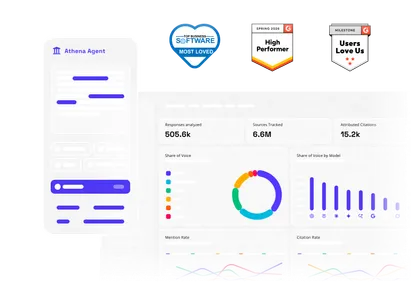
AthenaHQ tracks query performance and helps teams monitor how brands appear across a wide range of AI models, including ChatGPT, Perplexity, Gemini, Claude, Copilot, and Grok.
The platform combines visibility metrics, sentiment analysis, citation tracking, competitor benchmarking, and prompt level monitoring in one place, while integrations Google Analytics, Google Search Console, Shopify, and Webflow connect AI visibility observations with existing traffic, publishing, and conversion data. It also incorporates agentic workflows to convert insight into a prioritized list of actions, including specific recommendations to optimize pieces of content.
AthenaHQ offers a free plan for an unlimited number of users, which includes prompt and response analysis, sources and competitor insights, and content recommendations.
Troubleshoot Conflicting AI Search Results
Conflicting answers are bound to come up, but that doesn’t mean your tracking process is broken. Preserve them anyway, since differences can reveal changes in context, sources, or platform behavior that are worth understanding on their own.
Why the Same Prompt Can Produce Different Results
A brand may appear during one check and disappear in another due to changes in the platform, wording, model, interface, account state, personalization, location, language, device, even the check time . An identical prompt run twice can return a genuinely different generated answer, and that’s just par for the course when it comes to GEO. This is one of the limitations of manual AI visibility tracking. Generated responses can (and often do) change for reasons that have nothing to do with your content.
How to Make Your Baseline More Reliable
Generally speaking, it’s a good practice to investigate repeated differences for context or content gaps rather than writing them off as noise. Use this checklist to reconcile conflicting observations:
- Verify the exact prompt wording.
- Compare signed-in and signed-out account states.
- Check the country, language, device, and interface.
- Confirm whether each answer displayed citations.
- Separate the brand mention result from the citation result.
- Repeat the prompt at the next scheduled check.
- Annotate major changes instead of deleting an unexpected answer.
Compare cited pages and source types across both observations.
Turn Free AI Visibility Checks Into GEO Improvements
Real GEO improvements come from optimizing your content, PR, product marketing, and online authority, rather than tracking performance. The latter, however, provides critical evidence to inform your decisions. Here’s a simple process to implement your learnings:
- Find prompts where competitors appear or receive citations, while your brand is absent.
- Inspect the cited pages, domains, and source types in these AI-generated responses.
- Determine whether to focus on optimizing your content, technical, authority, or distribution.
- Publish or update the relevant asset.
- Recheck the unchanged prompt cohort on its regular cadence.
- Record the result without assuming that the update caused every change.
Prioritize Citation and Competitor Gaps
Start with high value prompts that influence discovery or evaluation directly. So for example, a category comparison page tied to a core product usually deserves attention before a blog post answering a broad informational question with limited relevance to your actual buyers.
Inspect what the cited competitor page actually contributes to the answer. It may provide a clearer definition, a direct comparison, original data, technical detail, or third party validation. Record the specific difference before determining next steps, since different gaps require their own fix.
How to use free AI search monitoring to boost your GEO rankings really begins with gap analysis. Free monitoring identifies where your brand or sources are absent, so your team can then decide whether the issue calls for a stronger page, clearer product information, better technical access, more earned media, or another authority signal entirely.
Make Changes That AI Systems Can Extract and Cite
Answer engines look for information they can easily crawl, extract, and contextualize. That means content that clearly identifies entities, relationships, products, audiences, and claims. When you’re writing, use concise factual statements that retain their meaning even when extracted from the surrounding page and dropped into a generated answer.
Best practices to follow:
- Define the brand, product, and topic in direct language.
- Organize all your content with hierarchical headings i.e. H2, H3, H4..
- Use semantic HTML that identifies headings, lists, tables, and page sections.
- Add relevant tables to make comparisons or specifications easier to interpret.
- Cite transparent primary or authoritative sources.
- Cover the topic fully enough to answer related questions your customers might have.
- Keep factual details consistent across important first-party pages.
- Add comprehensive schema markup that accurately represents the visible content.
These GEO tactics help LLMs interpret and extract your content more reliably. Note: While schema markup supports machine interpretation, it should describe the page accurately rather than introduce claims that users cannot actually see when they land on it.
Free methods to track your website’s visibility in AI powered search engines help uncover where to focus your effort. They do not improve visibility by themselves, and no content or technical change guarantees a citation, no matter how well it is executed.
Choose the Right Starting Point for Your Team
How to monitor AI search results for free to improve GEO performance really comes down to disciplined observation more than any particular tool. Start with manual tracking when you need a small, controlled baseline. Choose a fixed set of high value prompts, test them across the platforms your audience actually uses, and record every answer with its context and citation evidence intact.
Use free or freemium tools for quick audits, spot checks, and workflow validation along the way. Then move to paid tracking once wider prompt coverage, frequent refreshes, historical analysis, exports, reporting, and competitor intelligence become genuine operational requirements rather than nice-to-haves.
Frequently Asked Questions
What is AI search visibility tracking?
AI search visibility tracking is the practice of observing whether, where, and how a brand appears in AI generated answers, citations, and comparisons across platforms such as ChatGPT, Perplexity, Gemini, and Google AI Overviews. It captures signals that traditional keyword rank tracking does not, including mentions without links, citations without mentions, and sentiment.
Is free AI search visibility tracking accurate?
Free manual tracking is directional rather than statistically precise. AI answers can change based on the platform, exact prompt wording, account state, personalization, geography, language, device, and timing, so a free baseline shows patterns and trends rather than a fixed, guaranteed position.
What is the difference between a brand mention and a citation?
A brand mention means the AI answer names your brand in its generated text. A citation means the interface links to a page associated with your brand as a source. A brand can be mentioned without a citation, and a page can be cited without the brand being named, so both should be tracked as separate fields.
How often should I check my AI search visibility?
A weekly check on a small set of high priority branded, category, and comparison prompts, paired with a monthly review for patterns, competitors, and sentiment, is a practical starting cadence. This is a starting point rather than a fixed standard, and it should be adjusted to match how quickly a given category moves.
Can free tools replace a paid AI visibility platform?
Free and freemium tools are useful for one-time snapshots, small recurring checks, and initial audits, but they generally lack historical trends, scaled prompt coverage, and detailed competitor intelligence. A paid platform becomes worth considering once prompt volume, platform coverage, or reporting needs outgrow what a spreadsheet and a few free tools can support.
What is AthenaHQ?
AthenaHQ is an AI search visibility platform that tracks brand mentions, citations, sentiment, and competitor benchmarking across engines including ChatGPT, Perplexity, Gemini, Claude, Copilot, and Grok.
Why did my brand appear in an AI answer once but not the next time I checked?
The same prompt can return a different answer because the platform, exact wording, model, interface, account state, personalization, location, language, device, or check time changed between runs. This does not necessarily mean a stable rank was gained or lost, since AI generated answers do not work like fixed search rankings in the first place.
Become the Brand AI Trusts
See, Act, and Win on AI Search and Beyond
Keep Reading
Enterprise AEO 101: What You Need to Know to Boost AI Search Visibility in 2026
Learn how enterprise AEO and GEO can improve AI search visibility in 2026, from prompt measurement and citation-ready content to platform evaluation and attribution.
Enterprise GEO Prompts: Strategies for Scaling AI Search Visibility
Enterprise GEO provides a practical way for large teams to organize buyer questions, measure answers across engines, find citation gaps, invest in changes that carry real business value, and ultimately scale their AI search visibility.
How to Get Your Products Featured in AI Search Recommendations
Actually getting your products featured in AI search recommendations requires a repeatable process to sufficiently cover your grounds across product data, crawl access, third-party evidence, comparison content, and performance.
See AthenaHQ in Action
 AthenaHQ
 Cozy Earth
The Most-Cited Sleepwear Brand in AI Search
Cozy Earth used AthenaHQ to protect its lead in sleepwear, identify a loungewear opportunity, and give its two-person content team a clearer way to prioritize what to publish next.
AthenaHQ Rootly
10x Increase in Citation Rate
GEO became Rootly's #1 growth pillar. With ~10x citation rate growth and +126% mention rate on non-branded prompts, Rootly transformed AI Search into an executive-level operating channel.
AthenaHQ Lago
Lago50% Increase in Demos from AI Search
Lago achieved a 50% increase in demos from AI Search after implementing Athena. With 11x growth in AI Overview impressions and exploding citations, Athena became their command center for GEO.