How Do You Handle AI-Generated Misinformation, Hallucinations, or Inaccurate Brand Mentions?
The ugly truth: brands rarely control their own AI narrative. Here's what to do about it.

AthenaHQ
Action on AI Search
Key Takeaways
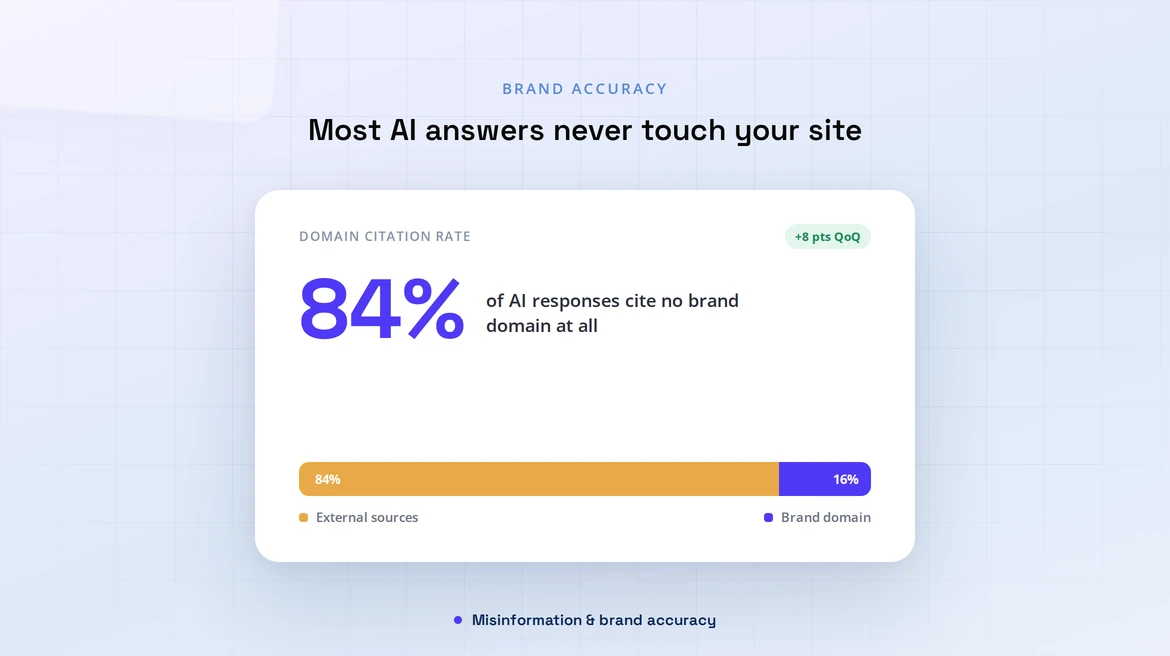
- Brands rarely control their own AI narrative: 84% of AI responses do not cite a brand's own domain at all, meaning most of what AI models say about a company comes from external sources like community platforms, review sites, and news coverage.
- AI models pull from a wide and varied range of sites per response, from 5.8 domains for Gemini up to 27 for Grok, which is why inconsistent or outdated brand descriptions surface more often in AI search than in traditional search.
- The fastest way to correct an inaccurate AI-generated description is not to dispute the AI's output directly, but to increase the volume, freshness, and citability of accurate brand information on external sites, paired with structured, schema-marked content.
- Domain citation rates climbed 8 points quarter over quarter, suggesting that brands actively publishing structured, up-to-date content are already closing the accuracy gap.
- Misinformation monitoring should be treated as an ongoing discipline rather than a one-time fire drill, since source rankings and model behavior are volatile enough that factual errors can persist in AI answers unnoticed without active, cross-model tracking.
Here’s the thing about AI search: answer engines can make mistakes, and it’s critical for marketers to keep on top of brand perception and product descriptions to ensure accuracy. How? By working with LLMs, not against them. So basically, knowing how they operate. We created the State of AI Search 2026 Report to help marketers do just that, specifically by sharing trends we’ve observed from millions of data points spanning 8+ LLMs, including ChatGPT, Claude, and Perplexity. However, we also wanted to go deeper and contextualize our findings, turning to extensive conversations with marketers grappling with a whole new acquisition channel that forms its own opinions on which brands or products to recommend.
Today, we’re exploring one of the most pressing questions around AI-generated misinformation.
Methodology
Between December 2025 and March 2026, we collected and analyzed millions of AI-generated responses across B2B and B2C. We also layered the product data with a supplementary analysis of over 500 conversations in Q2 (April-June 2026), including enterprise demos, strategy sessions, and onboarding calls. We identified the most common questions and unresolved priorities for marketing teams building out GEO programs. These companies include both enterprise and mid-market teams, with a median average revenue of $933 million and median average size of 755 employees.
Each question in this blog series is answered with benchmark metrics compiled from our product data, along with a series of recommended action items to improve your GEO efforts. You can view the full reporthere.
How Do You Handle AI-Generated Misinformation, Hallucinations, or Inaccurate Brand Mentions?
The starting point for any misinformation strategy is understanding how rarely brands actually control the narrative in the first place. Our data shows that 84% of AI responses do not cite a brand's own domain at all, meaning the majority of what AI models say about any given company is synthesized from external sources like community platforms, review sites, competitor comparison pages, and news coverage.
Combine that with the fact that AI models pull from a wide and varied range of sites per response (from 5.8 domains for Gemini up to 27 for Grok) and it becomes clear why inconsistent or outdated brand descriptions show up more often in AI search than traditional search, where your website could at least compete directly for the top organic position.
Because models are often citing external sources, the fastest way to correct an inaccurate or outdated description is not to dispute the AI's output directly, but increase the volume, freshness, and citability of accurate information about your brand on other sites. This typically involves partnerships to secure high-authority, off-page brand placements, combined with your own structured, schema-marked content to reinforce the correct narrative.
The data shows citation rates climbed 8 points quarter over quarter, which suggests that brands actively publishing structured, up-to-date content are already closing this gap.
It is also worth treating this as a monitoring discipline, not a one-time fire drill. Because source rankings and model behavior are volatile, a factual error or outdated claim about pricing, leadership, or product capabilities can persist in AI answers before a brand notices, unless it is actively tracked across models on an ongoing basis.
Action Items
- Run a standing audit of what AI models currently say about your brand, pricing, leadership, and core product claims across all seven major models, since inaccuracies often vary by model.
- When you find an inaccurate or outdated claim, prioritize publishing a clear, structured, schema-marked correction on your own domain and on the specific external source where the error originated, rather than attempting to contest the AI output directly.
- Keep pricing, leadership, product, and comparison pages current on a defined cadence. Stale on-page information is one of the most common root causes of outdated AI-generated claims.
- Treat your Domain Citation rate as an early-warning metric. A brand with a very low citation rate has effectively ceded the narrative to other sites, which raises the odds of inaccurate or incomplete descriptions surfacing in AI answers.
For more insights, check out the full State of AI Search 2026 report.
FAQs
How do you handle AI-generated misinformation, hallucinations, or inaccurate brand mentions?
The starting point is understanding that brands rarely control their own narrative in AI search, since 84% of AI responses don't cite a brand's own domain at all. Because of this, the most effective correction strategy is not disputing the AI's output directly, but increasing the volume, freshness, and citability of accurate information on external sites, combined with structured, schema-marked content on the brand's own domain, and treating this as an ongoing monitoring discipline rather than a one-time fix.
Why do AI models get brand information wrong more often than traditional search?
AI models synthesize answers from a wide and varied range of external sources per response, from 5.8 domains for Gemini up to 27 for Grok, rather than pulling primarily from a brand's own website. In traditional search, a brand's website can compete directly for the top organic position, but in AI search, most of what gets said about a company comes from community platforms, review sites, competitor comparisons, and news coverage instead.
Why doesn't disputing an AI's incorrect output work as a correction strategy?
Since AI models are usually synthesizing external sources rather than a brand's own domain, disputing the model's output directly doesn't address the root cause. Correction is far more effective when brands increase the volume, freshness, and citability of accurate information across the specific external sources the model is drawing from, alongside structured content on their own site.
How should marketers correct an inaccurate or outdated AI-generated claim?
When an inaccurate or outdated claim is found, the priority is publishing a clear, structured, schema-marked correction both on the brand's own domain and on the specific external source where the error originated, rather than attempting to contest the AI's output directly.
What is Domain Citation rate and why does it matter?
Domain Citation rate measures how often AI responses actually cite a brand's own domain versus relying on external sources. It functions as an early-warning metric: a brand with a very low citation rate has effectively ceded its narrative to other sites, which raises the odds of inaccurate or incomplete descriptions surfacing in AI-generated answers.
Is AI-generated misinformation about brands improving or getting worse?
The data shows some improvement, with domain citation rates climbing 8 points quarter over quarter. This suggests that brands actively publishing structured, up-to-date content are already making progress in closing the accuracy gap, though the underlying volatility of AI model behavior means ongoing monitoring is still necessary.
How often should brands audit what AI models say about them?
Brands should run a standing audit, not a one-time check, of what AI models say about their pricing, leadership, and core product claims across all seven major models, since inaccuracies often vary by model. Pricing, leadership, product, and comparison pages should also be kept current on a defined cadence, since stale on-page information is one of the most common root causes of outdated AI-generated claims.
Become the Brand AI Trusts
See, Act, and Win on AI Search and Beyond
Keep Reading
Enterprise GEO Prompts: Strategies for Scaling AI Search Visibility
Enterprise GEO provides a practical way for large teams to organize buyer questions, measure answers across engines, find citation gaps, invest in changes that carry real business value, and ultimately scale their AI search visibility.
How to Get Your Products Featured in AI Search Recommendations
Actually getting your products featured in AI search recommendations requires a repeatable process to sufficiently cover your grounds across product data, crawl access, third-party evidence, comparison content, and performance.
Free AI Search Visibility Tracking: Methods & Tools for 2026
See AthenaHQ in Action
 AthenaHQ
 Cozy Earth
The Most-Cited Sleepwear Brand in AI Search
Cozy Earth used AthenaHQ to protect its lead in sleepwear, identify a loungewear opportunity, and give its two-person content team a clearer way to prioritize what to publish next.
AthenaHQ Rootly
10x Increase in Citation Rate
GEO became Rootly's #1 growth pillar. With ~10x citation rate growth and +126% mention rate on non-branded prompts, Rootly transformed AI Search into an executive-level operating channel.
AthenaHQ Lago
Lago50% Increase in Demos from AI Search
Lago achieved a 50% increase in demos from AI Search after implementing Athena. With 11x growth in AI Overview impressions and exploding citations, Athena became their command center for GEO.