How Do You Handle AI Search Competitor Analysis and Benchmarking?
AI models have already formed opinions about leaders in different categories.

AthenaHQ
Action on AI Search
Key takeaways
- AI models have already formed fixed opinions about category leaders, and these opinions persist once established, making AI search competitive dynamics fundamentally different from traditional SEO.
- In the Software sector, Microsoft holds a 98.8% brand mention rate across AI models, with Google Workspace second at 54.9%.
- Within the narrower SaaS subsegment, the ranking shifts: Salesforce leads with a 55.7% brand mention rate, edging out Microsoft at 53%.
- Brand mention rate data is compiled across seven AI models, including ChatGPT, Gemini, Perplexity, Claude, Grok, Copilot, and AI Overview.
- Recommended actions include benchmarking mention rate and Share of Voice against real competitors, re-checking the competitive landscape quarterly, and prioritizing specific content gaps over broad overhauls.
AI search means a whole new set of rules, and we created the State of AI Search 2026 Report to share our latest findings to help marketers make sense of them. These insights are informed by millions of datapoints across 8+ LLMs, including ChatGPT, Claude, and Perplexity. However, we also wanted to go deeper. We spend a lot of time in the weeds with teams across industries and verticals, and decided to address some of the most pressing questions that have come up over hundreds of conversations in the past quarter alone. In our most recent post, we answered: How do you improve AI visibility and get cited more frequently? Today, we’re tackling another topic: AI search analysis and benchmarking. Let’s jump right in!
Methodology
Between December 2025 and March 2026, we collected and analyzed millions of AI-generated responses across B2B and B2C. To further corroborate findings, we dug into 13 industry verticals and 32 competitive subsegments, spanning Technology, Consumer & Retail, Services, and Specialized sectors. The findings in this particular edition are focused on overall trends.
We also layered the product data with a supplementary analysis of over 500 conversations in Q2 (April-June 2026), including enterprise demos, strategy sessions, and onboarding calls. We identified seven of the most common questions and unresolved priorities for marketing teams building out GEO programs. These companies include both enterprise and mid-market teams, with a median average revenue of $933 million and median average size of 755 employees.
Each question is answered with benchmark metrics compiled from our product data, along with a series of recommended action items to improve your GEO efforts. You can also view the full report here.
One of the top questions:
How Do You Handle AI Search Competitor Analysis and Benchmarking?
The data found AI models have already formed opinions about leaders in different categories, although gaps in brand mention rate vary significantly by sub-sector. In Software, for instance, Microsoft boasts a 98.8% brand mention rate, with Google Workspace coming in second at 54.9%. However, when we slice the data further into the SaaS segment, Microsoft actually falls slightly behind Salesforce (55.7%), with a brand mention rate of 53%.

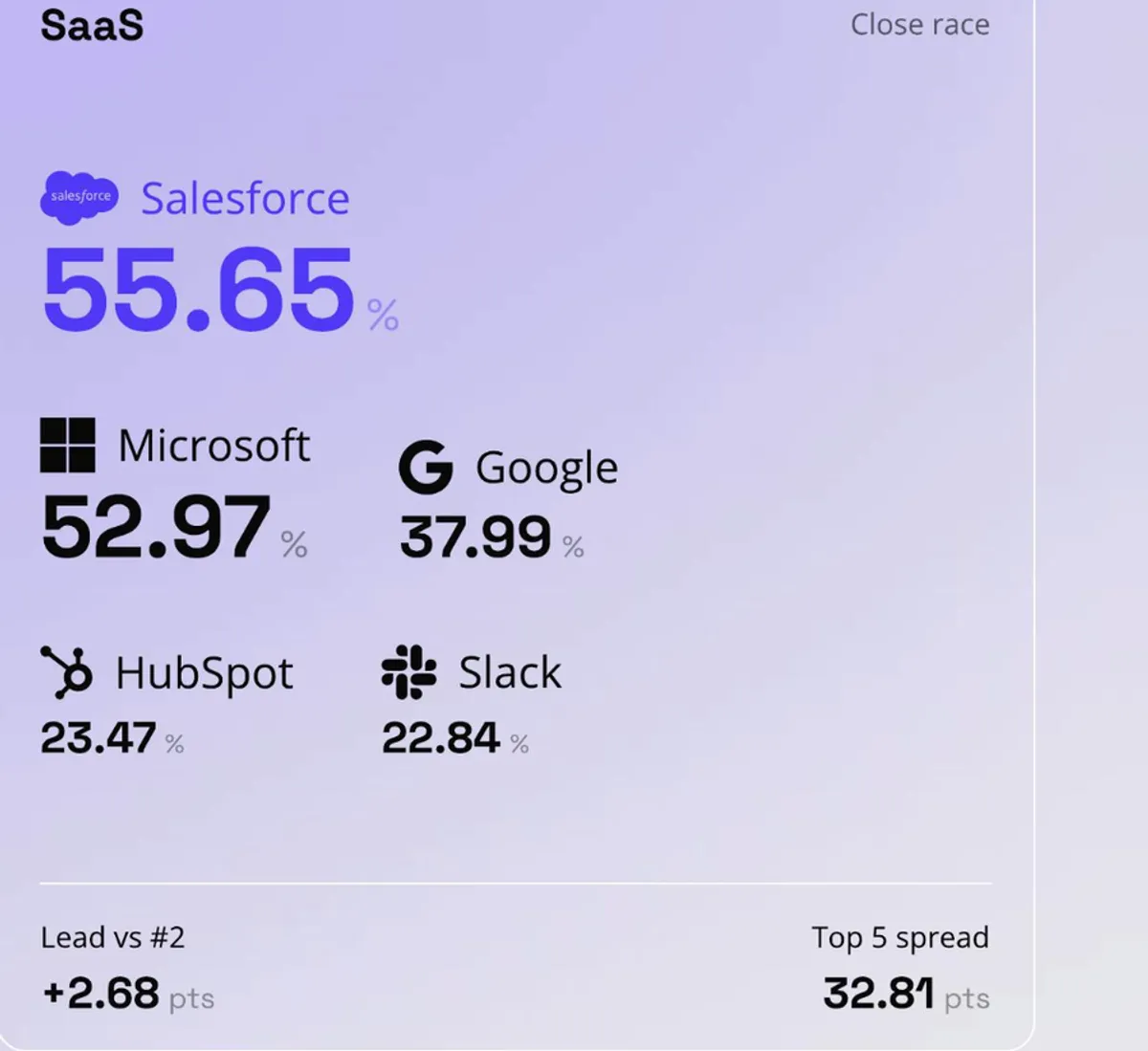
Top Brands Study, Technology sector: SaaS subsegment, Q2 2026. Brand mention rate by AI models across ChatGPT, Gemini, Perplexity, Claude, Grok, Copilot, and AI Overview.
This reveals competitive dynamics in AI search are a completely different beast to traditional SEO. Although earning a mention or citation typically takes less time than ascending to the top of the Search Engine Results Pages (SERPs), LLMs appear to develop fixed opinions about category leaders that persist once formed. On the plus side, teams demonstrating authority to answer engines now are likely influencing future citation preferences that will be difficult for competitors to dislodge.
Action Items
- Benchmark your mention rate and Share of Voice against actual brands appearing in AI responses across your category.
- Re-check competitors every quarter. New entrants can appear in AI answers faster than they climb traditional search rankings.
- Rather than tackling a broad content overhaul, prioritize specific gaps separating your brand from category leaders. This could be as simple as adding an authoritative comparison page, resolving a missing FAQ, or securing external validation like a mention on a high-authority site.
For more insights, check out the full State of AI Search 2026 report.
FAQs
What is AI search competitor analysis and benchmarking?
AI search competitor analysis and benchmarking is the process of measuring how frequently and favorably AI models such as ChatGPT, Gemini, Perplexity, Claude, Grok, Copilot, and AI Overview mention a brand compared to its competitors within a given category or subsector.
How is competitor benchmarking in AI search different from traditional SEO?
In traditional SEO, rankings shift continuously and earning a top position on the Search Engine Results Pages (SERPs) takes sustained effort over time. In AI search, LLMs tend to form fixed opinions about category leaders once those opinions are established, and those opinions persist rather than fluctuating. Earning a mention or citation from an AI model often happens faster than climbing traditional search rankings, but the resulting position is also harder to dislodge once competitors have secured it.
Why do brand mention rates vary so much by subsector?
Mention rates reflect how AI models perceive category leadership within increasingly specific segments, not just broad industries. For example, in the overall Software sector, Microsoft has a 98.8% brand mention rate, well ahead of Google Workspace at 54.9%. But within the narrower SaaS subsegment specifically, Salesforce actually leads with a 55.7% mention rate, ahead of Microsoft at 53%. This shows that category leadership in AI search must be benchmarked at the subsegment level, not just the industry level.
How often should teams re-check their competitive position in AI search?
Teams should re-check competitors on a quarterly basis. New entrants can appear in AI-generated answers and gain mention share considerably faster than they would climb traditional search rankings, so quarterly monitoring helps catch emerging competitors before they become entrenched.
What should a brand do if it's losing mention share to a category leader?
Rather than pursuing a broad content overhaul, brands should prioritize the specific gaps separating them from category leaders. Common fixes include adding an authoritative comparison page, resolving a missing FAQ that AI models are drawing on, or securing external validation such as a mention on a high-authority third-party site.
What data informs these AI search competitor benchmarks?
The findings draw on millions of AI-generated responses collected between December 2025 and March 2026, spanning 13 industry verticals and 32 competitive subsegments across Technology, Consumer & Retail, Services, and Specialized sectors. This was supplemented by an analysis of over 500 enterprise and mid-market conversations in Q2 2026, from companies with a median revenue of $933 million and a median size of 755 employees.
Why does early authority-building matter more in AI search than in SEO?
Because AI models form durable opinions about category leaders, brands that establish authority and earn citations now are more likely to shape which brands the models continue to favor going forward. This creates a compounding advantage: teams that act early make it progressively harder for competitors to displace them in future AI-generated answers.
Become the Brand AI Trusts
See, Act, and Win on AI Search and Beyond
Keep Reading
Enterprise GEO Prompts: Strategies for Scaling AI Search Visibility
Enterprise GEO provides a practical way for large teams to organize buyer questions, measure answers across engines, find citation gaps, invest in changes that carry real business value, and ultimately scale their AI search visibility.
How to Get Your Products Featured in AI Search Recommendations
Actually getting your products featured in AI search recommendations requires a repeatable process to sufficiently cover your grounds across product data, crawl access, third-party evidence, comparison content, and performance.
Free AI Search Visibility Tracking: Methods & Tools for 2026
See AthenaHQ in Action
 AthenaHQ
 Cozy Earth
The Most-Cited Sleepwear Brand in AI Search
Cozy Earth used AthenaHQ to protect its lead in sleepwear, identify a loungewear opportunity, and give its two-person content team a clearer way to prioritize what to publish next.
AthenaHQ Rootly
10x Increase in Citation Rate
GEO became Rootly's #1 growth pillar. With ~10x citation rate growth and +126% mention rate on non-branded prompts, Rootly transformed AI Search into an executive-level operating channel.
AthenaHQ Lago
Lago50% Increase in Demos from AI Search
Lago achieved a 50% increase in demos from AI Search after implementing Athena. With 11x growth in AI Overview impressions and exploding citations, Athena became their command center for GEO.