How Do You Improve AI Visibility and Get Cited More Frequently?
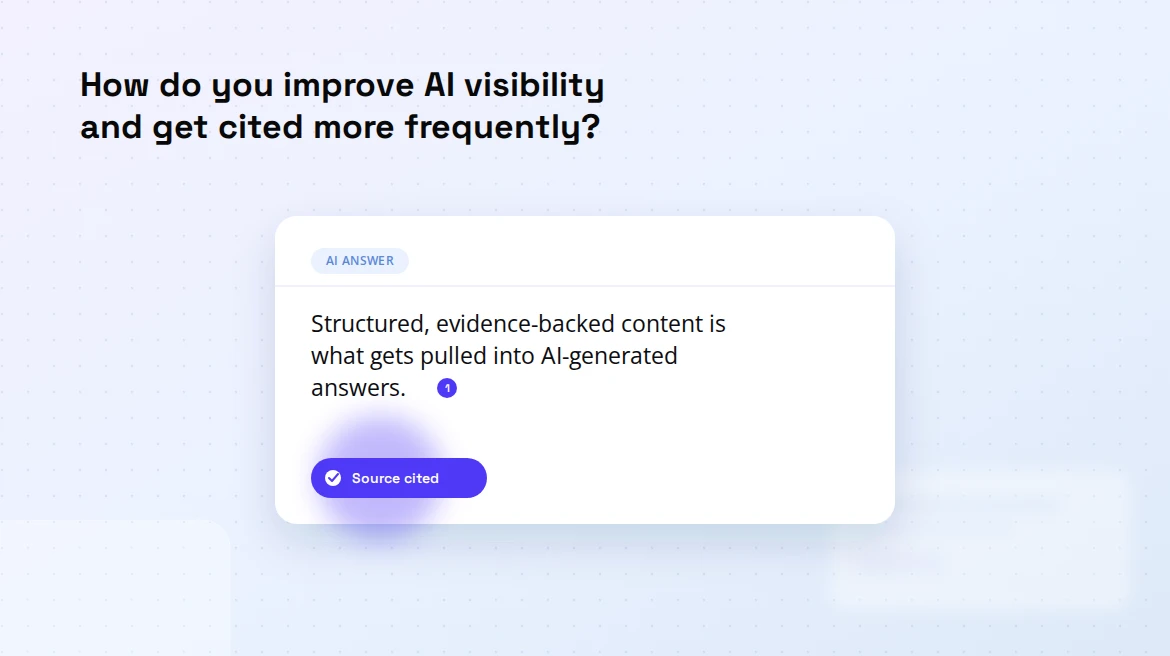
LLMs handle citations differently, with each model drawing on a different number of sources per response.

AthenaHQ
Action on AI Search
Key Takeaways
- Average brand mention rate across AI-generated answers is 16.3%, while top-performing brands reach 56.5%, roughly 3.5X the average.
- 84% of organizations receive zero citations (direct domain links) in AI-generated answers, leaving significant room for brands with structured, extractable content to stand out.
- The number of sources cited per response varies widely by model: Grok cites an average of 27 distinct domains, AI Mode 18, Perplexity 11, AI Overview 8, ChatGPT 8, Gemini 6, and Copilot 5.
- Over half of cited content is informational (36.2%) or comparative (23.2%), showing that answer engines favor pages that clarify concepts, answer broad questions, or help users compare options.
- Improving AI visibility requires auditing content for missing structured answer pages, applying LLM-friendly formatting such as clean headings, defined terms, and schema markup in open crawlable locations, and tracking citation rate by individual AI model rather than a single blended average.
Plummeting organic traffic. Customers flocking to answer engines. Playbooks to replace your entire job function overnight. Half your network squabbling over whether SEO is actually dead. AI content slop gumming up your feed. AI CMO’s. Token rationing. Weekly variations of the “Claude from Finance” meme. Pressure to prove ROI on absolutely everything, when the buyer’s journey seems to change every other day. Your AI detection abilities “quietly” bordering on supernatural. Death of the em dash. Prompt hacks. Vibe marketing. More systems. More playbooks. More acronyms to adopt and engines to optimize for.
And, to top it all off, a whole new channel that functions more like an free-thinking ecosystem: one that doesn’t obligingly surface blog posts and product descriptions like days of yore, but curates information across multiple sources, forms opinions, makes recommendations, and sometimes gets it wrong. It’s a dizzying era for marketers, to say the least, but there’s a lot of opportunity too, with early movers building trust with LLMs that will compound over time.
Athena is a GEO platform specifically designed to help teams improve their AI search visibility. We created the State of AI Search 2026 Report to share our latest findings on answer engines so marketers can take advantage of their preferences, patterns, and behavior. These insights are informed by millions of datapoints across 8+ LLMs, including ChatGPT, Claude, and Perplexity. However, we also wanted to go deeper. We spend a lot of time in the weeds with marketing teams across industries and verticals, all similarly working to transform AI search from a growth experiment into a bona fide acquisition channel that delivers consistent results.
To that aim, we’ve consolidated the most pressing questions we heard over hundreds of conversations in Q2 alone, so you can adjust the sails in Q3 and beyond. Our goal isn’t to pile more data on your plate, but provide clarity and concrete steps, so you can not only make better sense of AI search, but actually drive (and prove) real outcomes that leadership cares about: pipeline and revenue.
Let’s get into it!
Methodology
Between December 2025 and March 2026, we collected and analyzed millions of AI-generated responses across B2B and B2C.
We also layered the product data with a supplementary analysis of over 500 conversations in Q2 (April-June 2026), including enterprise demos, strategy sessions, and onboarding calls. We identified seven of the most common questions and unresolved priorities for marketing teams building out GEO programs. These companies include both enterprise and mid-market teams, with a median average revenue of $933 million and median average size of 755 employees.
Each question is answered using benchmark metrics compiled from our product data, along with a series of recommended action items to improve your GEO efforts. You can also view the full report here.
One of the top questions:
How do you improve AI visibility and citation frequency?
The data reveals an average brand mention rate across all segments of 16.3%, while top-performing brands reach 56.5% of AI-generated answers, roughly 3.5X more than average.

Average Citations: the percentage of responses in which a brand's own domain is cited as a source, all segments, Q2 2026.
There is also a significant gap when it comes to citations, or responses where LLMs directly link to a brand’s domain. The majority of organizations (84%) are not cited at all, which means teams investing in structured and extractable content have an opportunity to separate from the herd while the field’s still uneven.
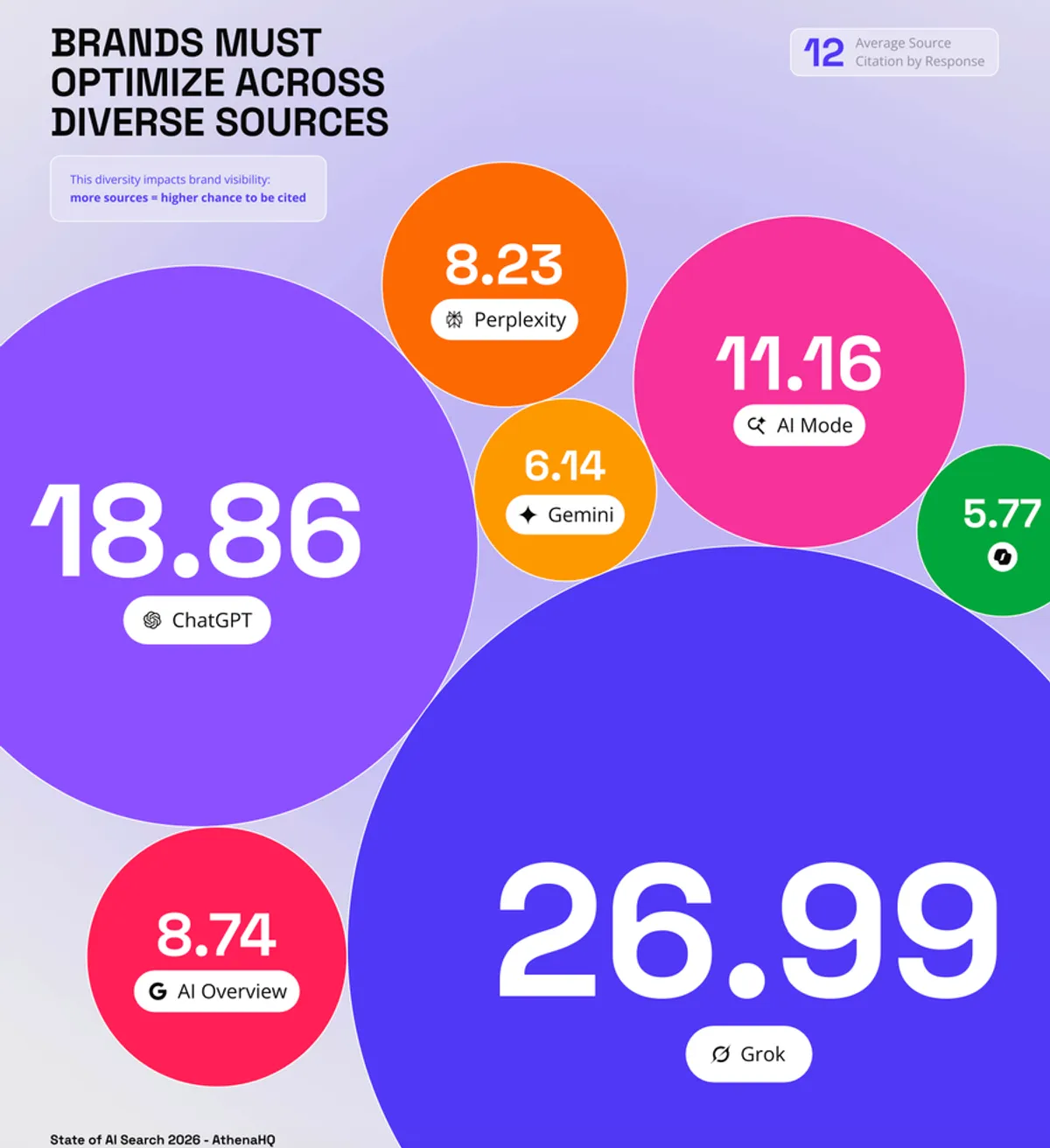
Part of the challenge, however, is that LLMs handle citations differently, with each model drawing on a different number of sources per response: Grok cites an average of 27 distinct domains, AI Mode 18, Perplexity 11, AI Overview 8, ChatGPT 8, Gemini 6, and Copilot 5.
So how do these LLMs actually decide which sources and brands to cite? Over half the content cited was informational (36.2%) or comparative (23.2%). While each model weights these categories differently, the overall trend is consistent: answer engines rely heavily on pages that clarify concepts, answer broad questions, or help users compare their options.
Action Items
- Audit your current content library. Flag gaps where you have no standalone page with clear definitions and structured answers to the most relevant questions in your category.
- Integrate best practices for LLM optimization into your content publishing process: clean headings, defined terms, and scheme markup for models to parse in an open, crawlable location (i.e. not gated)
- Track citation rate by AI model, not just as a blended average. Your brand may be performing well in ChatGPT but invisible in Gemini and Copilot. This consideration is especially important if you’re marketing to B2B buying committees, where multiple stakeholders could be turning to different answer engines.
For more insights, check out the full State of AI Search 2026 report.
FAQ
What is the average brand mention rate in AI-generated answers?
Across all segments, brands are mentioned in an average of 16.3 percent of AI-generated answers. Top-performing brands appear in as much as 56.5 percent of responses, about 3.5 times the average.
How many brands actually get a direct citation from AI models?
The majority, 84 percent, receive no citations at all. Only a minority of brands earn a direct link to their domain in AI-generated answers, which creates a meaningful opportunity for brands with structured, extractable content to differentiate while the field is still uneven.
Do all AI models cite sources the same way?
No. Each model draws on a different number of domains per response. Grok cites an average of 27 distinct domains, AI Mode 18, Perplexity 11, AI Overview 8, ChatGPT 8, Gemini 6, and Copilot 5.
What type of content do answer engines cite most often?
Over half of cited content is either informational (36.2 percent) or comparative (23.2 percent). Answer engines favor pages that clarify concepts, answer broad questions, or help users compare options, though the exact weighting varies by model.
What can marketing teams do to improve AI visibility?
Three action items stand out. Audit your content library for gaps where there is no standalone page with clear definitions and structured answers to your category's most relevant questions. Integrate LLM optimization best practices such as clean headings, defined terms, and schema markup into an open, crawlable location rather than a gated one. Track citation rate by individual AI model rather than a blended average, since performance can vary significantly across models.
Why does model-level tracking matter for B2B marketers specifically?
B2B buying committees often include multiple stakeholders who may rely on different answer engines during the same purchase decision. A brand performing well in ChatGPT could be invisible in Gemini or Copilot, so a blended citation average can mask gaps that affect deals already in progress.
Become the Brand AI Trusts
See, Act, and Win on AI Search and Beyond
Keep Reading
Enterprise GEO Prompts: Strategies for Scaling AI Search Visibility
Enterprise GEO provides a practical way for large teams to organize buyer questions, measure answers across engines, find citation gaps, invest in changes that carry real business value, and ultimately scale their AI search visibility.
How to Get Your Products Featured in AI Search Recommendations
Actually getting your products featured in AI search recommendations requires a repeatable process to sufficiently cover your grounds across product data, crawl access, third-party evidence, comparison content, and performance.
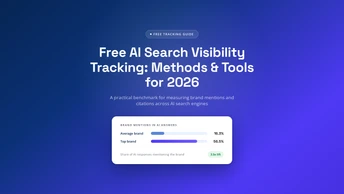
Free AI Search Visibility Tracking: Methods & Tools for 2026
See AthenaHQ in Action
 AthenaHQ
 Cozy Earth
The Most-Cited Sleepwear Brand in AI Search
Cozy Earth used AthenaHQ to protect its lead in sleepwear, identify a loungewear opportunity, and give its two-person content team a clearer way to prioritize what to publish next.
AthenaHQ Rootly
10x Increase in Citation Rate
GEO became Rootly's #1 growth pillar. With ~10x citation rate growth and +126% mention rate on non-branded prompts, Rootly transformed AI Search into an executive-level operating channel.
AthenaHQ Lago
Lago50% Increase in Demos from AI Search
Lago achieved a 50% increase in demos from AI Search after implementing Athena. With 11x growth in AI Overview impressions and exploding citations, Athena became their command center for GEO.