How Do You Scale GEO Across Multiple Brands, Regions, Languages, or Markets?
AI engines behave differently by vertical in content preference, trusted off-page sources, and brand domain interactions. A single GEO playbook will often be insufficient for multiple brands, regions, or business units.

AthenaHQ
Action on AI Search
Key Takeaways
- AI engines behave differently by vertical in content preference, trusted off-page sources, and brand domain interaction, meaning a single GEO playbook fails teams managing multiple brands, regions, or business units.
- Content-intent distribution varies sharply by industry: Healthcare & Life Sciences citations are 45.3% Informational, while Marketing & Advertising citations split more evenly across Informational (26.2%), Comparative (25.9%), and Acquisition (22.9%).
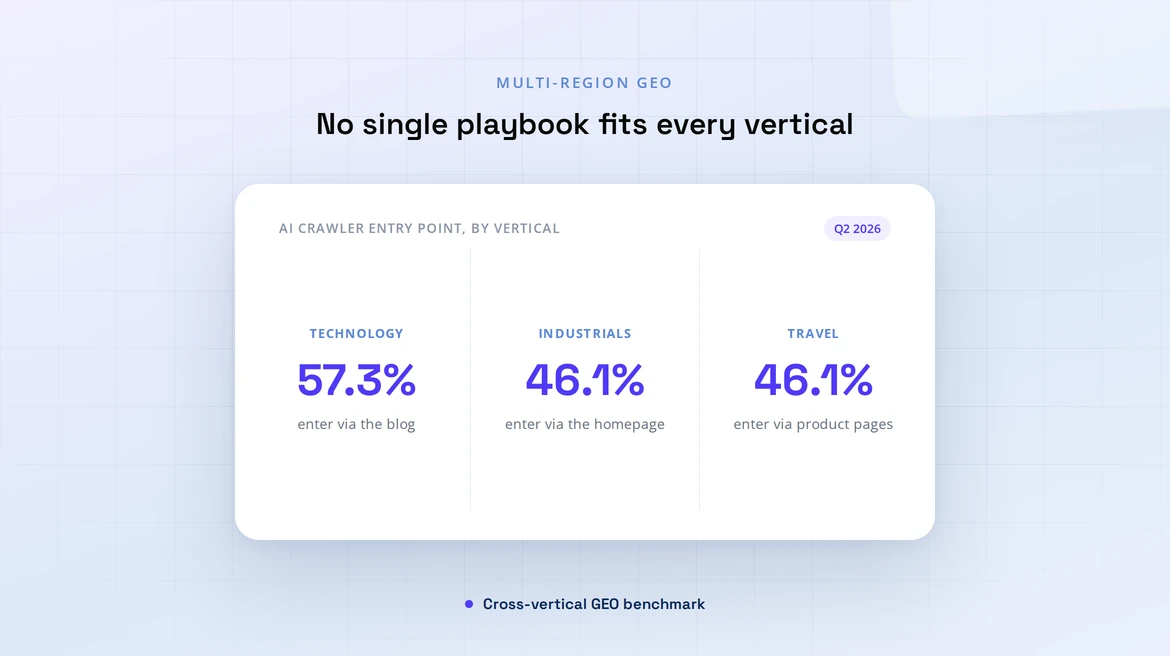
- On-page entry patterns also diverge by vertical: AI crawlers enter through the blog for 57.3% of Technology & Software content, but through the homepage for 46.1% of Industrials & Energy content and product pages for 46.1% of Travel & Hospitality content.
- The most scalable approach is a hub-and-spoke model: one shared measurement framework and reporting cadence using six standardized GEO KPIs, combined with locally tailored content-intent weighting, source prioritization, and on-page architecture per market.
- GEO programs should segment by brand, region, and language from the outset, since a blended average across a multi-brand portfolio can mask important vertical-specific patterns that need to be acted on individually.
We created the State of AI Search 2026 Report to help marketers scale GEO across multiple brands, regions, languages, markets, and product portfolios. It includes trends and observations from millions of data points spanning 8+ LLMs, including ChatGPT, Claude, and Perplexity. However, we also wanted to go deeper and contextualize our findings, turning to extensive conversations with marketers grappling with a whole new acquisition channel that forms its own opinions on which brands or products to recommend. Today, we’re digging into one of the biggest questions around multi-region and multi-brand GEO.
Methodology
Between December 2025 and March 2026, we collected and analyzed millions of AI-generated responses across B2B and B2C. We also layered the product data with a supplementary analysis of over 500 conversations in Q2 (April-June 2026), including enterprise demos, strategy sessions, and onboarding calls. We identified the most common questions and unresolved priorities for marketing teams building out GEO programs. These companies include both enterprise and mid-market teams, with a median average revenue of $933 million and median average size of 755 employees.
Each question in this blog series is answered with benchmark metrics compiled from our product data, along with a series of recommended action items to improve your GEO efforts. You can view the full reporthere.
How Do You Scale GEO Across Multiple Brands, Regions, Languages, or Markets?
The data shows that AI engines behave differently depending on the vertical, from their preferred type of content, most trusted off-page sources, even how they interact with brand domains. Healthcare & Life Sciences citations are 45.3% Informational, while Marketing & Advertising citations are more evenly split across Informational (26.2%), Comparative (25.9%), and Acquisition (22.9%). On-page entry patterns diverge sharply too. AI crawlers enter through the blog blog for 57.3% of Technology & Software content but through the homepage for 46.1% of Industrials & Energy content and product pages for 46.1% of Travel & Hospitality content.
This shows that a single playbook approach will fail teams managing GEO across multiple brands, regions, or business units.
The most scalable approach we see working is a hub-and-spoke model: a shared measurement framework and reporting cadence (the six GEO KPIs outlined previously) applied consistently across every market, combined with locally tailored content-intent weighting, source prioritization, and on-page architecture.
The data also provides a strong case for building your GEO program to segment by brand, region, and language from the get-go, since a blended average across a multi-brand portfolio could mask important vertical-specific patterns you’ll want to act on.
Action Items
- Establish one shared GEO measurement framework with standardized KPIs (Share of Voice, Average Brand Mentions, Daily Citations, Mentions Per Prompt, AI-Sourced Leads, ROI Per Prompt) across every brand, region, or market.
- Pull vertical-specific and region-specific content-intent and off-page source data for each brand or market.
- Prioritize brands or markets furthest below their category's #1-rank Share of Voice benchmark, since the gap-to-leader varies significantly by vertical.
- Build a recurring cross-brand review to catch diverging patterns early, since source rankings and model behavior shift over time.
For more insights, check out the full State of AI Search 2026 report.
FAQs
How do you scale GEO across multiple brands, regions, languages, or markets?
The most scalable approach is a hub-and-spoke model: establish one shared measurement framework with standardized KPIs (Share of Voice, Average Brand Mentions, Daily Citations, Mentions Per Prompt, AI-Sourced Leads, ROI Per Prompt) applied consistently across every brand or market, while allowing content-intent weighting, source prioritization, and on-page architecture to be tailored locally based on vertical-specific behavior.
Why doesn't a single GEO playbook work across multiple brands or verticals?
AI engines behave differently depending on the vertical, including which type of content they prefer to cite, which off-page sources they trust most, and how they interact with brand domains. Applying one uniform strategy across all verticals ignores these differences and leaves brands under-optimized in categories where the model's behavior diverges from the average.
How does content-intent distribution differ across verticals?
It varies substantially. In Healthcare & Life Sciences, 45.3% of citations are Informational, showing a strong skew toward one intent category. In Marketing & Advertising, citations are split much more evenly across Informational (26.2%), Comparative (25.9%), and Acquisition (22.9%), meaning a content strategy built for one vertical would be poorly calibrated for the other.
Do AI crawlers enter brand websites the same way across industries?
No. Entry patterns diverge sharply by vertical: AI crawlers enter through the blog for 57.3% of Technology & Software content, through the homepage for 46.1% of Industrials & Energy content, and through product pages for 46.1% of Travel & Hospitality content. This means on-page architecture priorities should be set per vertical rather than applied uniformly.
What is the hub-and-spoke model for multi-region or multi-brand GEO?
It's a structure where the "hub" is one shared, standardized measurement framework and reporting cadence used across every brand, region, or market, while the "spokes" are locally tailored elements, specifically content-intent weighting, off-page source prioritization, and on-page architecture, adjusted to match how AI models actually behave within each specific vertical or region.
Why should GEO programs segment reporting by brand, region, and language from the start?
A blended average across a multi-brand portfolio can mask important vertical-specific patterns, such as which content-intent category or off-page source matters most in a given market. Building segmentation into the reporting structure from the outset makes those patterns visible instead of hiding them inside an aggregate number.
How should teams prioritize which brands or markets to focus on first?
Teams should prioritize brands or markets that are furthest below their category's #1-rank Share of Voice benchmark, since the size of that gap-to-leader varies significantly by vertical. This makes the gap itself, rather than raw visibility numbers, the more useful prioritization signal.
How often should cross-brand or cross-region GEO performance be reviewed?
On a recurring basis, not as a one-time setup. Because source rankings and AI model behavior shift over time, a standing cross-brand review is needed to catch diverging patterns early, before they show up as a broader visibility problem in a specific market or brand.
Become the Brand AI Trusts
See, Act, and Win on AI Search and Beyond
Keep Reading
Enterprise GEO Prompts: Strategies for Scaling AI Search Visibility
Enterprise GEO provides a practical way for large teams to organize buyer questions, measure answers across engines, find citation gaps, invest in changes that carry real business value, and ultimately scale their AI search visibility.
How to Get Your Products Featured in AI Search Recommendations
Actually getting your products featured in AI search recommendations requires a repeatable process to sufficiently cover your grounds across product data, crawl access, third-party evidence, comparison content, and performance.
Free AI Search Visibility Tracking: Methods & Tools for 2026
See AthenaHQ in Action
 AthenaHQ
 Cozy Earth
The Most-Cited Sleepwear Brand in AI Search
Cozy Earth used AthenaHQ to protect its lead in sleepwear, identify a loungewear opportunity, and give its two-person content team a clearer way to prioritize what to publish next.
AthenaHQ Rootly
10x Increase in Citation Rate
GEO became Rootly's #1 growth pillar. With ~10x citation rate growth and +126% mention rate on non-branded prompts, Rootly transformed AI Search into an executive-level operating channel.
AthenaHQ Lago
Lago50% Increase in Demos from AI Search
Lago achieved a 50% increase in demos from AI Search after implementing Athena. With 11x growth in AI Overview impressions and exploding citations, Athena became their command center for GEO.