How Do You Use Prompts and Queries to Effectively Monitor AI Search Performance?
Effective AI search monitoring requires a discovery-prompt methodology that simulates real consumer questions, rather than old school keyword lists.

AthenaHQ
Action on AI Search
Key Takeaways
- Effective AI search monitoring requires a discovery-prompt methodology that simulates real consumer questions, rather than relying on branded and unbranded keyword lists carried over from traditional SEO.
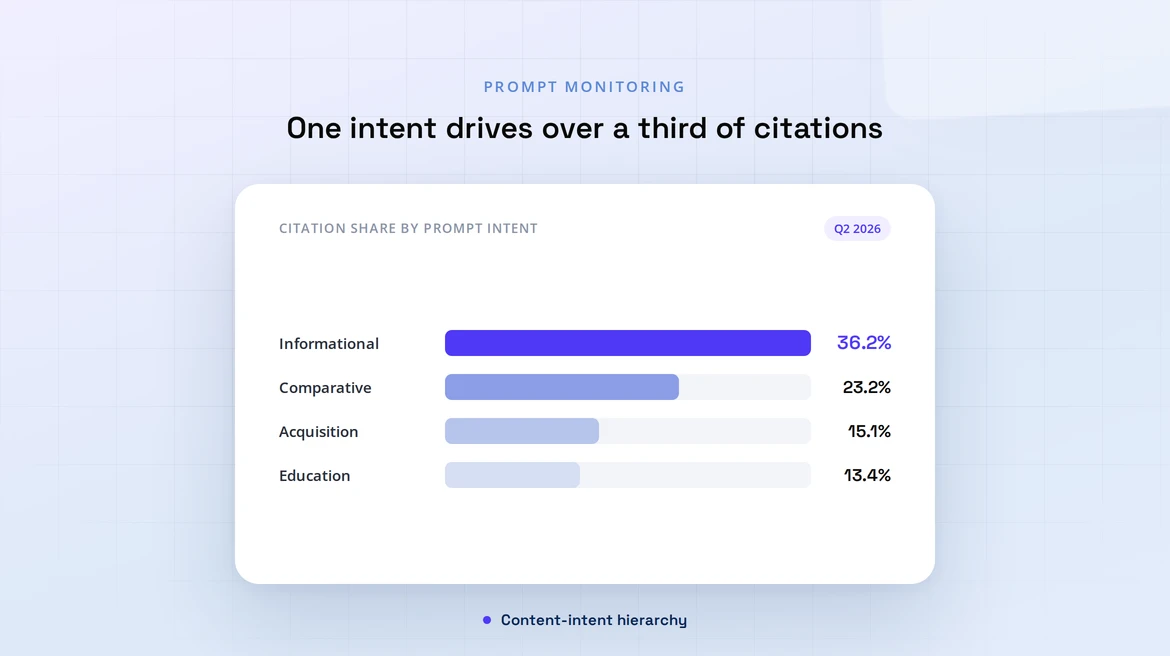
- Citations follow a clear content-intent hierarchy: Informational prompts drive 36.2% of citations, Comparative prompts drive 23.2%, Acquisition prompts drive 15.1%, and Education prompts drive 13.4%, with all remaining categories each accounting for less than 4%.
- Intent distribution shifts meaningfully by AI model: Learning and Education content represents 19.4% of citations in Gemini versus only 9% in Grok, while Comparative content is more prominent in AI Overview (24.2%) than in AI Mode (20.4%).
- Quarter-over-quarter shifts matter as much as the snapshot: between Q1 and Q2 2026, Comparative content share fell 1.9 points and Acquisition content fell 2.2 points, while Informational content gained 3.8 points, suggesting AI models are leaning further toward definitional and explanatory answers.
- Monitored prompt sets should mirror the real intent distribution (roughly a third informational, a quarter comparative, the remainder split across other categories), be run across every AI model buyers actually use, and be tracked for quarter-over-quarter delta to catch shifts before they show up as a visibility drop.
Increasing AI visibility requires a whole new approach from the traditional SEO playbooks. That’s why we created the State of AI Search 2026 Report: to share trends we’ve observed from millions of data points spanning 8+ LLMs, including ChatGPT, Claude, and Perplexity. However, we also wanted to go deeper and contextualize our findings, turning to extensive conversations with marketers grappling with a whole new acquisition channel that forms its own opinions on which brands or products to recommend. Today, we’re exploring one of the most pressing questions around performance monitoring using prompts and queries.
Methodology
Between December 2025 and March 2026, we collected and analyzed millions of AI-generated responses across B2B and B2C. We also layered the product data with a supplementary analysis of over 500 conversations in Q2 (April-June 2026), including enterprise demos, strategy sessions, and onboarding calls. We identified the most common questions and unresolved priorities for marketing teams building out GEO programs. These companies include both enterprise and mid-market teams, with a median average revenue of $933 million and median average size of 755 employees.
Each question in this blog series is answered with benchmark metrics compiled from our product data, along with a series of recommended action items to improve your GEO efforts.
You can view the full reporthere.
How Do You Use Prompts and Queries to Effectively Monitor AI Search Performance?
Athena’s discovery-prompt methodology simulates the real questions consumers actually ask AI engines, rather than relying on keyword lists carried over from traditional SEO.
Applied at scale, this approach surfaces a clear content-intent hierarchy: Informational prompts drive 36.2% of citations, Comparative or Selection prompts drive 23.2%, Acquisition or Obtaining prompts drive 15.1%, and Learning or Education prompts drive 13.4%. The remaining content categories, Navigation, Consumption, Updates, Investigation, and Optimization, each account for less than 4% .
Distribution also shifts significantly by AI model: Learning and Education content over-indexes in Gemini (representing 19.4% of its citations) relative to Grok (9%), while Comparative content is far more prominent in AI Overview (24.2%) than in AI Mode (20.4%).
This means your prompt set needs to mirror the same distribution, weighted toward informational and comparative framing, rather than a list of branded and unbranded keywords.
The quarter-over-quarter deltas are just as important as the snapshot. Comparative content share fell 1.9 points and Acquisition content fell 2.2 points between Q1 and Q2, even as Informational content gained 3.8 points. This suggests the models are leaning slightly more toward definitional and explanatory answers.
Action Items
- Build your monitored prompt set to mirror the real intent distribution: roughly a third informational, a quarter comparative, and the remainder split across acquisition, education, and long-tail categories, rather than weighting toward branded terms.
- Run prompts across every AI model your buyers actually use, not just the one that is easiest to test manually, since intent weighting shifts meaningfully by model.
- Track quarter-over-quarter delta on each intent category, not just the current snapshot, so you can catch a shift in what AI models are prioritizing before it shows up as a visibility drop.
- Prioritize new content production toward whichever intent category is both high-share and currently trending up in your vertical, since that combination signals where the near-term citation opportunity is expanding.
For more insights, check out the full State of AI Search 2026 report.
FAQs
How do you use prompts and queries to effectively monitor AI search performance?
Effective monitoring relies on a discovery-prompt methodology that simulates the actual questions consumers ask AI engines, rather than a traditional SEO-style keyword list. This approach reveals a content-intent hierarchy showing which types of prompts most frequently drive citations, allowing marketing teams to build a monitored prompt set that reflects real buyer behavior instead of assumptions carried over from search.
What is the content-intent hierarchy in AI search citations?
The content-intent hierarchy ranks prompt types by how often they drive citations: Informational prompts account for 36.2%, Comparative or Selection prompts account for 23.2%, Acquisition or Obtaining prompts account for 15.1%, and Learning or Education prompts account for 13.4%. The remaining categories, including Navigation, Consumption, Updates, Investigation, and Optimization, each account for less than 4%.
Why does Informational content drive the most citations?
Informational prompts represent the largest share of citations because AI engines are frequently asked to define, explain, or provide background context. Additionally, this category has been trending upward, gaining 3.8 percentage points between Q1 and Q2 2026, which suggests AI models are increasingly leaning toward definitional and explanatory answers over other content types.
Does prompt intent distribution vary by AI model?
Yes, significantly. Learning and Education content represents 19.4% of citations in Gemini but only 9% in Grok. Similarly, Comparative content is more prominent in AI Overview, at 24.2% of citations, than in AI Mode, at 20.4%. This means a prompt set optimized for one AI model may not reflect intent weighting in another, making cross-model testing important.
How should marketing teams structure their monitored prompt set?
Prompt sets should mirror the real intent distribution rather than weighting toward branded terms: roughly a third informational, a quarter comparative, and the remainder split across acquisition, education, and long-tail categories. Teams should also run these prompts across every AI model their buyers actually use, since intent weighting shifts meaningfully by model.
Why is quarter-over-quarter tracking important for GEO monitoring?
Quarter-over-quarter deltas reveal shifts in what AI models prioritize before those shifts show up as a visibility drop. Between Q1 and Q2 2026, Comparative content fell 1.9 points and Acquisition content fell 2.2 points, even as Informational content gained 3.8 points, showing that intent shares are not static and require ongoing tracking rather than a one-time snapshot.
How should content production be prioritized based on this data?
Teams should prioritize new content toward whichever intent category is both high-share and currently trending upward in their specific vertical. That combination signals where near-term citation opportunity is expanding, making it a more effective prioritization signal than focusing solely on the largest category in isolation.
What data supports these prompt-monitoring findings?
The findings are based on millions of AI-generated responses collected between December 2025 and March 2026 across B2B and B2C, supplemented by an analysis of over 500 conversations in Q2 2026 (April–June), including enterprise demos, strategy sessions, and onboarding calls with enterprise and mid-market teams averaging $933 million in revenue and 755 employees.
Become the Brand AI Trusts
See, Act, and Win on AI Search and Beyond
Keep Reading
Enterprise GEO Prompts: Strategies for Scaling AI Search Visibility
Enterprise GEO provides a practical way for large teams to organize buyer questions, measure answers across engines, find citation gaps, invest in changes that carry real business value, and ultimately scale their AI search visibility.
How to Get Your Products Featured in AI Search Recommendations
Actually getting your products featured in AI search recommendations requires a repeatable process to sufficiently cover your grounds across product data, crawl access, third-party evidence, comparison content, and performance.
Free AI Search Visibility Tracking: Methods & Tools for 2026
See AthenaHQ in Action
 AthenaHQ
 Cozy Earth
The Most-Cited Sleepwear Brand in AI Search
Cozy Earth used AthenaHQ to protect its lead in sleepwear, identify a loungewear opportunity, and give its two-person content team a clearer way to prioritize what to publish next.
AthenaHQ Rootly
10x Increase in Citation Rate
GEO became Rootly's #1 growth pillar. With ~10x citation rate growth and +126% mention rate on non-branded prompts, Rootly transformed AI Search into an executive-level operating channel.
AthenaHQ Lago
Lago50% Increase in Demos from AI Search
Lago achieved a 50% increase in demos from AI Search after implementing Athena. With 11x growth in AI Overview impressions and exploding citations, Athena became their command center for GEO.