How to Get Your Products Featured in AI Search Recommendations
Actually getting your products featured in AI search recommendations requires a repeatable process to sufficiently cover your grounds across product data, crawl access, third-party evidence, comparison content, and performance.

AthenaHQ
Action on AI Search
Key Takeaways
- AI search recommendations occur when an AI-generated answer presents a product as suitable for a defined buyer, requirement, or use case, and AthenaHQ’s own data shows why this matters at scale: AI-generated answers already dominate more than 60% of online queries, yet the average brand appears in only 16.3% of AI responses in its category, while the top-ranked brand reaches 56.5%.
- Getting a product featured is a repeatable operational program, not a copy tweak. It requires coordinated work across entity definition, crawlable product data, structured data, third-party evidence, comparison content, and ongoing measurement.
- Being indexed, cited, mentioned, and recommended are four distinct and separately measurable outcomes. A product can be technically accessible without ever appearing in an answer, and it can be mentioned without being cited or actually recommended for a given buyer context.
- Brand-owned domains are cited as a source in only about 16% of AI responses on average, according to AthenaHQ’s State of AI Search 2026 report, which means most of the evidence AI engines draw on to evaluate a product already comes from third-party sources such as retailer listings, reviews, and independent publishers.
- A 7-step workflow, from defining product entities through testing visibility across ChatGPT, Perplexity, Claude, Gemini, and Google AI Overviews, gives ecommerce and product teams a structured way to build and maintain AI search visibility instead of chasing a single platform’s algorithm.
AI search now influences how buyers select products, making it a meaningful channel for discovery. AthenaHQ's State of AI Search 2026 report uncovered that AI-generated answers dominate more than 60% of online queries, while McKinsey found that more than 70% of AI-powered search users ask questions to learn about a category, brand, product, or service. But how do you turn this channel into traffic or sales?
Actually getting your products featured in AI search recommendations requires a repeatable process to sufficiently cover your grounds across product data, crawl access, third-party evidence, comparison content, and performance. Treating these components in isolation tends to produce inconsistent results, especially since each AI platform differs in how it retrieves sources and generates answers.
This trusty guide provides a practical workflow for improving accurate product discovery, citations, mentions, and contextual recommendations. Let’s get started!
What It Means to Be Featured in AI Search Recommendations
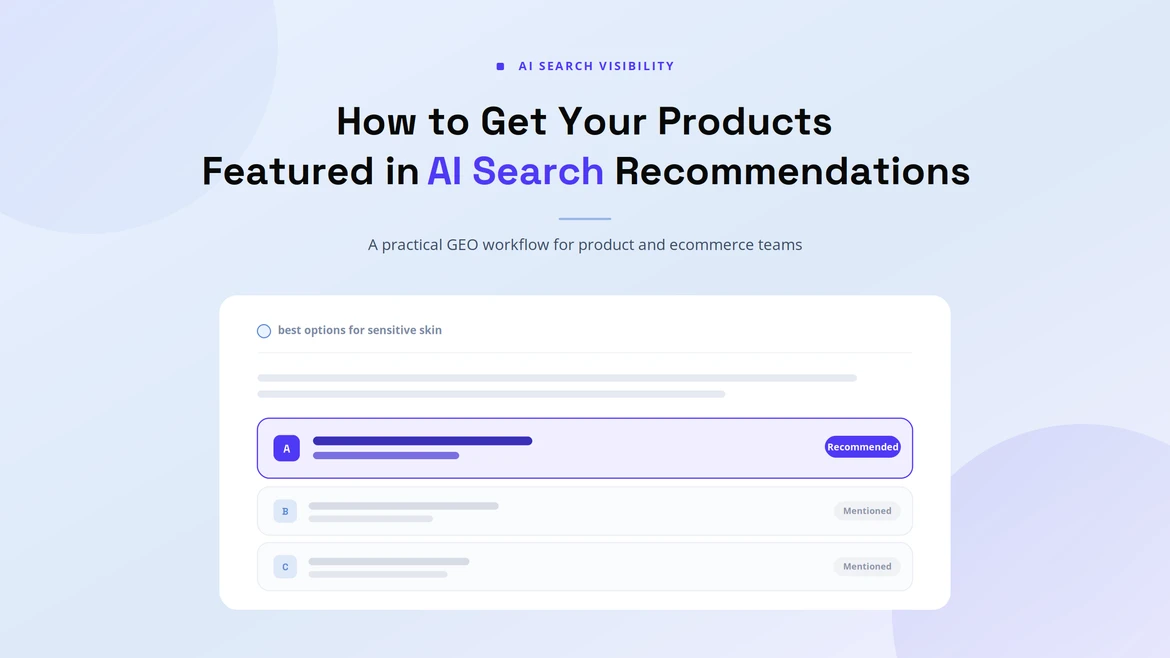
Before we get into the meat and potatoes, let’s take a quick look at how AI search recommendations actually work. Technically speaking, an AI search recommendation occurs when answer engines present a product as a suitable choice for a particular buyer, requirement, or use case. The response might list the product among several options, compare it with alternatives, or explain who specifically should choose it over the alternatives.
It’s important to note that recommendations are contextual by nature. A product could be suitable for beginners, sensitive skin, small businesses, frequent travelers, or another specific audience without being a general recommendation for everyone. This is an important distinction when it comes to gauging performance and actually measuring success.
LLMs typically build answers from accessible product pages, structured product data, retailer listings, reviews, editorial coverage, technical documentation, and other sources. Each engine often uses different retrieval methods, sources, and answer-generation logic. For example, AthenaHQ’s benchmark data uncovered that the average AI model cites between 6 and 27 distinct domains depending on the engine, with an overall average of 12 domain citations per response. That means your product may appear differently depending on the engine, so testing needs to cover the platforms your customers are actually using rather than a single default engine.
How AI Recommendations Differ From Traditional Search Rankings
Traditional SEO focuses on ranking web pages in search results and earning clicks. Generative Engine Optimization (GEO) aims to secure mentions or citations directly within AI-generated responses, which can inform how buyers think about your brand or product before they ever land on your website. An effective GEO program will help AI systems understand a brand, connect products with relevant needs, and retrieve evidence that supports an answer, which is a fundamentally different job than earning a high search ranking.
The practical difference affects how a team thinks about product content:
- SEO asks whether a product page can rank for a query.
- GEO asks whether an engine can understand, verify, cite, and accurately describe the product.
- Product recommendation optimization asks whether the available evidence connects that product to a specific buyer need.
Sound SEO practices remain necessary, especially crawlable pages, clear internal links, useful content, and technical quality support, all of which collectively impact search rankings and AI discovery. GEO takes it a step further through structured attributes, entity clarity, answer-ready content, and ongoing source monitoring.
Indexed, Cited, Mentioned, and Recommended: The Distinctions That Matter
A few other good terms to know when measuring product visibility:
- Indexed: This means the answer engine can access and process information about your product.
- Cited: The AI-generated answer identifies a product page, review, article, retailer, or other page as a source, which means it is actually linked.
- Mentioned: The product or brand appears in the generated response, with or without a visible citation.
- Recommended: The answer presents the product as an appropriate option within a specific buyer context, i.e. “Organic food delivery options for dogs in San Francisco”.
Quick note: a product can still be accessible to LLMs, even if it doesn’t appear in any answer. That’s because an engine can cite a product page while discussing the category without actually recommending that particular product. It can also recommend a product for one use case while omitting it entirely from a similar prompt with slightly different requirements.
That’s why it’s a good idea to record each outcome separately, rather than collapsing them into a single visibility number. Generally speaking, a product mention indicates recognition, while a citation reveals which source actually supported the answer. Acronyms and terminology aside, if the engine can specifically connect your product to a prompt’s criteria, that is the most commercially valuable outcome.
How AI Systems Discover and Evaluate Product Information
AI systems need retrievable information before they can evaluate a product, let alone to determine which to recommend to buyers. That means accessible pages, structured data, clean product feeds, and consistent attributes, all of which make it easier for an engine to identify products and compare them against alternatives. Since every LLM uses their own discovery algorithm, the best bet is to publish complete information that buyers, search crawlers, and retrieval systems can all interpret, rather than optimizing narrowly for one engine’s assumed preferences.
Make Product Information Accessible and Machine-Readable
Start by ensuring your product pages are clear enough to work without requiring an LLM to infer essential details. The official product name, brand, category, price, availability, specifications, and buyer-relevant attributes should all be directly in visible page content.
Product schema adds machine-readable fields to the page, so LLMs can . Product-focused parse price, availability, GTIN, brand, aggregate rating, review count, and offers. Be sure to only use fields that match the visible page and current records, since mismatched schema can actively confuse an AI system rather than help it.
Be sure to keep titles, prices, specifications, and availability consistent across your website, marketplaces, feeds, and review profiles, since conflicting values can lead directly to inaccurate answers about the product.
Crawlability is another prerequisite. OAI-SearchBot, GPTBot, and PerplexityBot are examples of AI-related crawlers, but their roles and access patterns differ meaningfully from one another. Review crawl-access policy, legal requirements, security controls, and technical constraints before changing robots.txt in either direction.
GEO favors factual, entity-rich content that uses schema markup to clarify meaning. A product page should identify the relationships between the product and its brand, category, variants, offers, reviews, and intended uses, rather than describing the product in isolation.
Give AI Systems Enough Evidence to Compare Products
LLMs need more than your product name and promotional description to actually make recommendations. Since AI systems are contextual by design, they look for attributes that correspond directly to a buyer’s criteria, such as dimensions, materials, ingredients, compatibility, price, intended user, or fulfillment options. When it comes to writing copy for your product pages, look to incorporate:
- Explicit attributes: State measurable or clearly defined product details directly, rather than implying them.
- Unambiguous entity relationships: Distinguish the brand, product family, model, variant, accessory, and seller from one another clearly.
- Independently verifiable evidence: Support important claims through official documentation, original data, qualified expert input, independent reviews, or credible retailer information.
Replace vague statements such as “ideal for every professional” with more precise descriptions of who the product actually supports and under which conditions. If a claim has limits, state them near the claim itself rather than burying disclosures elsewhere on the page.
Independent sources help an engine assess whether other publishers and customers describe the product consistently. Strong evidence becomes especially useful for safety, performance, compatibility, ingredients, awards, and suitability claims, where an AI system has a strong incentive to seek corroboration beyond the brand’s own statements.
A 7-Step Workflow for Getting Products Recommended by AI
Treat AI recommendation visibility as a product-information and measurement program rather than a one-time content project. Here’s how to get started in seven steps:
1. Define Each Product Entity and Its Ideal Buyer
Create a canonical record for every priority product, including its official name, category, target user, main use cases, differentiators, core specifications or ingredients, variants, and any relevant alternatives, all in one place.
Comprehensive entity coverage means mapping the entities related to a subject, defining their relationships, and addressing the attributes needed to understand them.
For example, let’s take a running shoe. The related entities could include the brand, model, category, intended terrain, cushioning type, available sizes, materials, and buyer profile. For software, this could mean the vendor, product, plan, integrations, deployment method, supported roles, and alternatives. Whatever your category, use a central canonical record to ensure every team is describing the product in the same way.
Checklist:
- Record the official product and brand names.
- Assign one clear primary category.
- Define the target user and relevant exclusions.
- List the main problems and use cases the product addresses.
- Document specifications, ingredients, or compatibility requirements.
- Identify evidence-backed differentiators.
- Map variants, accessories, bundles, and alternatives.
2. Publish Complete, Crawlable Product Information
Audit each product page from a buyer’s perspective.
Place essential information in visible HTML, including price, availability, specifications or ingredients, use cases, target audience, shipping information, return terms, and meaningful differentiators. Do not rely entirely on images, downloadable files, interactive widgets, or scripts that may hide key facts from crawlers. Keep important policy details close to the purchase decision, or link to the applicable policy in a clear way.
Also make sure to always use structured information, like hierarchical headings, semantic HTML, data tables, concise definition blocks, and clean links among product families. This helps both readers and LLMs quickly locate the specifics.
You’ll also want to check robots.txt, page-level directives, authentication requirements, canonical tags, and rendering behavior. Tip: An llms.txt file can help AI crawlers understand selected site resources. .
Checklist:
- Confirm that each priority page loads without authentication.
- Publish complete buyer and product details in visible text.
- Add clear links to shipping and return policies.
- Check robots.txt and page-level access directives.
- Test canonical URLs for products and variants.
- Verify that essential content appears in rendered HTML.
- Organize details with headings, tables, and definition blocks.
3. Add Structured Data and Keep Attributes Consistent
GEO uses comprehensive schema and question-based content to make information easier for answer engines to extract and integrate into answers. How? Schema provides the structure, while visible explanatory content gives buyers and LLMs the context needed to interpret each field correctly.
Add valid Product schema to each product page, with values mapped to visible content. This should include applicable identifiers, offers, pricing, availability, ratings, and review information wherever accurate.
Also be sure to keep a canonical source of truth for product data. A website, merchant feeds, retailer listings, marketplaces, review profiles, and internal systems should all reference the same product identity and current attributes.
Rather than relying on a fixed calendar, schedule cross-channel audits whenever there are changes to pricing, formulas, packaging, model names, inventory status, policies, or other specifications. Always correct the source system first before updating connected channels downstream.
Checklist:
- Add applicable Product schema properties.
- Validate the markup with an appropriate testing tool.
- Match every structured value to visible page content.
- Assign one internal source of truth for each attribute.
- Synchronize product feeds and marketplace listings.
- Audit titles, prices, availability, and specifications regularly.
- Record the date and owner of each material update.
4. Build Third-Party Evidence and Authority
AI-generated recommendations also draw on sources well beyond your website, so it’s always a good idea to build accurate product coverage through independent review sites, relevant publishers, retailer listings, expert sources, industry awards, and credible community discussions.
Authority signaling can include expert attribution, transparent data, citation networks, and institutional affiliations. Encourage honest customer feedback and
track third-party pages for accuracy after publication. Having a central source for product descriptions will make it easier to identify and request corrections if necessary. Preserve editorial independence throughout this process while still supplying verifiable facts the publisher can choose to use.
Checklist:
- Identify trusted sources that influence your category.
- Prepare an accurate product fact sheet for reviewers.
- Encourage authentic customer feedback.
- Submit eligible products for relevant awards or evaluations.
- Publish transparent methods for original product data.
- Monitor external pages for outdated factual details.
- Reject paid arrangements that require misleading claims.
5. Create Comparison and Use-Case Content for Recommendation Prompts
Create content around the exact questions buyers ask while evaluating options. Useful formats include product comparisons, alternatives pages, use case guides, compatibility pages, and question-led product content generally. Some good prompt patterns to start with:
- “best [category] for [use case]”
- “which products are alternatives to [competitor]”
- “compare [product] by price, features, ingredients/specifications, and suitability”
Answer these questions with specific attributes and clearly defined selection criteria. A strong comparison guide should explain which product fits each type of buyer, where the supporting evidence comes from, and when the comparison was last updated. AthenaHQ’s benchmark data shows that across all segments, Comparative/Selection content accounts for 23.16% of what AI models actually cite, so this is a good format to invest in.
Question-based structures also support GEO because they connect a clear query with a direct, extractable answer. Keep the answer near the question itself, then provide the supporting details, limits, and evidence.
Comparison content needs real editorial discipline to stay useful. Include relevant alternatives rather than only favorable ones and apply the same criteria to each product being compared. Also establish a process for updating the page whenever the underlying products, prices, or availability change.
Checklist:
- Collect buyer questions from sales, support, reviews, and search data.
- Group questions by category, use case, and buyer type.
- Publish comparison and alternatives pages with stated criteria.
- Build use-case pages around concrete requirements.
- Answer common questions directly before adding detail.
- Cite appropriate evidence for material claims.
- Add an update date and responsible owner.
6. Test Product Visibility Across AI Platforms
Build a recurring prompt set for each product category including category discovery, use-case recommendations, alternatives, feature comparisons, price-related questions, and suitability prompts.
Aim to use 20 to 30 buying-intent prompts per category, then run the set across the AI platforms your buyers actually use. From there, you can record whether the product appeared, how it was described, and which sources were cited in support of the answer.
It’s important to note that prompt tests provide a controlled observation, not a full reproduction of every shopper’s experience. Answers may change with wording, location, account context, model updates, and retrieval conditions.
Preserve the exact prompt, platform, date, response, citation, and observed position for every test. This helps distinguish an isolated appearance from repeatable, dependable category coverage.
Checklist:
- Create a prompt set for every priority category.
- Include discovery, comparison, alternative, and suitability prompts.
- Run the same core prompts across relevant platforms.
- Save the complete response and visible citations.
- Record mentions, recommendations, and factual errors separately.
- Repeat tests under a consistent method.
- Flag results that require content or data corrections.
7. Measure Results and Improve Continuously
Create a cadence to independently measure product mentions, citations, and recommendations rather than lumping them all together into one AI visibility score.
What you’re looking for here is which sources are appearing consistently across prompts. A repeated citation pattern can reveal whether engines favor a brand’s own product page, a retailer, an independent publisher, or a competing source for a particular type of question, which directly informs where to invest next.
Measure coverage by category, use case, buyer type, and platform rather than relying on a single blended number. Turn each finding into a defined, owned task. Prioritize missing attributes, inaccurate product details, thin comparison content, insufficient third-party evidence, crawl barriers, and feed inconsistencies according to buyer value and error severity, in that order.
Checklist:
- Separate mentions, citations, and recommendations in reporting.
- Record answer position only when observable.
- Group performance by category and use case.
- Identify the sources cited for each prompt group.
- Prioritize factual errors before visibility improvements.
- Assign each corrective task to an owner.
- Re-test affected prompts after publishing changes.
The Product Information Checklist LLMs and Buyers Need
Here’s a handy checklist to ensure each individual SKU, product family, and category page is precise, consistent, current, and easy to verify.
Remember when optimizing for product recommendations that every criterion needs an appropriate source. Depending on the claim, that source might be an official product page, technical documentation, an independent review, a retailer listing, or original data. Leave a field blank with a dash when evidence does not exist rather than inventing support for it.
| Information Group | Required Product Details | Where It Should Appear | Evidence to Verify It | Maintenance Owner | Review Cadence |
|---|---|---|---|---|---|
| Identity and category | Official product name, brand, model, variant, product identifiers, primary category | Product page, schema, catalog, feeds, retailer listings | Official product record, packaging, catalog documentation | Product operations or catalog manager | On every catalog change |
| Buyer fit and use cases | Target user, main use cases, differentiators, suitability limits, relevant alternatives | Product page, use-case guide, comparison page, FAQ content | Product documentation, original research, qualified review, customer evidence | Product marketing | On positioning or product changes |
| Price and availability | Current price, currency, offer details, inventory status, sales region | Product page, Product schema, merchant feed, marketplace listing | Commerce platform, inventory system, retailer listing | Ecommerce operations | Daily or when values change |
| Specifications or ingredients | Dimensions, materials, compatibility, performance details, ingredients, variant-specific data | Product page, specification table, technical documentation, schema | Technical documentation, laboratory data, manufacturing record | Product, technical, or regulatory team | On formulation, model, or specification changes |
| Fulfillment and policies | Shipping coverage, fulfillment conditions, return terms, warranty information | Product page, cart, shipping page, returns page, retailer listing | Official policy pages and fulfillment system | Ecommerce operations or customer experience | On every policy change |
| External evidence and freshness | Independent reviews, awards, expert coverage, dated citations | Product page, evidence page, comparison content | Original publisher, award body, expert source, retailer, dated PR | Content or product marketing | Monthly and after material updates |
Before publishing, verify the product name, category, target user, use cases, differentiators, price, availability, specifications or ingredients, shipping or return details, evidence, and when it was last updated. Make sure to verify the complete record as one product entity rather than reviewing isolated fields in separate places, since inconsistency between fields is often more damaging than a single missing detail.
How to Optimize for Specific AI Platforms Without Chasing One Algorithm
Test the platforms your customers actually use instead of assuming one tactic works equally across every engine.
ChatGPT and Perplexity
Test category discovery, product alternatives, buyer suitability, and direct comparison prompts. Include both broad questions and specific prompts containing real constraints such as budget, ingredients, features, or compatibility requirements.
For each answer:
- Run: Product category, use case, alternative, and comparison prompts.
- Validate: Product identity, price, availability, specifications, suitability, and stated limitations.
- Record: Product mentions, recommendation context, visible citations, cited domains, and inaccurate claims.
- Correct: Improve missing product details, resolve conflicting attributes, and strengthen the pages relevant to cited questions.
Review whether the cited page actually supports the answer that uses it. If a citation leads to outdated or ambiguous information, update the source directly or request a factual correction from the external publisher if necessary. .
Claude and Gemini
Use the same core prompt set so results can be compared consistently across platforms. Add longer evaluation prompts that ask the system to apply explicit requirements, since these tests reveal whether product attributes are clear enough to support a genuinely reasoned comparison.
For each test:
- Run: Buyer-fit, feature, ingredient, specification, and alternatives prompts.
- Validate: Model names, variant differences, target audience, compatibility, policies, and claim evidence.
- Record: Which products appear, how the answer qualifies suitability, and which sources are visible.
- Correct: Clarify entity relationships, add missing evidence, and separate family-level claims from variant-level facts.
Don’t worry that a missing citation means the system has no source at all. Record only what the interface actually exposes, then focus effort on whether the answer itself is accurate and useful to the buyer.
Google AI Overviews
Test queries that resemble the searches buyers actually use before visiting product pages. You’ll want to category research, comparisons, use cases, specifications, and questions about product suitability. Here’s how:
- Run: Search-style questions with clear purchase criteria.
- Validate: Product details, availability, seller identity, policies, specifications, and applicable evidence.
- Record: Overview inclusion, linked sources, competing pages, and factual inconsistencies.
- Correct: Improve the relevant product or category page, align structured data, and resolve differences across feeds and listings.
Review the standard search results alongside the AI Overview itself. This will help you identify which category, editorial, retailer, and product pages already address the query.
Common Mistakes That Keep Products Out of AI Recommendations
Effective GEO emphasizes structured product data, buyer-question content, third-party validation, and consistent product identity. Most AI visibility problems come from preventable gaps. Here are some of the bigger mistakes to watch out for: :
- Incomplete product attributes. Fix it by completing the entity record and publishing buyer-ready details.
- Stale price or inventory data. Fix it by synchronizing the commerce system, feeds, structured data, and visible page content.
- Contradictory details across channels.Fix it by assigning a canonical source of truth and run the cross-channel audit.
- Blocked or inaccessible product pages. Fix it by reviewing robots rules, page directives, authentication, rendering, and canonical URLs.
- Generic keyword-only copy. Fix it by directly stating concrete attributes, buyer fit, use cases, and selection criteria.
- Unsupported product claims.Fix it with appropriate evidence or remove the claim entirely.
- Missing third-party validation.Fix it by pursuing honest, ethical reviews, publisher coverage, retailer listings, expert sources, or relevant awards.
- Weak comparison coverage. Fix it by creating fair comparisons, alternatives pages, and use case content based on real buyer questions.
- Testing only one engine or one prompt. Fix it with a recurring cross-platform prompt set.
Products also need to be in stock and fulfillable in real time to remain viable recommendation options.
Turn AI Search Visibility Into an Ongoing Product-Discovery Program
Start with one priority product category rather than the entire catalog at once. From there, complete the product information checklist, build a buying-intent prompt set, test the relevant platforms, and save a baseline of mentions, citations, recommendations, and factual errors before making changes.
Establish recurring reviews across ecommerce, product marketing, SEO, content, product operations, and PRto prioritize technical fixes, missing attributes, evidence gaps, and new buyer-question content. The key to getting your product featured in AI search recommendations is to operationalize the process with consistent monitoring and clear ownership from the start.
Frequently Asked Questions
Should you optimize every product for AI search recommendations at once?
No. Start with products that have strong availability, strategic value, complete documentation, and clear buyer demand. Use what is learned from that initial category to create a reusable template before expanding to the rest of the catalog, rather than spreading effort thin across everything simultaneously.
Can a product be recommended by AI if it has few third-party reviews?
Yes, because reviews are one type of evidence rather than a universal requirement. Strengthen other verifiable sources, such as technical documentation, retailer listings, expert evaluations, certifications, or transparent original data, all of which can substitute for a thin review base.
Do paid ads guarantee that a product will appear in AI recommendations?
No. Advertising placement does not guarantee inclusion in an independently generated recommendation. Manage paid media and AI search visibility as separate programs, each with distinct evidence, testing, and measurement standards, since conflating the two tends to produce misleading conclusions about what is actually driving results.
Who should own AI search recommendation optimization inside an ecommerce team?
Assign one accountable program owner, often in SEO, product marketing, ecommerce, or growth. That owner should coordinate catalog operations, content, technical SEO, analytics, PR, legal, and customer experience through a shared review process, since the work touches nearly every function that maintains product information.
What is the difference between a product being mentioned and a product being recommended?
A mention means the product or brand name appears somewhere in the generated response, with or without a visible source attached to it. A recommendation is a stronger and more specific outcome: the answer actively presents the product as an appropriate option for a defined buyer context, such as a stated use case, budget, or requirement. A product can be mentioned frequently while rarely being recommended, which is why the two outcomes should always be tracked separately.
How many prompts does a reasonable AI visibility test require per product category?
A practical starting point is 20 to 30 buying-intent prompts per category, covering category discovery, use-case recommendations, alternatives, feature comparisons, price-related questions, and suitability prompts. This is large enough to reveal repeatable patterns while still being manageable to review and act on consistently.
Why do brand-owned product pages get cited less often than third-party sources?
AthenaHQ’s State of AI Search 2026 report found that brand-owned domains are cited as a source in only 16.05% of AI responses on average, meaning the large majority of citations come from third-party sources such as community platforms, review sites, and independent publishers. AI engines generally treat independent validation as stronger evidence than a brand’s own claims about itself, which is why building third-party evidence, not just improving owned product pages, is a core part of getting featured in AI recommendations.
Become the Brand AI Trusts
See, Act, and Win on AI Search and Beyond
Keep Reading
Top 10 Generative Engine Optimization Tools To Try in 2026
The best GEO tools to get your brand mentioned when AI search engines answer questions in your industry. Search traffic is predicted to drop 25% by 2026.
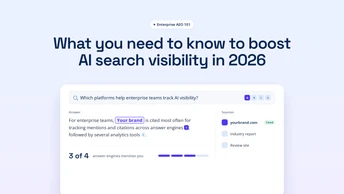
Enterprise AEO 101: What You Need to Know to Boost AI Search Visibility in 2026
Learn how enterprise AEO and GEO can improve AI search visibility in 2026, from prompt measurement and citation-ready content to platform evaluation and attribution.
Enterprise GEO Prompts: Strategies for Scaling AI Search Visibility
Enterprise GEO provides a practical way for large teams to organize buyer questions, measure answers across engines, find citation gaps, invest in changes that carry real business value, and ultimately scale their AI search visibility.
See AthenaHQ in Action
 AthenaHQ
 Cozy Earth
The Most-Cited Sleepwear Brand in AI Search
Cozy Earth used AthenaHQ to protect its lead in sleepwear, identify a loungewear opportunity, and give its two-person content team a clearer way to prioritize what to publish next.
AthenaHQ Rootly
10x Increase in Citation Rate
GEO became Rootly's #1 growth pillar. With ~10x citation rate growth and +126% mention rate on non-branded prompts, Rootly transformed AI Search into an executive-level operating channel.
AthenaHQ Lago
Lago50% Increase in Demos from AI Search
Lago achieved a 50% increase in demos from AI Search after implementing Athena. With 11x growth in AI Overview impressions and exploding citations, Athena became their command center for GEO.