How to Track Competitor E-Commerce Brand Mentions in AI Search Results
Learn how to track competitor e-commerce brand mentions in AI search, compare recommendations and citations, and turn competitive insights into action.

Andrew Yan
Co-Founder, CEO of AthenaHQ
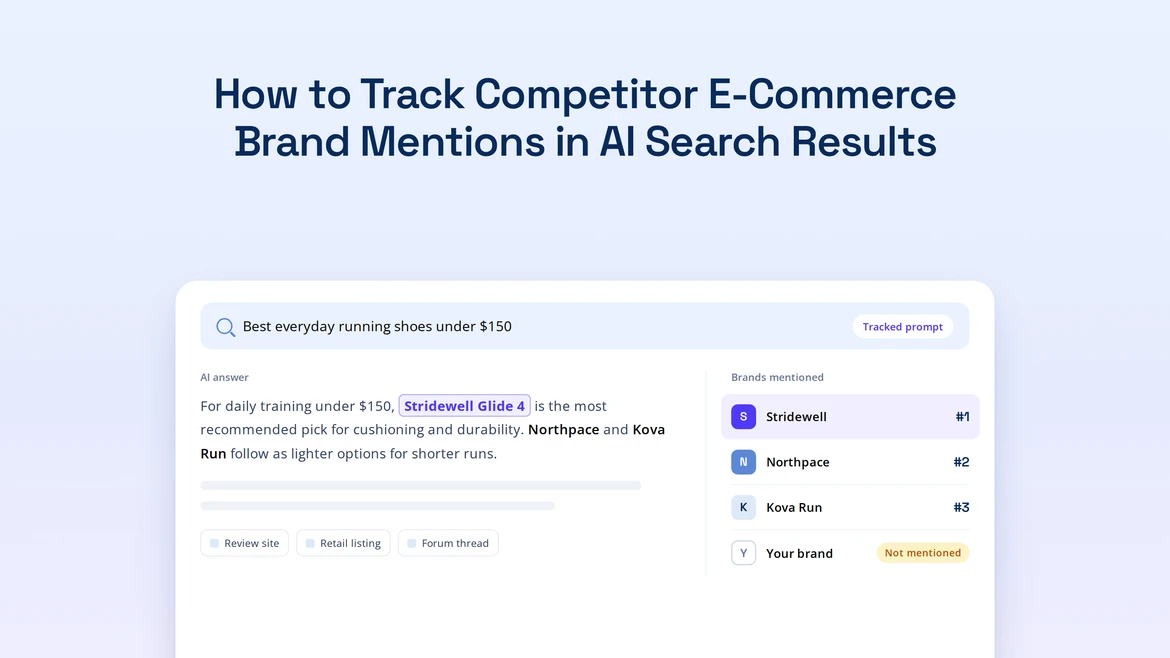
Key Summary
- Competitor brand mention tracking measures how often AI search engines name competing brands in responses to relevant shopping questions. It helps e-commerce marketers understand which brands appear during product discovery, comparison, and purchase decisions.
- A reliable tracking process starts with a representative prompt library. Include category discovery, product comparisons, alternative-brand searches, and purchase-intent questions across the AI platforms your customers use.
- Track mentions, recommendations, and citations separately. Mention rate measures the percentage of eligible answers naming a brand, while competitive share of mentions compares its presence against other brands in a defined competitive set.
- Consumer Goods & Retail brands face significant visibility differences in AI search. AthenaHQ's State of AI Search report found that the average brand appears in 15.46% of tracked AI answers, compared with 53.21% for category leaders.
- Competitor monitoring is most useful when it leads to action. Analyze the sources behind rival recommendations, identify recurring visibility differences, and use those findings to improve product information, comparison content, and third-party coverage.
Your customers are already asking AI search engines for product recommendations, but what determines who actually makes it into the response? Competitors can enter the shopping journey before a customer ever visits a retailer website, and tracking their mentions in AI search gives you a clearer view of your position. With a consistent measurement process, you can identify which brands appear across relevant shopping questions, understand why they receive visibility, and uncover opportunities to improve your own performance.
This guide walks through how to track competitor e-commerce brand mentions in AI search results, from defining your competitive set and building a prompt library to creating scorecards and turning your findings into action. Let’s get into it!
Why Competitor Mentions Matter in AI Search
A shopper researching a new product might ask ChatGPT for recommendations, compare suggestions, and narrow down their choices without opening a single product page. That creates a new competitive challenge for e-commerce brands. Your brand can rank well in traditional search results, but that doesn't necessarily mean AI search engines will include you in relevant responses.
Competitor tracking helps you understand which brands AI platforms associate with particular product categories, customer needs, and purchase requirements. It can also reveal where competitors receive recommendations that your brand doesn't.
The differences can be substantial. According to AthenaHQ's State of AI Search report, the average Consumer Goods & Retail brand appears in just 15.46% of tracked AI answers, while category leaders achieve 53.21%. The report also found that leading brands in this category capture an average 33.98% share of voice, compared with 18.57% for second-ranked brands and 12.81% for third-ranked brands.
These figures show why consistent competitor monitoring matters. Instead of relying on occasional spot checks, you need a repeatable way to measure visibility across the questions your customers actually ask.
Define What You Will Track Before You Start
Before collecting data, establish exactly what you're measuring.
AI search engines can mention a brand without recommending it. They can also recommend a product while citing a retailer, review site, or another third-party source.
These distinctions matter because each metric tells you something different about your competitive position.
Start by defining your unit of analysis, classification rules, and competitor set. That way, everyone on your team uses the same methodology when reviewing results.
Use a Consistent Unit of Analysis
Treat each prompt execution as one observation: one question submitted to one AI engine or model under recorded conditions, producing one response.
Count a brand once per answer, even if the response mentions its name several times.
Then classify the results using four categories:
- Brand mention: The AI-generated answer names the brand.
- Recommendation: The answer presents the brand as suitable for the shopper's needs or requirements.
- Citation: The answer links to a source supporting a claim or recommendation.
- Owned-site citation: The cited URL belongs to the named brand's website.
It's important to distinguish these outcomes from indexing, too. Just because an AI engine can access your product information doesn't mean it will mention your brand in a response.
You should also track recommendation position, or the order in which AI-generated answers present suitable brands.
For sentiment, classify appearances as positive, neutral, or qualified. Qualified mentions include caveats about pricing, product features, availability, or suitability for a particular audience.
Document examples of ambiguous cases so your team can classify them consistently.
Set a Fair Competitor Set
Your AI search competitors won't necessarily be the same brands you monitor in traditional SEO.
A retailer might compete with your brand for product recommendations even if it doesn't appear alongside you in conventional search rankings. Meanwhile, a publisher or review website might influence AI-generated answers without selling a competing product.
Focus on brands that shoppers would realistically consider for the same need.
Depending on your category, your competitive set may include:
- Direct-to-consumer brands
- Traditional retailers
- Marketplaces
- Private-label products
- Product-level competitors
For each competitor, document its brand identifiers, relevant product names, and website domain. The goal is to establish a fair comparison group before you start measuring performance.
Build an E-Commerce Prompt Set That Reveals Real Competitors
Your prompt library determines which competitive opportunities you'll actually measure.
If you only track questions that mention your brand by name, you'll miss an important part of the picture: which competitors AI engines introduce when shoppers haven't already decided what to buy.
Start with the questions customers ask throughout the shopping journey, from early product research to purchase decisions.
Cover the Buyer Journey
Build your prompt library around seven common shopping scenarios:
- Category discovery: “What are reliable [product category] options for [audience]?”
- Problem or use-case discovery: “What should I buy to help with [specific need]?”
- Product comparison: “Compare [product type] options for [requirement].”
- Alternative-brand comparison: “What are alternatives to [brand] for [use case]?”
- Product or SKU research: “Is [product] suitable for [audience or condition]?”
- Seasonal or promotional research: “Which [category] products work well for [season or event]?”
- Purchase intent: “Where can I buy [product type] with [price, delivery, availability, or returns requirement]?”
Keep branded and unbranded prompts separate. Branded questions reveal how AI platforms respond to existing interest in a company or product, while unbranded prompts help you understand which brands the engines introduce independently.
Pay particular attention to informational and comparison-oriented questions.
AthenaHQ's State of AI Search report found that informational content accounts for 35.06% of analyzed content intent in Consumer Goods & Retail, followed by comparative or selection content at 28.43% and acquisition-oriented content at 14.81%.
These findings reinforce the importance of monitoring visibility across different stages of product research.
Your library doesn't need to be enormous to be useful. A smaller retailer might start with a focused set of high-value questions, while a large e-commerce business may need separate prompt groups for different product categories, audiences, geographic markets, and seasonal priorities.
Keep Prompts Comparable
Small changes in prompt wording can produce different answers. If you want to measure changes in competitive visibility over time, you need consistent testing conditions.
Give every prompt a unique ID and record:
- Exact wording
- Search intent
- Product or category
- Target audience or use case
- Stage of the buying journey
Use the same wording for repeated tests. If you decide to revise a prompt, document the change and start a new measurement period for the revised version.
Whenever possible, run prompts in fresh sessions without previous conversation history. Keep language and geographic settings consistent, and record any personalization or search-mode differences that could affect the results.
This gives you a more reliable basis for comparing competitor mentions over time.
Run and Record Tests Across AI Search Engines
AI engines don't always recommend the same brands in their responses, even if the shopping question is identical. Your products might appear regularly in ChatGPT but receive fewer mentions in Perplexity or Google AI Overviews. That's why competitor tracking should cover all the platforms your customers use.
Standardize Each Test
For every prompt execution, record the following:
- Date and time
- AI platform
- Model or search mode, when visible
- Prompt ID and exact wording
- Interface used
- Language
- Region or location setting
- Response status
- Complete answer text, screenshot, or archived record
These details help you understand whether a change in competitor visibility reflects a meaningful difference in results or a change in testing conditions. For example, a model update or specific geographic setting might affect which brands appear, even when your website and product information haven't changed.
Be sure to keep engine-level results separate before combining them into an overall report. Otherwise, strong performance on one platform could conceal weaker visibility elsewhere.
Capture the Full Response Context
A mention count only tells part of the story. If an AI engine names your competitor, you also need to know how it describes that brand and whether the response recommends its products. For each brand mentioned in an eligible answer, record:
- Whether the answer recommends the brand
- Its position among recommended options
- The product or category mentioned
- Sentiment and any qualifications
- Every cited URL and citation domain
- Whether each citation belongs to the brand, a competitor, or a third party
Preserve the surrounding response text so you can distinguish genuine recommendations from passing mentions or negative comparisons.
You can use a spreadsheet for a small baseline audit. Create one row for each prompt execution on each platform and store the full responses separately. As your monitoring expands across more engines, markets, and product categories, a dedicated platform can help automate response collection and competitor analysis.
Turn Responses Into a Competitor Visibility Scorecard
Once you've collected your responses, it's time to turn the data into something useful. A competitor visibility scorecard helps you compare how often brands appear, receive recommendations, and earn citations across the same set of shopping questions. Start by segmenting your results by AI engine, prompt group, product category, geography, and reporting period. Then calculate your core metrics:
- Mention rate: The percentage of usable AI-generated answers that name a particular brand.
- Citation rate: The percentage of usable answers that link to the brand's website.
- Recommendation rate: The percentage of usable answers that explicitly recommend the brand as suitable for the shopper.
- Competitive share of mentions: A brand's portion of all eligible brand-answer appearances within your selected competitive set.
Here's how to calculate each one:
| Metric | Formula |
| Mention rate | (Answers mentioning the brand ÷ All usable answers) × 100 |
| Website citation rate | (Answers citing the brand's website ÷ All usable answers) × 100 |
| Recommendation rate | (Answers recommending the brand ÷ All usable answers) × 100 |
| Competitive share of mentions | (Brand-answer appearances ÷ All eligible competitor-group brand-answer appearances) × 100 |
Count each brand only once per response for these calculations, even when its name appears multiple times. Also, keep in mind that a mention doesn't necessarily come with a website citation: an AI-generated answer might recommend your product while referencing a marketplace listing, independent review, or retailer website.
Track owned-site and third-party citations separately to understand which sources support each brand's visibility. Additional diagnostic metrics can help you interpret the results:
- Average recommendation position: Where the brand typically appears among recommended options.
- Sentiment mix: The proportion of positive, neutral, and qualified appearances.
- Product or category coverage: Which product areas generate mentions and which remain underrepresented.
- Source-domain overlap: Websites that AI engines cite when discussing multiple competitors.
- Change over time: Differences between comparable reporting periods.
Avoid introducing complicated weighted scores unless you can explain how they relate to a specific business objective.
Use a Scorecard to Compare Change Over Time
A scorecard makes it easier to spot competitive differences without reviewing hundreds of individual responses. Here's a simple reporting structure you can use:
| Brand | Mention rate | Citation rate | Recommendation rate | Average position | Top citing domain |
| Your brand | — | — | — | — | — |
| Competitor A | — | — | — | — | — |
| Competitor B | — | — | — | — | — |
Illustrative template. Populate each field with results from the same defined testing period.
Create separate views for different AI engines and prompt categories. For example, you might discover that your brand appears frequently in category-discovery prompts but loses visibility when shoppers ask about delivery times, returns, or budget-friendly alternatives.
Compare each reporting period against an equivalent previous period, then investigate which specific prompts account for the changes. AthenaHQ supports e-commerce AI search performance tracking and AI-driven revenue attribution, helping teams evaluate competitive visibility alongside downstream business outcomes when identifiable referral data is available.
Investigate Why a Competitor Appears and Decide What to Do Next
Your scorecard tells you where competitors have an advantage. The next step is figuring out where it might be coming from. Look beyond the mention counts and examine the content, citations, and product information associated with competitor recommendations.
Find the Sources Behind Competitor Visibility
Start by reviewing the URLs and domains cited alongside competitor recommendations, then organize them into categories:
- Competitor-owned product or category pages
- Retailer listings
- Marketplace pages
- Customer review platforms
- Editorial comparisons and buyer guides
- Technical documentation
- Other third-party sources
Look for patterns across multiple responses. Does a competitor consistently receive citations from detailed product pages? Do AI engines reference independent reviews when recommending its products? Are marketplace listings providing information that your own product pages don't include? These findings can help you identify where to investigate further.
Third-party visibility is particularly relevant in e-commerce. AthenaHQ's State of AI Search report identifies YouTube, Reddit, Instagram, Facebook, and Amazon as the five most-cited off-page sources in Consumer Goods & Retail. For brands, that makes citation analysis useful beyond their owned websites. It can also reveal which external platforms and sources appear repeatedly in AI-generated shopping answers.
Review your own product information, too. Accessible product pages, accurate specifications, structured product data, retailer listings, and credible reviews can all provide information relevant to AI-generated responses. JSON-LD schema can also help make product attributes machine-readable, while consistent product details across channels can reduce conflicting information.
None of these changes guarantees an AI mention or recommendation. Use citation patterns as evidence to guide your investigation rather than assuming a single optimization will improve visibility.
Turn Findings Into E-Commerce Actions
Once you've identified a recurring competitive difference, decide what your team can do about it.
For example:
- Improve product-page information when competitor citations include more complete or accurate specifications.
- Create or update comparison content when important buyer questions lack coverage on your website.
- Resolve inconsistent product details across your site, product feeds, marketplaces, and retailer listings.
- Strengthen legitimate third-party coverage when independent reviews or editorial sources frequently support competitor recommendations.
Focus your alerts on meaningful changes rather than every fluctuation. A competitor entering an important prompt cluster, overtaking your brand in recommendation order, or repeatedly gaining citations from a new source may warrant investigation.
Assign each finding to the appropriate team. Product marketers can improve product information and feed accuracy, while merchandising specialists can address category and seasonal priorities, content teams can develop useful buyer resources, and analysts can investigate identifiable AI referral traffic and conversions.
Keep the original prompt, AI response, supporting citations, proposed action, responsible owner, and review date together. That creates a record of what changed, what your team did, and whether subsequent monitoring reveals a sustained improvement.
Make Competitor Monitoring a Repeatable Operating Rhythm
Tracking competitor brand mentions in AI search works best when you treat it as an ongoing process rather than a one-time audit.
Start with a representative prompt library and a clearly defined competitor set. Run consistent tests across relevant AI engines, measure mentions, recommendations, and citations separately, and investigate the sources behind meaningful changes.
Choose a reporting schedule your team can maintain. A smaller e-commerce business might start with biweekly checks, while a larger organization may need more frequent monitoring across multiple categories and markets.
You can also run additional checks around product launches, seasonal campaigns, assortment changes, and major updates to product information.
The goal is to identify repeatable competitive patterns, understand what may be contributing to them, and prioritize improvements based on evidence. With a consistent monitoring process in place, you can move beyond asking whether competitors appear in AI-generated answers. Instead, you'll have the evidence to understand how your brand compares and make more informed decisions about where to invest your efforts.
AthenaHQ helps e-commerce brands track AI search visibility, compare competitors, identify citation sources, and connect recommendation performance with measurable business outcomes. Learn more.
Frequently Asked Questions
What is competitor brand mention tracking in AI search?
Competitor brand mention tracking measures how often AI search engines name competing brands in responses to relevant prompts. E-commerce marketers use it to compare brand visibility, recommendations, citations, and positioning across AI platforms.
How do you track competitor mentions in ChatGPT and other AI search engines?
Start with a representative set of shopping-related prompts. Run the same questions across platforms such as ChatGPT, Perplexity, Gemini, and Google AI Overviews. Record which brands appear, whether the responses recommend them, their position, and the sources cited. Repeat the tests under consistent conditions to monitor changes.
What is the difference between mention rate and share of voice?
Mention rate measures the percentage of eligible AI responses that name a particular brand. Competitive share of mentions measures that brand's portion of all eligible brand appearances within a defined competitive set. Both metrics help evaluate visibility, but they use different denominators.
How do you calculate competitor brand mention rate?
Divide the number of usable AI-generated responses mentioning a competitor by the total number of usable responses, then multiply by 100. For example, if a competitor appears in 20 of 50 responses, its mention rate is 40%.
How often should e-commerce brands monitor competitor mentions?
Choose a schedule that supports consistent comparisons. Some brands may start with biweekly or monthly checks, while larger businesses may monitor more frequently. Additional testing around launches, promotions, and major product changes can help identify important competitive shifts.
Why does a competitor appear in AI search results more often than my brand?
Several factors may contribute, including differences in product information, category relevance, third-party coverage, and the sources available to AI search engines. Review the prompts where competitors appear, how their products are described, and which websites receive citations before deciding what to improve.
Which metrics should a competitor AI search dashboard include?
A useful dashboard should include mention rate, competitive share of mentions, recommendation rate, website citation rate, average recommendation position, sentiment, product-category coverage, and changes over time. Segment results by AI engine, prompt intent, geography, and reporting period.
Can competitor mention tracking help improve e-commerce sales?
Competitor tracking can help identify opportunities to improve product visibility and recommendations in AI search. To evaluate commercial impact, connect AI visibility reporting with identifiable referral traffic, product-page engagement, conversions, and revenue. A change in mentions alone doesn't establish that AI search caused additional sales.
Become the Brand AI Trusts
See, Act, and Win on AI Search and Beyond
Keep Reading
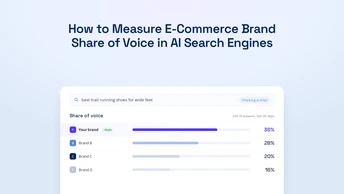
How to Measure E-Commerce Brand Share of Voice in AI Search Engines
Learn how to measure e-commerce brand share of voice in AI search, benchmark competitors, track AI citations, and connect visibility to revenue.
Top 10 Generative Engine Optimization Tools To Try in 2026
The best GEO tools to get your brand mentioned when AI search engines answer questions in your industry. Search traffic is predicted to drop 25% by 2026.
Enterprise AEO 101: What You Need to Know to Boost AI Search Visibility in 2026
Learn how enterprise AEO and GEO can improve AI search visibility in 2026, from prompt measurement and citation-ready content to platform evaluation and attribution.
See AthenaHQ in Action
 AthenaHQ
 Cozy Earth
The Most-Cited Sleepwear Brand in AI Search
Cozy Earth used AthenaHQ to protect its lead in sleepwear, identify a loungewear opportunity, and give its two-person content team a clearer way to prioritize what to publish next.
AthenaHQ Rootly
10x Increase in Citation Rate
GEO became Rootly's #1 growth pillar. With ~10x citation rate growth and +126% mention rate on non-branded prompts, Rootly transformed AI Search into an executive-level operating channel.
AthenaHQ Lago
50% Increase in Demos from AI Search
Lago achieved a 50% increase in demos from AI Search after implementing Athena. With 11x growth in AI Overview impressions and exploding citations, Athena became their command center for GEO.