Profound vs AirOps: Which Tool is Better for GEO in 2026?
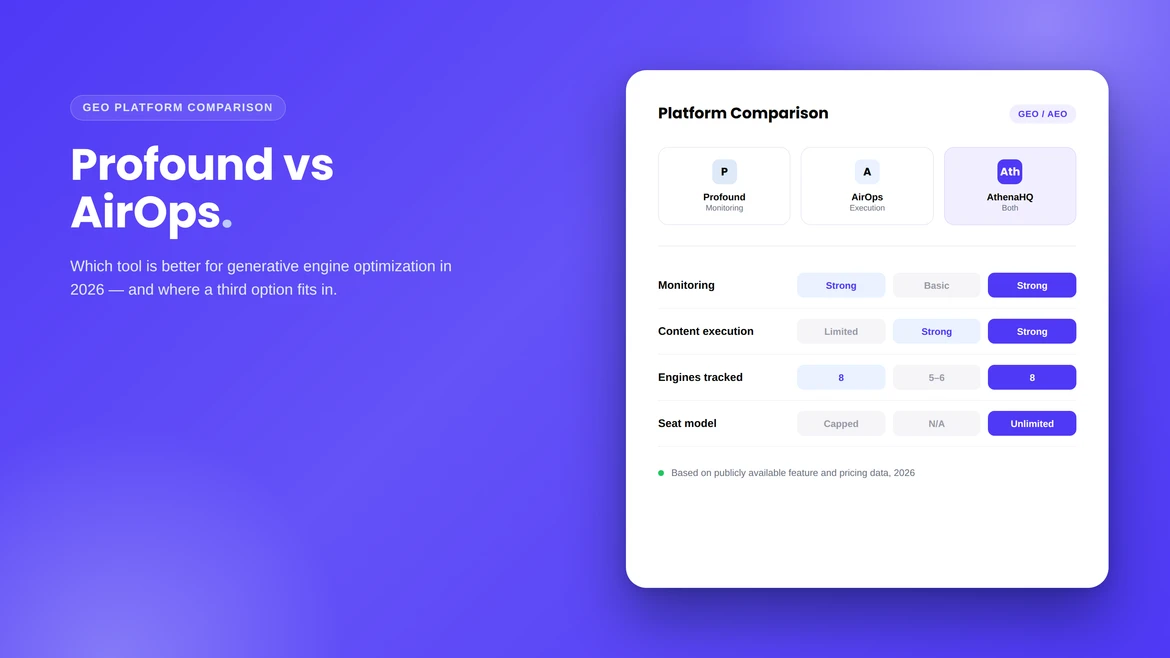
Profound leads over AirOps on monitoring, AirOps beats Profound on content execution, and AthenaHQ is the superior choice for a combination of monitoring and actionable workflows to put insights into action.

AthenaHQ
Action on AI Search
Key Takeaways
- Profound and AirOps perform different core functions. Profound is built for AI-search monitoring and measurement, while AirOps pairs AI-search insight with content production and publishing workflows. The right choice depends on whether your team needs to measure visibility or execute content changes at scale.
- Profound leads over AirOps on monitoring depth. Profound is the broader option for multi-engine AI visibility tracking, prompt-volume data, and executive-level reporting, with coverage across eight AI surfaces including Perplexity, ChatGPT, Claude, Gemini, Grok, Microsoft Copilot, DeepSeek, and Google AI Overviews.
- AirOps beats Profound on content execution. AirOps connects AI-search insight to content operations, with page-level reporting that ties AI citations to Search Console and GA4 data, making it the stronger fit for teams that already know their content priorities and need a repeatable production workflow.
- Pricing information is limited. AirOps doesn’t offer publicly available pricing, while Profound ranges from $99/month for small teams and $399/month for growing (only 3 answer engines tracked), with estimates up to $2,000/month for the full package. Plan-specific quotes should be confirmed directly with sales for both platforms.
- AthenaHQ offers a third alternative. AthenaHQ combines deep AI engine monitoring and insights with content execution in one single platform, with agents turning citation data into prioritized next steps to improve your AI search visibility. It also offers a seat-unlimited pricing model built for teams that want to run GEO across the whole organization, not just a single analyst.
With over 61% of consumers turning to AI search to evaluate products and services, brands are turning away from traditional SEO tactics to earn attention. Generative engine optimization (GEO) helps your brand get in AI-generated answers, prioritizing mentions and citations over page rankings.
Two platforms in this category include Profound and AirOps, but there are some critical differences between them. While Profound leans toward AI visibility monitoring and measurement, AirOps connects AI-search insights to content operations. This guide breaks down each tool in more detail, and introduces a third option, AthenaHQ, for teams that do not want to choose between measuring and acting.
Comparison Criteria: What Matters When Choosing a GEO Platform
Before evaluating Profound vs AirOps specifically, it helps to define the key capabilities for GEO platforms. Primary criteria include:
- Monitoring and measurement: This covers leading indicators that your brand is actually showing up in AI answers, including LLM coverage, brand mentions, citations, prompts, demand signals, competitor intelligence, reporting, and data freshness.
- Execution: This means content creation, workflow automation, publishing integrations, and repeatable processes that enable you to take insights and put them into action.
- Enterprise readiness: Implementation, integrations and API options where verified, governance and security evidence, team workflows, regional coverage, and pricing transparency.
Profound vs AirOps at a Glance
| Profound | AirOps | |
| Core focus | AI visibility analytics and measurement | AI-search insights plus content operations |
| Supported AI engines | Perplexity, ChatGPT, Claude, Gemini, Grok, Microsoft Copilot, DeepSeek, Google AI Overviews | AI Search, Google, Gemini, Perplexity, Claude, ChatGPT |
| Visibility & citation measurement | Real-time reference rates and sentiment | Basic citation alerts; page-level citation data |
| Prompt-volume or demand data | Prompt Volumes listed | Not confirmed |
| Competitor intelligence | Advanced competitor benchmarking | Not confirmed |
| Content creation | AEO FAQ Generator workflow | Content operations workflows |
| Workflow automation | Agents and Aim listed | End-to-end content workflow automation |
| Integrations | API, CMS plugins, SSO | Built-in CMS integrations, Power Steps builder |
| Reporting | Enterprise and competitive intelligence | Page-level data with AI citations, Search Console, and GA4 |
| Enterprise readiness | SOC 2, GDPR, secure SSO, 15-minute refresh | GDPR compliance, daily batch updates |
| Pricing availability | $99/month for small teams and $399/month for growing (only 3 answer engines tracked) + enterprise pricing (reportedly $2,000/per month) | Not publicly available |
Now let’s dig in to see how Profound and AirOps compare across specific categories.
AI Engine Coverage and AI Search Visibility Tracking
Profound’s full plan includes Perplexity, ChatGPT, Claude, Gemini, Grok, Microsoft Copilot, DeepSeek, and Google AI Overviews, while AirOps reportedly spans ChatGPT, Perplexity, Claude, Gemini, and Google AI Overviews. However, their coverage serves different purposes. Sources primarily position AirOps around content workflow automation and publishing, while Profound is more strongly suited for AI visibility analytics and strategic insight.
Prompt Data, Citations, and Competitive Intelligence
Profound lists Prompt Volumes among its monitoring and insight features, along with prompt-volume data, advanced competitor benchmarking, and AI-visibility analytics. External sources compare Profound more favorably in this area, with deeper insights, including real-time reference rates and sentiment analysis. AirOps, by comparison, offers more basic citation alerts. AirOps also provides page-level data combining AI citations, Search Console, and GA4 traffic .
Before you commit, run through a short validation checklist. Good questions to ask on a demo include:
- Which prompts are tracked, and how is a citation defined?
- What competitor set is included?
- Which engines and countries are covered?
- What reporting exports are available, and how often does data refresh?
- Can data be segmented by product line, page, or region?
Which Tool Is Better for Enterprise AI-Search Monitoring and Reporting?
It’s also important to consider whether your team needs executive and competitive intelligence or reporting tied directly to content-production workflows. If security is a factor, one comparison notes that Profound offers API, CMS plugins, secure SSO, SOC 2, GDPR, and 15-minute refreshes, while AirOps provides a Power Steps builder, GDPR compliance, and daily batch updates . Be sure to validate current terms directly with each vendor, since these details can change by plan and date.
How Much Implementation Effort Should You Expect?
Choose a measurement-first rollout if you need to establish a baseline across prompts, engines, competitors, and citations before acting. Choose an execution-first rollout if you already have clear content priorities and need a repeatable production workflow. Either way, request a live walkthrough of onboarding, data connections, roles, CMS or analytics integrations, review stages, and export or API requirements before you commit. Do not assume unverified integrations are available on your plan.
Pricing
How Should You Compare Pricing When Plans Are Not Public?
At time of publication, Profound’s pricing page listed $99/month for small teams and $399/month for growing organizations, with custom packages available for enterprise. AirOps, alternatively, did not provide any pricing information. One report indicated that AirOps multi-engine insights start at $2,000 dollars per month (useomnia.com). This would be comparable to public estimates of Profound’s enterprise plan. However, it’s important to confirm directly with each vendor before budgeting.
Build a total-cost checklist that covers:
- Platform subscription and included seats
- Engines and regions required
- Prompt or response allowances
- Implementation and data integrations
- Content-production volume and review labor
- Support and enterprise governance needs
How to Evaluate GEO ROI Over Time
Establish pre-launch baselines first. Track visibility and citation indicators by priority engine and prompt, connect content releases to those changes, then evaluate downstream traffic, conversion, and pipeline metrics over a consistent reporting period. This sequence keeps you from crediting a content push for changes that were already in motion, and it gives you a clearer perspective when you report results to leadership.
Profound Pros and Cons
Pros:
- Broad listed engine coverage across the eight surfaces named in the feature matrix
- Prompt Volumes and Answer Engine Insights included among monitoring features
- Monitor, Create, and Operate positioning that spans measurement and content
- An AEO FAQ content workflow that scrapes a page and produces content
Cons:
- Meaningful use of the tool is restricted to higher pricing tiers, and even the growth plan ($399/month) is limited to just three answer engines
- Teams prioritizing high-volume content workflow automation may find AirOps' offer more aligned than Profound
AirOps Pros and Cons
Pros:
- AI-search insight plus content operations that connects measurement to execution
- Support for ChatGPT, Perplexity, Claude, and Gemini
- Scalable content workflows and high-velocity publishing
- Page-level data combining AI citations, Search Console, and GA4 traffic
Cons:
- Pricing is not publicly available, which makes for a more cumbersome evaluation process
- Teams requiring deeper prompt-volume data may find AirOps’ insights lacking
A Third Option: AthenaHQ for All-in-One GEO
Profound measures well but leaves execution to a single content workflow. AirOps delivers on content execution but offers thin competitor and prompt-volume intelligence by comparison. That’s where AthenaHQ comes in. Rather than asking teams to stitch together a monitoring tool and separate content pipeline, AthenaHQ runs the complete GEO workflow inside one platform. That means deep insights that show exactly where your brand is losing ground and actionable workflows to fix it all live in the same place.
Why Teams Evaluating Profound and AirOps Are Adding AthenaHQ to the Shortlist
- Monitoring depth without the plan-gating. AthenaHQ tracks brand and competitor visibility across eight AI platforms, including ChatGPT, Gemini, Claude, and Perplexity, so teams see the exact questions AI models are answering when they mention or omit a brand.
- Actionable insights instead of a raw data feed. Where Profound and AirOps both leave interpretation largely to the analyst, AthenaHQ converts citation and visibility data into a prioritized list of what to write, update, or restructure next.
- A full content production suite. Profound's content capability centers on one FAQ-generation workflow, and AirOps focuses on publishing automation. AthenaHQ pairs its monitoring layer with a broader set of content production tools built specifically for citation-worthy formatting, so teams don’t need a second platform to act on what the data shows.
- Business outcomes, not just visibility scores. AthenaHQ connects AI-search visibility to demos, leads, and pipeline rather than stopping at mention counts, so you can see the real impact of your GEO efforts.
- Pricing built for team-wide adoption. AthenaHQ uses a single subscription plus credits model with unlimited seats, rather than the fixed, seat-capped tiers reported for tools like Profound. That matters once more than one or two people need access, since seat limits are one of the most frequent scaling complaints in this category.
- Regional and segment-level reporting. For multi-location GEO, AthenaHQ can break visibility down by region or product line, so a national brand can see that its AI visibility in one market lags another and route content fixes to the right regional team.
| Comparison Criterion | Profound | AirOps | AthenaHQ |
| Core job | AI visibility monitoring | Content publishing plus AI search insights | Unified monitoring and content execution in one platform |
| Turning insight into action | Manual interpretation of dashboards; one FAQ-generation workflow | Content workflow automation focused on publishing | Action Center surfaces prioritized, specific next steps |
| Content production | Single AEO FAQ Generator workflow | Workflow automation and CMS publishing | Full content production suite built for citation-worthy formatting |
| Business outcome tracking | Not confirmed | Page-level GA4 and Search Console reporting | Visibility tied directly to leads, demos, and pipeline (GA4 and Shopify integration) |
| Seats and scalability | Reported seat-capped tiers | Not confirmed | Unlimited seats on a subscription plus credits model |
| Regional or segment reporting | Not confirmed | Not confirmed | Visibility segmentable by region, market, or product line |
Who Should Choose Profound, AirOps, or AthenaHQ?
The best tool depends on your primary focus: measurement, execution, or both at once.
Choose Profound If You Need Strategic AI-Search Measurement
Profound is a better choice over AirOps for teams looking for multi-engine AI-search monitoring, prompt-volume insights, competitive and executive reporting, and strategy-led visibility measurement.
Choose AirOps If You Need Content Operations Connected to AI Search
AirOps is the stronger choice for growth and content teams that want to use AI-search insights to run scalable content workflows, operationalize improvements, and publish at higher velocity.
Choose AthenaHQ If You Need Monitoring and Execution Without Two Separate Tools
AthenaHQ is the stronger fit for teams that require comprehensive AI monitoring alongside the ability to act on insights with full-scale content execution.
Frequently Asked Questions
How does Profound compare to AirOps for generative engine optimization?
Profound and AirOps approach GEO from different angles. Profound focuses on enterprise AI-search monitoring, prompt-volume data, and competitive reporting across a broad set of AI engines. AirOps focuses on turning AI-search insight into content operations, with page-level reporting that ties AI citations to Search Console and GA4 data. Teams that need to measure visibility across many engines tend to prefer Profound, while teams that need to act on that visibility through content workflows tend to prefer AirOps.
Which tool is better for enterprise AI search monitoring, AirOps or Profound?
Profound is the stronger option for enterprise AI search monitoring based on supplied evidence, with named coverage across eight AI surfaces, dedicated prompt-volume data, and reporting of real-time reference rates, SOC 2 compliance, and secure SSO. AirOps offers monitoring as well, but sources describe its citation tracking as more basic and its reporting as more tightly coupled to content and page performance than to enterprise-wide competitive intelligence.
Does Profound or AirOps offer better AI search visibility tracking?
For the broadest supplied evidence of multi-engine visibility tracking, Profound is the stronger pick, with named coverage across Perplexity, ChatGPT, Claude, Gemini, Grok, Microsoft Copilot, DeepSeek, and Google AI Overviews. AirOps tracks brand appearance across ChatGPT, Gemini, Claude, and Perplexity and pairs that tracking with page-level data connecting citations to Search Console and GA4 traffic, which is useful when the priority is tying visibility to specific pages rather than tracking the widest possible set of engines.
What is the best GEO software, Profound, AirOps, or another option?
There is no single best GEO software for every team; the right choice depends on whether the priority is measurement, execution, or both. Profound suits teams that need deep, multi-engine monitoring and executive reporting. AirOps suits teams that need to convert AI-search insight into scalable content operations. AthenaHQ is built for teams that want both monitoring and execution in one platform, with an Action Center that prioritizes next steps and a content production suite to carry them out, without paying for or managing two separate tools.
How do Profound and AirOps compare on pricing and platform features?
Neither Profound nor AirOps publishes numeric pricing on its homepage; both expose demo or trial paths instead. Third-party estimates for the two tools vary widely and do not agree with each other, with figures ranging from roughly 99 dollars per month to more than 2,000 dollars per month depending on the source and plan tier. On features, Profound is reported to offer broader engine coverage, deeper prompt and citation analytics, and enterprise governance credentials like SOC 2 and GDPR, while AirOps is reported to offer stronger content workflow automation, CMS integrations, and page-level performance reporting. Buyers should request current, plan-specific pricing directly from each vendor before comparing total cost of ownership.
Where does AthenaHQ fit compared to Profound and AirOps?
AthenaHQ sits between the two, combining Profound-style monitoring depth with AirOps-style content execution inside a single platform. It tracks brand and competitor visibility across major AI engines, prioritizes what to fix through an Action Center, includes a full content production suite rather than one narrow workflow, ties visibility to business outcomes like leads and demos, and prices access with unlimited seats so an entire content and marketing team can use it without hitting a seat cap.
Which AI engines should a GEO or AEO tool track at minimum?
Most brands should look for coverage of ChatGPT, Google Gemini, Claude, and Perplexity at minimum, since these represent the majority of AI search traffic. Broader coverage that adds Grok, Microsoft Copilot, or Google AI Overviews helps prevent blind spots as AI search usage shifts, but confirm which engines are included at your specific plan tier rather than assuming homepage-listed coverage applies to every pricing tier.
Become the Brand AI Trusts
See, Act, and Win on AI Search and Beyond
Keep Reading
Enterprise AEO 101: What You Need to Know to Boost AI Search Visibility in 2026
Learn how enterprise AEO and GEO can improve AI search visibility in 2026, from prompt measurement and citation-ready content to platform evaluation and attribution.
Enterprise GEO Prompts: Strategies for Scaling AI Search Visibility
Enterprise GEO provides a practical way for large teams to organize buyer questions, measure answers across engines, find citation gaps, invest in changes that carry real business value, and ultimately scale their AI search visibility.

How to Get Your Products Featured in AI Search Recommendations
Actually getting your products featured in AI search recommendations requires a repeatable process to sufficiently cover your grounds across product data, crawl access, third-party evidence, comparison content, and performance.
See AthenaHQ in Action
 AthenaHQ
 Cozy Earth
The Most-Cited Sleepwear Brand in AI Search
Cozy Earth used AthenaHQ to protect its lead in sleepwear, identify a loungewear opportunity, and give its two-person content team a clearer way to prioritize what to publish next.
AthenaHQ Rootly
10x Increase in Citation Rate
GEO became Rootly's #1 growth pillar. With ~10x citation rate growth and +126% mention rate on non-branded prompts, Rootly transformed AI Search into an executive-level operating channel.
AthenaHQ Lago
Lago50% Increase in Demos from AI Search
Lago achieved a 50% increase in demos from AI Search after implementing Athena. With 11x growth in AI Overview impressions and exploding citations, Athena became their command center for GEO.