Semrush vs Ahrefs: Which Platform Is Actually Right for AI Visibility in 2026?
Semrush and Ahrefs are traditional SEO platforms with added AI-visibility features. Both tools were originally built for keyword rankings and backlinks, not AI answers.

AthenaHQ
Action on AI Search
Key Takeaways
- Semrush and Ahrefs are traditional SEO platforms with added AI-visibility features. Both tools were originally built for keyword rankings and backlinks, not AI answers.
- Keyword rankings and backlink authority do not reliably predict AI citations, which is why more teams are tracking traditional SEO performance and AI-answer visibility separately.
- Reported pricing shows Semrush's AI visibility tools sitting in a higher paid tier and Ahrefs' Brand Radar as an add-on to existing plans.
- AthenaHQ is a purpose-built generative engine optimization (GEO) platform that monitors 8+ LLMs, including ChatGPT, Perplexity, Gemini, and Claude, and turns citation data into prioritized actions. It also runs on a single subscription plus credits, with unlimited seats included from the entry tier.
Choosing between Semrush and Ahrefs in 2026 isn’t just about keyword tools and backlink indexes. The rise of AI answer engines have fundamentally changed the playbook when it comes to earning attention. While traditional SEO tools have adapted to this new reality by adding more AI search features, that may or may not be sufficient to meaningfully improve your brand visibility across ChatGPT, Perplexity, Gemini, Claude, and other LLMs.
In this guide, we’re digging into Ahrefs and Semrush to see how they stack up. We’ll also take a look at a third option: dedicated GEO platforms like AthenaHQ, purpose-built for the AI search era. Let’s get started!
Semrush vs Ahrefs: 2026 Verdict at a Glance
Before we get into the meat and potatoes, we wanted to establish some common criteria to make it easier for you to assess each platform: traditional SEO data, keyword research depth, backlink intelligence, AI-visibility coverage, actionability, agency and enterprise workflows, API access, pricing structure, usage limits, reporting, and scalability. Treat this a starting point for your own evaluation, not a final scorecard.
| Platform | Best fit | Primary measurement layer | Key trade-off |
|---|---|---|---|
| Semrush | Broad SEO plus wider marketing operations | Traditional SEO with AI-visibility add-ons | Reported pricing suggests AI-visibility tools sit in a higher paid tier |
| Ahrefs | Backlink-led and search-first SEO | Traditional SEO with Brand Radar AI monitoring | Search metrics correlate with, but do not directly predict, AI citations |
Platform Overviews: Where Each Option Fits
Semrush
Semrush isa traditional SEO and marketing suite with AI-visibility functionality layered on top. Its official materials span keyword research, competitor and market analysis, backlink analysis, rank tracking, technical site health, reporting, AI brand sentiment, and AI visibility. Independent coverage of exactly which AI engines Semrush supports is inconsistent across sources, so be sure to verify the current roster directly with Semrush.
Ahrefs
Ahrefs focuses on search data, keyword research, backlinks, and technical SEO foundations. It also offers a Brand Radar AI-visibility monitoring feature, which reportedly covers ChatGPT, Google AI Overviews, Google AI Mode, Gemini, Perplexity, Grok, and Copilot. Its proprietary web index continues to anchor its backlink and keyword datasets.
| Core role | Strongest use case | |
|---|---|---|
| Semrush | All-in-one SEO and marketing suite | Teams wanting broad marketing data |
| Ahrefs | Search data and backlink depth | Backlink and search-first SEO |
Is Semrush or Ahrefs Better for Keyword Research?
The better keyword research tool ultimately depends on your workflow. Both platforms provide keyword ideas, questions, search volume, keyword difficulty, and CPC data, so the differences show up more in scope and usability.
Semrush Keyword Research Workflows
Semrush's Keyword Magic Tool is reported to draw on a 20-billion-keyword database, compared with a 6.3-billion-keyword Ahrefs keyword index, according to one comparison. Generally speaking, Semrush is considered the stronger fit for organizations that want more marketing data in one place, including advertising research, content creation tools, CRM-style link outreach, and broader integrations.
Ahrefs Keyword Research Workflows
Ahrefs tends to suit more search-centered workflows. Its Keyword Explorer works in a similar way to Semrush, returning keyword ideas, questions, volume, difficulty, and CPC data.
Best Choice by Team Type
- Content teams: Semrush, for wider content and topic planning tied into its broader marketing toolset.
- PPC-linked SEO teams: Semrush, for advertising and CPC research alongside organic data.
- Technical SEO specialists: Either platform works, though Ahrefs gains a slight edge for greater depth of search data.
- Agencies: Semrush for breadth, Ahrefs for search focus.
To validate the best fit for your team, be sure to test each workflow against a real project. Enter your priority keywords, check the clustering output, generate a report your stakeholders will actually read, and confirm export limits before you commit budget. Also be aware that traditional keyword volume doesn’t indicate AI prompt demand. These are different signals, and conflating them is a common mistake for teams planning content for AI search. A
Backlink Analysis and Database Coverage
When it comes to evaluating the best backlink platform, it’s a good idea to go beyond database size and collectively evaluate index size, crawl freshness, referring-domain discovery, anchor-text analysis, link-quality filtering, historical data depth, competitor-gap reporting, and export practicality.
Backlink Research Capabilities
Ahrefs is widely regarded as best-in-class for deep backlink-index research, referring domains, and anchor-text analysis. According to one comparison, Ahrefs maintains a 35-trillion-link live backlink index. Semrush's official pricing notes that backlink analysis is included in its broader suite, alongside keyword research, rank tracking, and technical site health. However, this capability is generally seen as secondary to Ahrefs.
AI Visibility and GEO: Can Semrush or Ahrefs Measure What AI Engines Say?
Both Semrush and Ahrefs now offer AI-visibility features. Where independent sources disagree is the scope and depth of that coverage.
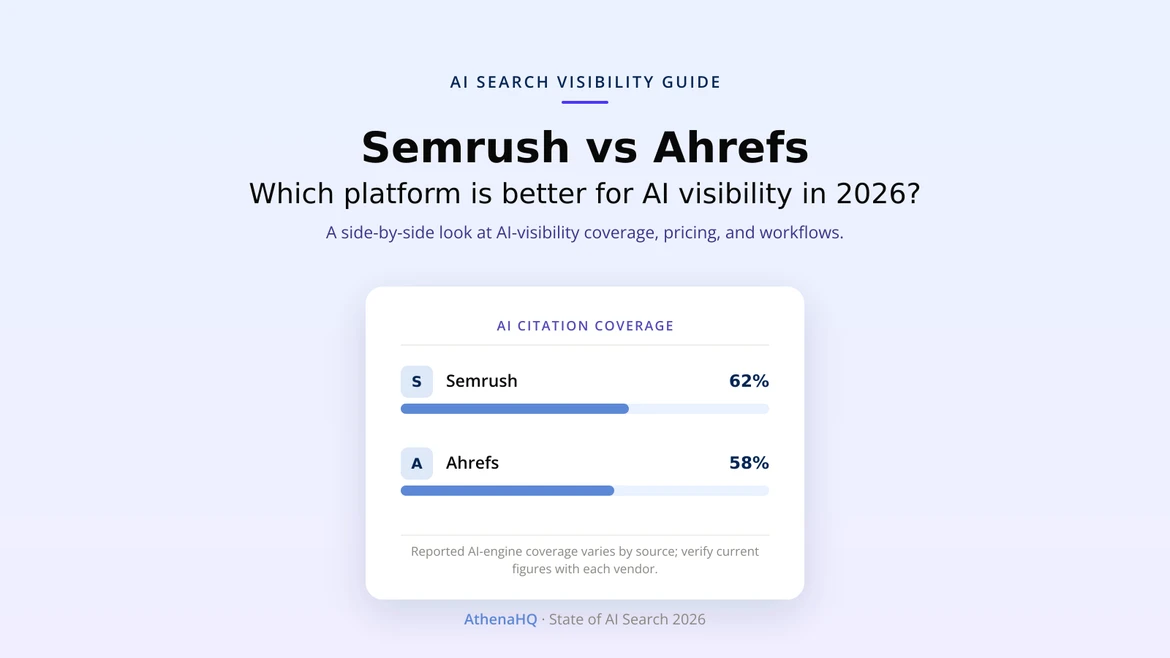
According to one 2026 comparison, Semrush and Ahrefs both cover ChatGPT, Google AI Overviews, Google AI Mode, and Gemini. Ahrefs also reportedly covers Perplexity, Grok, and Copilot. A separate review describes Semrush as tracking five platforms at the more detailed prompt-level, while Ahrefs Brand Radar was characterized as narrower in scope. As these findings conflict, you’ll want to verify current coverage directly with each vendor.
Citations, Mentions, Sentiment, and Source URLs
One comparison reports that AI-visibility tracking is a paid Semrush upgrade which starts from $199 per month, while Ahrefs Brand Radar is included on paid plans beginning at $129 per month. Both companies adjust tiering fairly often, so you’ll want to confirm directly.
AI Citation Volatility
AI citations move around more than most people expect. The exact same prompt can surface different brands depending on the day, as models and retrieval systems continually update behind the scenes. Individual spot checks rarely tell you anything useful, and it’s important to build a repeatable process if you’re looking to improve AI search visibility in a meaningful way.
At the same time, comparing one AI answer against one search-engine result gives you two snapshots, not a trend. Whether you’re using Semrush, Ahrefs, or a dedicated GEO tool like AthenaHQ, tracking real progress requires equivalent prompts, engines, and locations compared over a defined window. In practice, that means evaluating:
- Test prompts: a fixed set matched to your real buyer questions.
- AI engines: the specific engines your audience actually uses.
- Locations, devices, and logged-in state: recorded for every run.
- Date range and frequency: a defined window with a set cadence.
- Competitor set: a fixed list of brands to compare against.
- Source-URL capture rules: how cited URLs get logged.
Metrics to Track Over Time
| Metric | Definition | Cadence | Decision it informs |
|---|---|---|---|
| Citation rate | Share of answers citing your domain | Weekly to monthly | Content and source-URL strategy |
| Mention rate | Share of answers naming your brand | Weekly to monthly | Brand-presence priorities |
| AI answer share | Your share of tracked AI answers | Monthly | Overall AI-visibility progress |
| Share of voice | Your presence versus competitors | Monthly | Competitive positioning |
| Sentiment | Tone of brand framing in answers | Monthly | Reputation and messaging work |
| Source URLs | URLs cited by AI answers | Continuous | Which pages to strengthen |
| Prompt coverage | Prompts where you appear | Monthly | Prompt and content gaps |
Pricing, Plans, Usage Limits, Seats, and Reporting
According to one 2026 comparison, Semrush SEO starts at $139 per month and Semrush Starter with AI-visibility tools at $199 per month, with Ahrefs Brand Radar on paid plans starting from $129 per month. Be sure to confirm pricing specifically with each vendor, including seat counts and project allowances. Good questions to ask include:
- How many tracked keywords, projects, and report exports does each seat allow?
- What are the credit or usage limits, and what happens at overage?
- How long is data retained, and can you export it on your own schedule?
- Do AI-visibility features sit in a separate, higher paid tier?
API Access and Data Limitations
Semrush API and MCP
Semrush's official website includes separate API documentation, and also mentions a Semrush MCP integration.
Ahrefs API and Data Access
Ahrefs' pricing page mentions a Firehose monitoring position, but it does not provide enough detail here to publish a reliable current API price, credit allowance, rate limit, or endpoint comparison. Be sure to confirm those specifics in Ahrefs before planning for any integration.
Procurement Checklist
Whichever platform you lean toward, validate each of the following against live documentation rather than a sales deck:
- API authentication and access controls.
- Endpoint scope and coverage.
- Export permissions and row limits.
- Rate limits and credit consumption.
- Data-retention terms.
- Webhook or MCP support.
- Overage pricing.
- Security review and integration reliability.
Agency Requirements
The best platform for agencies support multi-client reporting, permissions, seats, scalable exports, API access, operational workload, integration needs, and the ability to cleanly separate client data and workflows.
Ahrefs agency plans are generally framed around SERP-focused reporting like traditional ranking and traffic data. Teams with multiple services lines will likely prefer Semrush, which covers SEO, PPC, and content metrics in one place.
Pros and Cons by Platform
| Platform | Pros | Cons | Best-fit buyer |
|---|---|---|---|
| Semrush | Broad SEO and marketing scope; solid reporting depth | AI visibility may require a higher paid tier | Teams wanting all-in-one marketing data |
| Ahrefs | Strong keyword and backlink research | SEO metrics do not predict AI citations | Backlink-led and search-first SEO teams |
Recommended Search Stack for 2026
Many teams are pairing a traditional SEO platform like Semrush or Ahrefs with a dedicated GEO platform specifically built for AI search visibility. As for the SEO layer:
Choose Semrush When
You want one to manage SEO, PPC, content, and wider marketing operations in one place, and you’re comfortable paying extra for AI-visibility tools on top of that.
Choose Ahrefs When
You lead with backlinks and search-data depth, and are looking for a workflow designed around traditional SEO metrics.
Building a Two-Layer Measurement System
For all the SEO capabilities platforms like Semrush and Ahrefs bring to the table, keyword rankings alone won’t actually tell you whether your brand shows up in AI search. No matter how you slice it, keyword and backlink data simply isn’t built to measure brand mentions and citations inside ChatGPT, Claude, Perplexity, Gemini, or Google AI Overviews. That’s why marketers are increasingly tracking AI search separately from traditional SEO, rather than use a blended metric that fails to effectively capture both. Here’s how to implement a two-layer measurement system:
- Define your measurement goals, separating traditional SEO from AI search visibility.
- Run a controlled proof of concept with a documented methodology.
- Validate commercial limits and API requirements against live documentation.
- Assess reporting for your actual team structure and client model.
- Select complementary tools where the measurement layers genuinely differ.
This approach gives you the ability to handle both SEO and AI visibility, rather than forcing one tool to do a job it wasn’t built for.
A Third Option Worth Knowing: AthenaHQ
Semrush and Ahrefs are traditional SEO platforms with added AI visibility features. But what if you want more? AthenaHQ is a GEO platform specifically designed for AI search from day one. Its entire architecture was built to determine what makes an AI model choose to cite or mention a brand, so you can effectively track, benchmark, and improve your content to see meaningful results.
Built Around Citations, Not Retrofitted for Them
The real difference betweenSEO and AI visibility boils down to where your customers actually find the answer. Traditional SEO focuses on a list of blue links at the top of the search results page. AthenaHQ measures whether your brand shows up inside an AI-written answer, often with no link at all. To accomplish this, AthenaHQ monitors brand and competitor visibility across nine or more large language models in real time, including ChatGPT, Perplexity, Gemini, Claude, and Google AI Overviews, so you can see how often your brand is cited, how often it is simply mentioned without a citation, and how sentiment shifts over time. That distinction is exactly the kind of nuance that gets lost when AI tracking is a secondary feature inside a larger suite built for old-school SEO.
From Dashboard to Action Center
A recurring theme across independent reviews of Semrush and Ahrefs' AI features is that the data shows up, but turning it into a prioritized next step still takes real SEO expertise and manual interpretation. AthenaHQ makes it easy to act on insights by surfacing specific, prioritized recommendations, whether that’s a content gap to fill, a page that needs restructuring, or a competitor gaining ground on a specific prompt cluster.
A Pricing Model Built for Whole Teams, Not Per Seat
Where Semrush and Ahrefs generally price and gate AI-visibility features by seat and by tier, AthenaHQ takes a different approach: one subscription plus a credit pool, where a single credit corresponds to one AI response analyzed. The Starter plan runs $295 per month and includes 3,600 monthly credits, visibility across nine models, and unlimited team members, with optional paid API access for teams that want to pipe the data into their own systems. There is also a free plan available. Enterprise AthenaHQ plans come with custom credit volumes, unlimited seats, role-based access control, and API access included by default.
Turning Visibility Into Content, Not Just Reports
AthenaHQ doesn’t stop at analysis. It also includes a content production workflow, so teams can move from spotting a citation gap directly into drafting and shipping the content to close it, without exporting data into a separate tool to get the work done.
The Bottom Line
If your team's mandate is broad SEO and marketing operations, Semrush remains a strong, sensible choice. If backlink depth and search-first workflows are your priority, Ahrefs earns its reputation. But if the metric you actually care about is whether your brand shows up when someone asks ChatGPT, Perplexity, Gemini, or Claude a question in your category, a platform purpose-built for that outcome, like AthenaHQ, is going to get you there faster and with a lot less manual interpretation than an AI feature grafted onto a traditional SEO suite.
Frequently Asked Questions
Is Semrush or Ahrefs better for AI search visibility?
Neither is purpose-built for it. Both have added AI-visibility features on top of tooling originally designed for traditional SEO, so they can show you some signal on AI mentions and citations, but the depth and engine coverage varies by source and changes often. If AI search visibility is your primary goal rather than a secondary metric, a dedicated AEO and GEO platform such as AthenaHQ is worth evaluating alongside either suite.
What is the actual difference between SEO and AEO or GEO?
SEO (Search Engine Optimization) is about ranking web pages highly in traditional search results so people click through to your site. AEO (Answer Engine Optimization) and GEO (Generative Engine Optimization) are about getting an AI model to cite or mention your brand directly inside its generated answer, often without any click-through at all. The two require different content strategies and different measurement, which is why treating them as one blended metric tends to produce misleading conclusions.
Does a high Semrush or Ahrefs ranking mean I'll show up in ChatGPT or Perplexity answers?
Not reliably. Traditional ranking signals can correlate loosely with citation probability, but they do not predict it directly. A page that ranks first for a keyword is not guaranteed to be the page an AI model quotes when it answers a related question, which is exactly why AI-visibility tracking exists as its own discipline.
How much do Semrush and Ahrefs charge for their AI-visibility features?
Reported figures vary by source. One 2026 comparison puts Semrush's AI-visibility upgrade at $199 per month and Ahrefs Brand Radar at $129 per month on paid plans, while another comparison reports Ahrefs entry pricing from $29 per month and Semrush from $139 per month. Treat all of these as reported rather than current vendor-verified numbers, since both companies adjust tiering fairly often, and confirm directly with each vendor before budgeting.
Which platform has better keyword research, Semrush or Ahrefs?
It depends on your workflow more than any single feature. Semrush is generally the stronger fit for teams that want broader marketing data alongside keyword research, including PPC and content-planning tools, and is reported to draw on a larger keyword database. Ahrefs suits more search-centered workflows and pairs its keyword tool tightly with its backlink data. Testing both against a real project is the most reliable way to decide.
Is Ahrefs really stronger than Semrush for backlinks?
Based on the available evidence, yes, Ahrefs is generally seen as the stronger starting point for link-led SEO, with a reputation for backlink-index depth, referring-domain discovery, and anchor-text analysis. Semrush includes backlink analysis as one part of its broader suite, but it is typically viewed as the secondary strength behind Ahrefs specifically in this category.
Can I use Semrush and Ahrefs together with a tool like AthenaHQ?
Yes, and for many teams that is the more practical setup. A common pattern is running a traditional SEO platform, either Semrush or Ahrefs, for search foundations like rankings, keywords, and backlinks, while layering a dedicated AI-visibility platform like AthenaHQ on top specifically to track and act on citations, mentions, and sentiment inside AI-generated answers. The two measurement layers are different enough that few teams get full value trying to force one tool to cover both.
What makes AthenaHQ different from the AI-visibility features inside Semrush or Ahrefs?
AthenaHQ was built from the ground up around the question of what drives AI citations, rather than having AI tracking added later to an existing SEO suite. It monitors nine or more LLMs through its Athena Citation Engine, distinguishes citations from simple mentions, and pairs that data with actionable workflows that turn findings into specific, prioritized next steps rather than leaving a team to interpret raw dashboards. Its pricing is also structured around unlimited team seats plus a shared credit pool, rather than gating features behind per-seat tiers.
Become the Brand AI Trusts
See, Act, and Win on AI Search and Beyond
Keep Reading
Enterprise AEO 101: What You Need to Know to Boost AI Search Visibility in 2026
Learn how enterprise AEO and GEO can improve AI search visibility in 2026, from prompt measurement and citation-ready content to platform evaluation and attribution.
Enterprise GEO Prompts: Strategies for Scaling AI Search Visibility
Enterprise GEO provides a practical way for large teams to organize buyer questions, measure answers across engines, find citation gaps, invest in changes that carry real business value, and ultimately scale their AI search visibility.
How to Get Your Products Featured in AI Search Recommendations
Actually getting your products featured in AI search recommendations requires a repeatable process to sufficiently cover your grounds across product data, crawl access, third-party evidence, comparison content, and performance.
See AthenaHQ in Action
 AthenaHQ
 Cozy Earth
The Most-Cited Sleepwear Brand in AI Search
Cozy Earth used AthenaHQ to protect its lead in sleepwear, identify a loungewear opportunity, and give its two-person content team a clearer way to prioritize what to publish next.
AthenaHQ Rootly
10x Increase in Citation Rate
GEO became Rootly's #1 growth pillar. With ~10x citation rate growth and +126% mention rate on non-branded prompts, Rootly transformed AI Search into an executive-level operating channel.
AthenaHQ Lago
Lago50% Increase in Demos from AI Search
Lago achieved a 50% increase in demos from AI Search after implementing Athena. With 11x growth in AI Overview impressions and exploding citations, Athena became their command center for GEO.