
How to Write AI-Digestible Content
AI-digestible content is content structured so AI models like ChatGPT, Perplexity, and Gemini can easily parse, extract, and cite it. That means leading with direct answers, using question-based headings, breaking information into short, self-contained sections, backing claims with verified facts, and adding schema markup that gives machines explicit structural context.
AI answer engines now sit between your brand and your audience, deciding which sources to pull from and which brands to name when someone asks a question. If your content is hard for a model to read, you disappear from the answer.
This guide shows you how to write content that AI systems can find and cite. You will learn what makes content AI-digestible, how answer engines pick the brands they recommend, and the practical steps you can take today to improve your visibility.
What Is AI-Digestible Content?
AI-digestible content is content structured for machine readability so it can be easily extracted and cited by AI answer engines like ChatGPT, Perplexity, and Gemini. It uses clear headings and direct answers to help models pull accurate information into their generated responses.
This matters more every month. According to AthenaHQ's State of AI Search 2026 report, leading publisher sites have reported traffic declines of more than 50% since AI Overviews and similar features rolled out, meaning a growing share of your audience never sees a traditional list of links. They see a synthesized answer, and your brand is either in it or absent.
AI-digestible content is the foundation for two strategic frameworks: Answer Engine Optimization (AEO) and Generative Engine Optimization (GEO). AEO focuses on structuring content so answer engines can cite it. GEO is the broader practice of building authority and entity coverage so generative models trust and recommend your brand.
The goal is not just to be mentioned in passing. You want to be cited as an authoritative source, the way a research paper cites its references. That distinction is real: AthenaHQ's State of AI Search 2026 report found AI engines cite a brand's own domain in only about 16% of responses on average, meaning in roughly 84% of answers the brand's site is absent as a source — so content that earns those citations has a durable advantage.
How Do AI Answer Engines Decide Which Brands to Recommend?
Understanding how AI answer engines decide which brands to recommend to users starts with a shift in mindset. These systems do not rank a single list of pages the way Google does. Instead, they read across many documents at once and select sources by weighing signals of credibility, consistency, and clarity.
AI models synthesize a direct answer by analyzing multiple sources, then cross-reference that information to confirm it is reliable, as Envigo explains [1]. If your claims match what other trusted sources say, the model gains confidence in citing you. If your information contradicts the wider web, it hesitates.
Three factors carry the most weight:
- Entity clarity: The model needs complete, stable information about your brand, products, and category. Consistent names, descriptions, and details across your site and third-party sources help the model form a clear picture of who you are.
- Citation strength: Mentions from other trusted publications act as votes of confidence. AI search engines cite brands by evaluating credibility and topical authority across multiple trusted sources, as Ruby Digital describes [2].
- Factual consistency: When your data points, dates, and claims line up everywhere they appear, models treat you as verifiable. Inconsistency is a red flag that pushes you out of the answer.
AI answer engines also favor content structured for easy extraction. Question-and-answer formats, clear data tables, and short definitional passages give the model clean chunks it can lift directly. As Brandconn notes, these engines prioritize brand credibility and usefulness over simple page ranking, so content that is easy to understand and summarize wins inclusion [3].
AI-Digestible Content vs. Traditional SEO Content: What's the Difference?
Traditional SEO and AI-digestible content share some fundamentals, but they optimize for different outcomes. SEO targets search engine crawlers to earn a ranking position. AI-digestible content targets language models to earn extraction and citation inside a generated answer.
The table below shows where the two approaches diverge.
With SEO, you optimize a page to climb a ranked list and win a click. With AEO, you structure information so an AI model can extract it and name your brand as a source, often with no click at all. Both still matter, and strong SEO fundamentals keep your content crawlable, but the signals that drive AI visibility work differently.
If you want to compare tools that support this shift, our roundup of the top generative engine optimization tools for 2026 walks through the options.
Best Practices for Writing AI-Digestible Content
These are the best practices for writing AI-digestible content for better AEO outcomes. Each one improves how easily a model can read, trust, and cite your work. Apply them together for the strongest effect.
Structure for Clarity and Retrieval
Structure is the first thing a model reads. Give it clean signals so it can map your content quickly.
- Use descriptive H2 and H3 headings that state the question or topic each section covers. Vague headings hide your content from extraction.
- Keep paragraphs short, ideally 3 to 5 sentences, so each block carries one idea.
- Break lists of items, tips, or steps into bullet points or numbered lists. As Luminary advises, formats like Q&As and lists make content easier for AI models to understand [4].
- Implement schema markup, such as FAQPage or Article schema, to give machines explicit structural context. Structured data helps models parse your content accurately, a point Progress emphasizes [5].
Prioritize Factual Accuracy and Authority
Accuracy is what earns citations. Models cross-reference your claims before they repeat them, so every fact needs to hold up.
Cite recent, authoritative data and name your expert sources. This is a core principle of GEO's authority signaling: content that shows verifiable evidence reads as trustworthy. Credible Content notes that AI prioritizes up-to-date, original insights over keyword tactics [6].
Keep your figures current and consistent with what appears elsewhere on the web. When your data matches trusted sources, you become the kind of verifiable authority that AI search engines prefer to cite.
Write in Plain, Direct Language
Clear writing helps both humans and machines. Use the inverted pyramid method: front-load the most important information in the first one or two sentences of each section, then add supporting detail.
Avoid jargon, and when a technical term is unavoidable, explain it immediately. Gravitate Design explains that structuring content for clarity and simplicity directly improves visibility in AI search results [7].
Write in a direct, conversational tone. Short sentences and active verbs give models clean, unambiguous text to extract. Complex, winding prose buries your answer.
Embrace a Cross-Channel Approach
On-page content alone will not carry you. AI models build confidence by seeing consistent information about your brand across many places, not only your own site.
WeGrowFolk points out that prioritizing entities and thorough topic coverage makes your brand more interpretable and authoritative to AI models [8]. That authority grows when the same clear message appears on third-party platforms.
- Maintain consistent brand descriptions, product details, and claims wherever you appear.
- Earn mentions and citations in trusted industry publications.
- Stay active on high-authority community and social platforms where AI models frequently pull citations.
Consistency across channels is what turns scattered mentions into a stable entity that models recognize and recommend.
A Checklist for Creating and Auditing AI-Digestible Content
Use this checklist to audit an existing page or guide a new draft. Work through the highest-impact items first.
Content quality:
- Is the primary answer stated in the first one or two sentences of each section?
- Are claims backed by recent, cited data from authoritative sources?
- Is the language clear, direct, and free of unexplained jargon?
- Does each section answer a specific question a user might ask?
Structural elements:
- Are your headings descriptive and framed around real questions or topics?
- Is the text broken up with bullet points, numbered lists, and short paragraphs?
- Do tables present comparative data in a clean, extractable format?
Technical readiness:
- Is relevant schema markup, such as FAQPage or Article, implemented?
- Are images optimized with descriptive alt text?
- Can AI crawlers access the page through your robots.txt file?
Maintenance:
- Review each piece every 3 to 6 months to update statistics and refresh outdated claims.
A regular refresh keeps your data consistent with the wider web, which protects the factual consistency that models reward.
Putting It All Together: An AthenaHQ Workflow Example
Here is how these principles come together in a practical AEO and GEO workflow using AthenaHQ. The point is the process, not the product, so adapt it to your own stack.
- Find the gaps. Use AthenaHQ's analytics to identify high-priority content gaps where competitors are being cited and you are not. This tells you exactly which questions and prompts to target first.
- Get structural recommendations. Open the Action Center for specific, prompt-level guidance on how to structure a new article. The recommendations are built to be user-friendly, so you can act on them without a steep learning curve, and every one maps to the passages and sources AI models actually pull from in your category.
- Write to the best practices. Draft the content using the guidance in this article: direct answers up front, descriptive headings, cited data, and schema markup.
- Monitor and iterate. Track brand visibility and citation improvements across ChatGPT, Perplexity, and other engines from the platform dashboard. Its API-driven data collection scales with your content library and delivers reliable, consistent tracking, so you can watch your share of voice and citation count move over time.
The Athena Citation Engine (ACE) supports this loop by helping predict citation probability, so you can prioritize the changes most likely to earn a mention. If you are choosing between platforms, our 30-day GEO platform test results compare how different tools handle this workflow. Startups can also review the best GEO platforms for startups for a lighter-weight starting point.
Frequently Asked Questions About AI-Digestible Content
What is the difference between AEO and GEO?
AEO, or Answer Engine Optimization, is the on-page craft covered earlier in this guide. GEO, or Generative Engine Optimization, is the broader strategy that also covers authority signals, entity coverage, and cross-web consistency. Think of AEO as the on-page craft and GEO as the full brand-level playbook that surrounds it.
How long should an AI-digestible article be?
There is no fixed word count that guarantees citations. Depth and thoroughness matter far more than length, because top-performing content tends to answer a question fully and cover related subtopics. Write until you have genuinely and clearly answered the query, then stop. Padding a page with filler makes extraction harder, not easier.
Do backlinks still matter for Answer Engine Optimization?
Backlinks still signal domain authority and help keep your content crawlable, so they retain value. AEO, however, places more weight on direct citations from authoritative sources and consistent information across the web. These citation signals function differently from links: a model cares that trusted sources repeat your claims, not only that they link to you. Treat backlinks as one input among several rather than the main lever.
Can I use AI to write AI-digestible content?
Yes, AI tools can help with drafting, outlining, and research, which speeds up your process. Human oversight remains essential to verify factual accuracy, align the writing with your brand voice, and add the genuine expertise that models reward. Publishing unchecked AI output risks factual errors and generic content that fails to earn citations. Use AI as an assistant, and keep a person accountable for the final piece.
Citations
- https://www.envigo.co.in/blog/how-ai-answer-engines-choose-brands-and-why-seo-still-matters
- https://www.rubydigital.co.za/blog/how-ai-search-engines-decide-which-brands-to-cite
- https://www.brandconn.com/blog/2026/02/how-ai-answer-engines-choose-brands
- https://www.luminary.com/blog/practical-guide-to-writing-ai-friendly-content
- https://www.progress.com/blogs/making-your-content-ai-friendly-practical-guide
- https://credible-content.com/blog/how-to-write-content-that-makes-ai-recommend-your-business
- https://www.gravitatedesign.com/blog/ai-readability-optimization
- https://www.wegrowfolk.com/blog/ai-ready-content-how-to-write-for-ai-models
Become the Brand AI Trusts
See, Act, and Win on AI Search and Beyond
Keep Reading
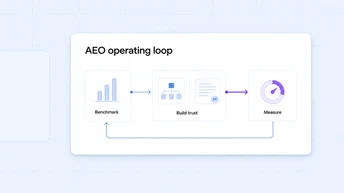
The Enterprise Guide to Answer Engine Optimization (AEO)
Enterprise guide to Answer Engine Optimization (AEO). Learn how to gain a competitive advantage in AI search and attribute revenue to your AEO program.
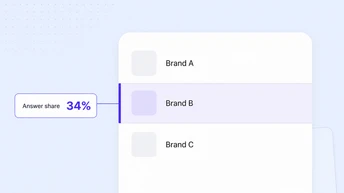
What Is AI Share of Voice?
What is share of voice in AI search? Learn how this new metric measures brand presence in AI answers and discover how to calculate, track, and improve it.
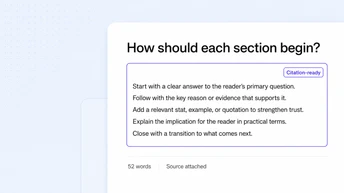
How to Optimize Blog Posts for AI Answer Engines
Optimize your blog posts for AI answer engines. Learn best practices for AEO, GEO, content length, and structured data to get cited by generative AI.
See AthenaHQ in Action
 AthenaHQ
 Rootly
10x Increase in Citation Rate
GEO became Rootly's #1 growth pillar. With ~10x citation rate growth and +126% mention rate on non-branded prompts, Rootly transformed AI Search into an executive-level operating channel.
AthenaHQ Lago
Lago50% Increase in Demos from AI Search
Lago achieved a 50% increase in demos from AI Search after implementing Athena. With 11x growth in AI Overview impressions and exploding citations, Athena became their command center for GEO.
AthenaHQ Nuvadermis
3x Share of Voice in 3 Months
Nuvadermis grew Share of Voice 3x in 3 months, with on-page citation rate climbing to 20%+ against a 4% category average, taking share from scar treatment heavyweights.