AthenaHQ vs Ahrefs:
Which Platform is Better for Enterprise AI Visibility?

Andrew Yan
Co-Founder, CEO of AthenaHQ

 VS
VS
Key Takeaways
Summary
 AthenaHQ is purpose-built for AEO and GEO, while Ahrefs approaches AI visibility as an extension of a broader SEO research suite. That difference shapes everything from the metrics each platform emphasizes to the workflows it supports.
- Enterprise AI visibility requires more than tracking mentions. Teams need prompt-level context, citations, source attribution, competitor presence, sentiment, share of voice, and repeatable testing to understand why a brand appears the way it does.
- AthenaHQ is oriented toward AI-first operating workflows, including cross-model monitoring, Source Intelligence, sentiment analysis, optimization recommendations, ACE agents, and attribution through GA4 and Shopify. Ahrefs combines AI visibility with established backlink, keyword, ranking, and technical SEO research.
- The right cost comparison depends on operating volume, not entry price. AthenaHQ uses response credits, while Ahrefs separates AI indexes and custom-prompt packages, so teams should model prompts, engines, markets, languages, refresh cadence, integrations, and existing subscriptions before comparing spend.
- For enterprise teams, the strongest evaluation is a controlled proof of work. Run the same high-value prompts, competitors, markets, and workflows through both platforms, then compare how well each product helps your team move from detection to diagnosis, action, and remeasurement.
AI search has created a visibility problem that traditional SEO metrics can’t fully explain: a brand can rank well in Google, maintain a strong backlink profile, and still be barely visible when a buyer asks ChatGPT or Perplexity which vendors to consider.
AthenaHQ’s State of AI Search 2026 report shows how wide that gap can become: across its benchmark, the average brand appeared in just 16.3% of AI responses to discovery prompts, while leading brands reached 56.48%. Brand-owned domains were cited in only 16.05% of responses overall, which means roughly 84% didn’t cite the brand’s own website. In Technology & Software, average brand mentions reached 17.54%, while top brands reached 58.20%.
This shows that AI visibility isn’t simply SEO with a new dashboard. Traditional search asks whether a page ranks and earns traffic. AI search introduces a whole other set of questions: Does the brand appear in the answer? How is it described? Which competitors appear beside it? What sources support the response? Does the engine cite the brand’s own content, or is a third-party defining the narrative instead?
AthenaHQ and Ahrefs approach those questions from different starting points. AthenaHQ is a dedicated answer engine optimization (AEO) and generative engine optimization (GEO) platform purpose-built to measure and improve brand representation in AI-generated answers. Ahrefs is an established SEO suite for backlink analysis, keyword research, rank tracking, and technical audits, with Brand Radar extending its workflow into AI mentions, citations, and competitive visibility.
The distinction is important for teams deciding whether AI visibility should live inside an existing SEO workflow or operate as a dedicated program with its own prompts, sources, metrics, owners, and optimization cycle. This guide compares the two platforms, with special consideration for enterprise teams.
How We Compare AthenaHQ and Ahrefs
Any useful AthenaHQ vs. Ahrefs comparison has to look beyond whether both products can display an AI mention. Similar metrics can be built from different prompt sets, engines, refresh schedules, source data, or classification methods, and those differences affect what enterprise teams can safely conclude from the dashboard.
This particular guide focuses on two main questions: what does each platform measure, and what can your team actually do with the findings? That means looking at engine and prompt coverage, citation analysis, source attribution, competitive intelligence, sentiment, reporting, integrations, action workflows, traditional SEO depth, enterprise administration, and total cost.
The starting point should be your primary job to be done. A team that spends most of its week investigating AI answers, tracing citations, comparing competitor representation, and assigning GEO actions has a different operating model from one that primarily manages backlinks, rankings, site health, and keyword opportunities. Which one should you choose?
- Prioritize a dedicated AI-search platform if your team routinely investigates prompts, citations, sentiment, sources, and AI-generated recommendations.
- Prioritize a traditional SEO suite if backlinks, keywords, rankings, technical audits, and conventional organic-search research remain your main responsibilities.
- Consider a combined workflow if conventional SEO and AI visibility are distinct programs that need different analytical depth but still share content, technical, and reporting resources.
For enterprise buyers, the operating-model question is more useful than asking which platform has the longest feature list. A feature only matters if it actually helps your team make a better decision, assign work, or measure whether that work changed the outcome.
What Counts as AI Visibility
AI visibility measures whether, where, and how a brand appears in AI-generated answers, citations, recommendations, and comparisons. AI responses can expose a brand in several ways, which makes it impossible to report in a single metric.
For example, your company might be named but not cited. Your website may be cited without your brand being explicitly mentioned as the recommended option. A competitor could appear less often in AI-generated responses, but receive significantly stronger recommendation language that influences purchase decisions. Or maybe a brand dominates their category because third-party review sites repeatedly frame it as the default choice. For each of these potential outcomes, you’ll need a different unit of measurement:
- AI Overview appearance tracking: Records whether your brand or page appears in a search engine’s generated overview.
- LLM-answer presence tracking: Checks whether an AI assistant includes your brand in its response.
- Brand-mention monitoring: Finds linked and unlinked references to your brand.
- Citation tracking: Records whether the response cites your domain, page, or another source associated with your brand.
- Cited-URL tracking: Preserves the exact destination URL so you can identify which assets earn references.
- Sentiment: Classifies the tone and context surrounding a brand mention.
- Share of voice: Compares your presence with selected competitors across a controlled prompt set.
- Prompt coverage: Measures the prompts, topics, intent groups, markets, and languages represented in monitoring.
- AI-search ranking or URL detection: Records prominence, ordering, or detected pages where a platform supports those measurements.
The source layer is especially important for enterprise GEO. AthenaHQ’s 2026 benchmark found that brand-owned domains are cited in only 16.05% of responses overall, while Reddit, YouTube, Wikipedia, LinkedIn, and Forbes ranked among the most frequently cited off-page sources. For enterprise teams, GEO extends beyond optimizing owned pages, but also requires understanding the wider information environment AI engines use to construct an answer.
The report also found that blogs represented 37.53% of the most commonly cited on-site paths across all segments and 57.27% in Technology & Software. That doesn’t mean every company should publish more blog posts indiscriminately, but it does reinforce the value of explanatory, comparison-oriented, and evidence-rich content that can answer a buyer’s question directly.
The Evaluation Criteria
The following criteria remain fixed throughout the comparison, so both AthenaHQ and Ahrefs are evaluated against the same enterprise requirements.
| Comparison criterion | What enterprise teams should evaluate | Why it matters for AI visibility |
|---|---|---|
| AI engine coverage | Supported answer engines, AI search products, regions, and languages | Customer behavior varies across platforms and markets. |
| Prompt and query coverage | Fixed prompts, suggested prompts, custom prompts, intent clusters, and limits | Coverage determines which demand patterns the platform can observe. |
| Citations and source attribution | Cited URLs, source domains, citation context, and historical records | Source data shows which pages and third parties shape AI answers. |
| Competitor benchmarking | Prompt-level mentions, cited pages, relative visibility, and selected competitors | Comparative data identifies where another brand receives stronger representation. |
| Sentiment and share of voice | Mention tone, prominence, and relative presence | These measures add context beyond a simple mention count. |
| Reporting | Exports, dashboards, trend views, and stakeholder-ready reports | Enterprise teams need repeatable analysis across functions. |
| Integrations and attribution | Analytics, commerce, content systems, and API connections | Integrations connect visibility with traffic, conversions, or revenue. |
| Action workflows | Content recommendations, source work, technical tasks, and ownership | Measurement becomes useful when teams can assign and evaluate changes. |
| Traditional SEO depth | Backlinks, keywords, rank tracking, technical audits, and content research | Many teams still need conventional search data beside AI visibility. |
| Enterprise administration | Member access, governance, workspaces, and implementation support | Larger programs require controlled access and clear accountability. |
| Pricing | Subscription fees, package requirements, add-ons, and custom terms | Headline prices may exclude required capabilities. |
| Usage-cost predictability | Credits, responses, prompts, indexes, overages, and API use | Monitoring volume can materially change total cost. |
This framework also prevents a common procurement mistake: comparing products at the level of labels instead of workflows. Two vendors may both list “citations,” for example, while one provides enough source context to diagnose a visibility problem and the other primarily identifies a cited page. Enterprise teams should test the depth behind the feature name.
AthenaHQ at a Glance
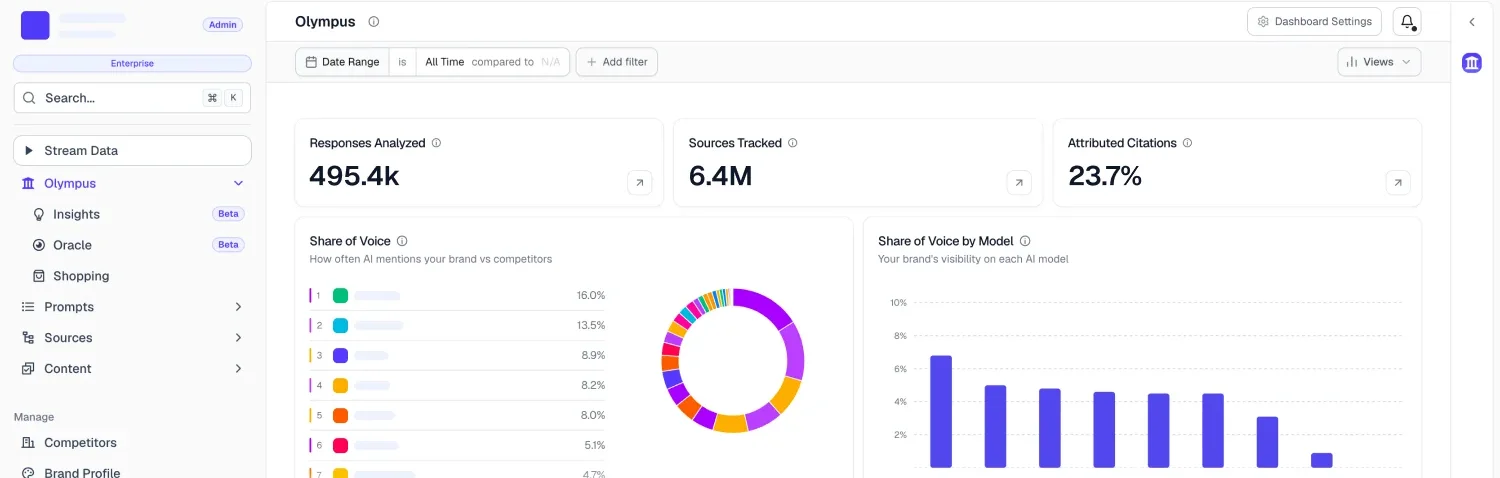
AthenaHQ is purpose-built for AEO and GEO rather than conventional keyword and backlink research. Its workflow centers on tracking AI answers, identifying the prompts and sources shaping those answers, and turning the resulting evidence into actions that can improve brand representation. Created by experts from Google Search and DeepMind, its key capabilities include:
- Comprehensive AI Engine Tracking: AthenaHQ provides a unified view of your brand’s presence across all major AI search platforms, including ChatGPT, Gemini, Claude, and Perplexity.
- Actionable Insights: AthenaHQ isn’t a passive dashboard. It translates raw monitoring data into prioritized optimization tasks to dramatically improve AI search visibility.
- Autonomous Agents (ACE): AthenaHQ’s proprietary Athena Citation Engine (ACE) agent independently analyzes content gaps, optimizes assets, and executes multi-step workflows for even the most robust, enterprise-scale AEO playbooks.
- Integrated Workflows: AthenaHQ seamlessly connects insights to actions, surfacing prompts and automating content production and optimization to increase citation probability.
- Business Outcome Focus: Through native integrations with Shopify and Google Analytics, AthenaHQ can directly attribute AEO efforts to actual revenue. Customers have achieved 1,561% ROI using AthenaHQ to convert AI visibility into quantifiable leads and sales pipeline.
- Enterprise Scalability: With flexible pricing and unlimited seats, AthenaHQ scales with organizations, instead of locking teams into per-user restrictions.
AthenaHQ has a 4.9 star rating on G2 and serves enterprise customers like SoFi, Wix, and ZoomInfo.
Results in AthenaHQ
AthenaHQ customers have seen dramatic results in their AI search visibility, including:
- 50 % increase in demos from AI search
- 38 % MoM increase in leads from AI search
- 40 % increase in brand mention rate
- 85 % faster response to brand mentions
- 50 % reduction in time spent on AI visibility tracking
- 2.5 x increase in AI-driven organic traffic
- 5 x increase in AI content citations
- 10 x increase in citation rate
Core Focus and Enterprise Fit
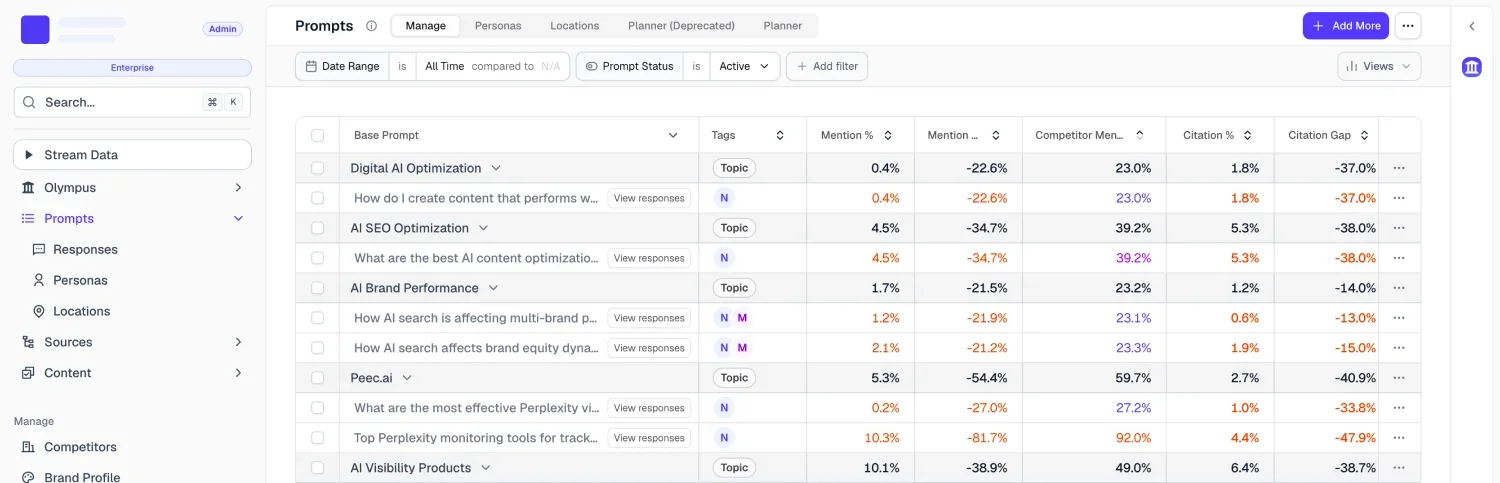
AthenaHQ is designed for teams treating AI search as an ongoing operating program rather than another metric tucked into an SEO report. The platform tracks brand and competitor appearances across major generative engines, and its Starter plan includes visibility across 11 models and AI search experiences: ChatGPT, Perplexity, Google AI Overviews, Google AI Mode, Gemini, Claude, Copilot, Grok, DeepSeek, Meta AI, and Mistral.
That breadth is especially critical for fragmented buyer’s journeys. A customer may begin with ChatGPT, validate an answer in Google, ask Gemini for a comparison, and encounter a different source set in Perplexity. A cross-model program helps teams see whether brand representation is consistent or whether visibility depends heavily on one engine.
AthenaHQ also makes GEO easier to treat as cross-functional work. Content teams can address answer gaps, PR teams can investigate influential third-party sources, growth teams can monitor demand and attribution, and e-commerce teams can connect visibility with Shopify or analytics data. All teams operate from the same insights and answer environment surrounding their brand, and can execute accordingly.
What AthenaHQ Measures and Helps You Do
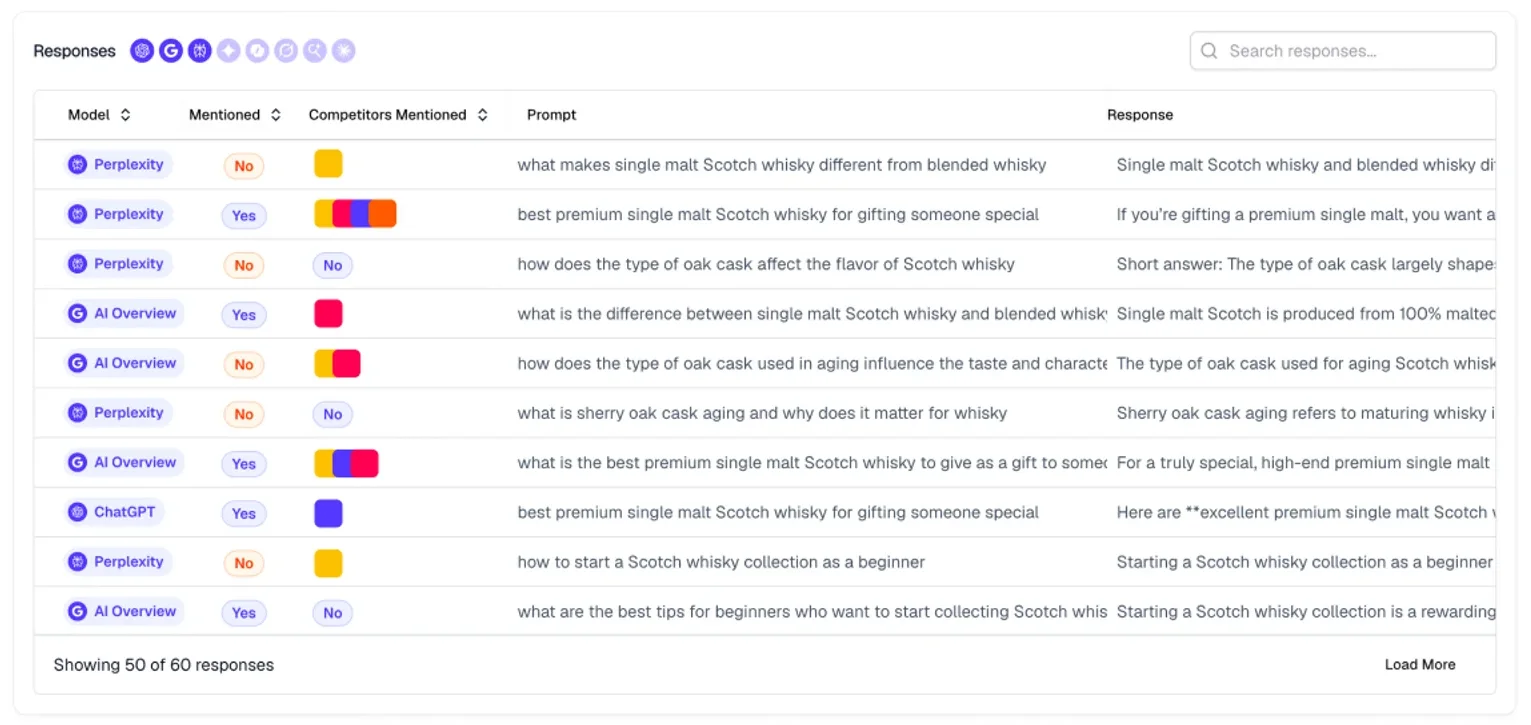
AthenaHQ measures visibility, mentions, citations, sentiment, share of voice, and competitor appearances. Prompt-level tracking identifies which questions trigger a brand mention and where competitors appear instead, giving teams a more precise unit of analysis than a single aggregate visibility score.
Source Intelligence adds another layer by examining the sources AI engines reference when discussing a brand. That can help distinguish several very different problems: your site may not answer the question clearly, a competitor may have stronger supporting evidence, an influential third-party page may omit your brand, or an outdated source may be shaping the answer. AthenaHQ also provides sentiment monitoring to support reputation work: a mention isn’t automatically a positive outcome. If an AI engine consistently describes a product as expensive, difficult to implement, or better suited to a different audience, the team needs to know both that the description exists and which sources may be reinforcing it.
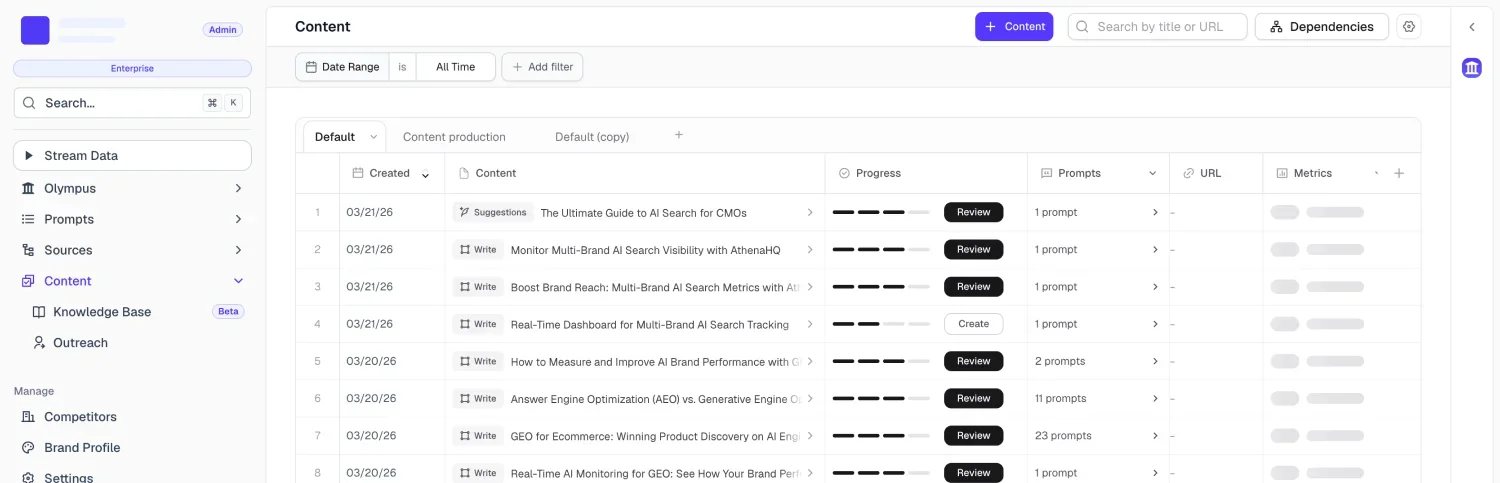
AthenaHQ also connects visibility data with Google Analytics, Search Console, Shopify, and Webflow workflows. Shopify and GA4 attribution can help teams investigate whether AI discovery aligns with traffic or revenue, while ACE agents analyze content gaps and draft optimization recommendations for human review.
This loop provides real practical value for enterprise GEO: detect a visibility problem, inspect the prompt and sources behind it, decide whether the issue belongs to content, technical SEO, PR, product marketing, or another owner, implement a controlled change, then re-measure the same prompt cohort.
Ahrefs at a Glance
Ahrefs begins from a completely different foundation: it’s a traditional SEO platform centered on backlinks, keyword research, rank tracking, competitive research, and site audits, while Brand Radar extends that environment with AI mentions, citations, and competitive visibility data.
Core Focus and AI Visibility Role
Ahrefs can be a fit for organizations that want AI visibility data inside an established SEO research workflow. For teams already using Ahrefs to understand rankings, backlinks, content opportunities, and technical issues, Brand Radar adds another view of how the brand appears when search behavior moves into AI-generated answers.
Brand Radar’s reported coverage includes ChatGPT, Gemini, Perplexity, Copilot, Google AI Overviews, and Google AI Mode. Enterprise buyers should still validate current engine availability, package access, geographic support, language settings, and refresh behavior because AI-search products change quickly.
The important distinction is that Brand Radar complements Ahrefs’ core SEO capabilities. Its value is partly the surrounding ecosystem: an analyst can investigate an AI visibility issue and then move into backlink, keyword, content, or technical research without leaving the broader Ahrefs environment.
What Brand Radar Adds to an SEO Workflow
Brand Radar provides AI mentions, cited pages, competitor benchmarking, prompt suggestions, and content-gap research. Those capabilities can help SEO teams compare conventional organic-search performance with brand representation in generated answers and identify places where the two diverge.
Ahrefs Web Analytics also adds AI referral reporting, which can show identifiable visits from AI sources. That data is useful, but it answers a different question from answer visibility. A buyer can read an AI-generated recommendation, absorb a brand name, and later visit directly or search for the company without ever clicking the original citation.
For existing Ahrefs customers, the central buying question is therefore not whether Brand Radar can track AI visibility at all. It’s whether its indexes, custom prompts, cited-page analysis, competitive data, and workflow depth are sufficient for the organization’s specific GEO program without adding a specialist platform.
Feature Matrix: AthenaHQ vs Ahrefs for Enterprise AI Visibility Monitoring
The primary trade-off is specialization. AthenaHQ concentrates on specifically AI search measurement, diagnosis, and action, while Ahrefs combines Brand Radar with a broader SEO research suite.
| Capability | AthenaHQ | Ahrefs | Enterprise buying implication |
|---|---|---|---|
| Core focus | Dedicated AEO and GEO platform | SEO suite with Brand Radar AI visibility | Choose based on whether AI operations or conventional SEO is the primary job. |
| AI engine coverage | 11 models, including ChatGPT, Gemini, Perplexity, Copilot, Claude, Google AI Overviews, and Google AI Mode | Reported coverage includes ChatGPT, Gemini, Perplexity, Copilot, Google AI Overviews, and Google AI Mode | Confirm every required engine in the chosen package. |
| AI answer monitoring | Tracks visibility and brand mentions | Brand Radar tracks AI mentions | Validate how each product defines a detected appearance. |
| Citation monitoring | Tracks citations and their context | Reports cited pages | Test whether the available detail supports source analysis. |
| Prompt tracking | Prompt-level monitoring and demand intelligence | Prompt suggestions and separately packaged custom-prompt tracking | Estimate custom-prompt volume before comparing cost. |
| Competitor benchmarking | Prompt-level brand and competitor comparison | Competitor benchmarking | Use the same competitor set during evaluation. |
| Sentiment | Supported | Not established by the supplied evidence | Teams managing reputation should test classification and review workflows. |
| Share of voice | Supported | AI visibility comparisons supported; exact supplied scope unavailable | Confirm calculation methods and underlying prompt sets. |
| Source attribution | Source Intelligence examines references shaping answers | Cited-page reporting | Decide how much source-level diagnosis your workflow requires. |
| Content-action workflows | Content-gap analysis, recommendations, and ACE agents | Prompt suggestions and content-gap research | Compare assignment and approval needs, not only dashboard output. |
| On-page actions | Optimization recommendations and drafting support | Research findings can inform SEO work; a Brand Radar optimizer isn't supported by supplied evidence | Decide whether the platform must recommend changes directly. |
| Off-page actions | Source and competitive intelligence can guide PR and source-strengthening work | Backlink research supports conventional off-page analysis | The platforms approach authority from different measurement layers. |
| Traditional SEO research | Not positioned as a full traditional SEO suite | Backlinks, keywords, rank tracking, and site audits | Ahrefs fits teams that want one environment for core SEO research. |
| Traffic attribution | GA4 integration | AI referral reporting through Web Analytics | Confirm source identification and reporting scope. |
| Revenue attribution | Shopify and GA4 attribution workflows | Not established by the supplied evidence | E-commerce teams should test revenue mapping with their own analytics setup. |
| Reporting | AI visibility, prompt, citation, sentiment, and competitive reporting | Brand Radar and Web Analytics reporting | Review exports, trend views, and stakeholder requirements. |
| Integrations | Google Analytics, Search Console, Shopify, and Webflow | Web Analytics within the Ahrefs workflow | Check authentication, data fields, and package access. |
| Agency or enterprise workflows | Governed actions and agency-oriented workflows | Existing Ahrefs research workflow; supplied enterprise administration details are unavailable | Run a role-based proof of work before contracting. |
| Pricing model | Free tier, paid subscription, response credits, and paid add-ons | AI indexes and custom-prompt packages, assessed with any required Ahrefs subscription | Model expected usage rather than comparing entry prices alone. |
Category-by-Category Breakdown
The feature matrix shows where the products differ, but what does that actually mean from an operational standpoint? Let’s dig in.
AI Response Visibility, Citations, and Source Attribution
AthenaHQ monitors visibility, mentions, citations, sentiment, and competitive movement across relevant AI platforms and markets, while Source Intelligence identifies the pages and domains associated with generated responses. The benefit of that combination is diagnostic depth: teams can move from “we aren’t appearing” to a more useful question about which sources, claims, or competitors are shaping the answer instead.
Ahrefs Brand Radar reports AI mentions and cited pages, which supports discovery of brand assets appearing in AI answers and comparison with competitors. For teams already doing SEO research in Ahrefs, cited-page data can become another signal alongside backlinks, rankings, and content performance.
During evaluation, be sure to use several answer types rather than a single branded prompt. Include product comparisons, category recommendations, informational questions, alternatives, problem-led prompts, and purchase-oriented queries. Then test whether each platform preserves enough source and answer context to explain what happened.
This matters because a citation is not inherently beneficial: a page may be cited for a minor factual detail while a competitor receives the recommendation. Conversely, a brand may be mentioned prominently without a citation. Enterprise teams need enough context to distinguish visibility from influence.
Prompt and Query Coverage
Prompt coverage determines what your measurement program can actually see. A dashboard can look comprehensive while missing the questions that matter most to buyers, which is why enterprise teams should build a governed prompt portfolio before comparing vendors.
AthenaHQ uses a credit-based structure in which one credit equals one AI response. The cost and analytical value of a prompt library therefore depend on the number of prompts, engines, markets, languages, and repeated checks.
Ahrefs separates AI index access from custom-prompt packages. Indexes can support broader market discovery, while controlled custom prompts are more useful for repeatable measurement against the exact questions your buyers ask.
Enterprise teams often need both discovery and control: broad data can reveal patterns you didn’t know to look for, while a fixed prompt cohort lets you test whether a specific content, source, or technical change affected representation over time. When comparing platforms, ask how each handles both jobs.
Competitor Benchmarking, Sentiment, and Share of Voice
Competitor benchmarking becomes more useful when it moves beyond counting names. AthenaHQ provides prompt-level competitor comparisons, which can show where another brand appears, what sources support the answer, and how the language around each company differs.
Sentiment adds an important reputation layer. A company can have strong visibility and still be represented poorly. One brand may appear frequently but be framed as expensive or difficult to implement, while a competitor appears less often but receives stronger recommendation language. Those outcomes require different responses.
Share of voice also needs context. An aggregate percentage can help show movement, but enterprise teams should know which prompts, engines, markets, and competitors sit underneath the number. A gain driven by low-value informational prompts may matter less than a smaller gain across high-intent comparison queries.
Ahrefs supports competitor benchmarking through Brand Radar, but the supplied evidence doesn’t establish a matching sentiment capability. If reputation monitoring is part of the buying requirement, include sentiment classification, source context, and human-review workflows in the product demonstration rather than assuming feature parity.
Reporting, Integrations, and Enterprise Workflows
AI visibility data becomes more valuable when teams can connect it with the systems they already use to make decisions. AthenaHQ connects visibility metrics with Shopify and GA4 data, giving growth and e-commerce teams an attribution layer for investigating whether AI discovery aligns with traffic or revenue.
Ahrefs provides AI referral reporting through Web Analytics, which can suit SEO teams that want to place detectable AI traffic beside other acquisition data. The distinction is important: referral reporting measures identifiable visits, while AI visibility can influence a buyer even when no click occurs.
Enterprise buyers should also examine the less glamorous workflow details that determine whether a platform survives contact with a large organization: exports, APIs, user roles, workspace controls, approval processes, repeatable reporting, and ownership. A useful demonstration should follow one finding from detection through diagnosis, assignment, implementation, and remeasurement.
The best dashboard in the world becomes decorative wallpaper if nobody knows who owns the next action.
Ease of Use and Operational Fit
Ease of use depends on what the user is trying to accomplish. AthenaHQ is organized around recurring GEO monitoring, citation research, competitor analysis, and optimization actions, which can reduce the amount of translation required for teams operating an AI-first program.
Ahrefs fits a different kind of workflow: SEO teams that already live in Ahrefs can add AI visibility research without abandoning the environment they use for backlinks, keywords, rankings, and audits. That continuity can matter when GEO is still owned by the SEO team rather than a separate cross-functional program.
Instead of relying on generic usability scores, ask the people who’ll actually use the product to complete the same tasks in both platforms. Can an analyst identify a weak prompt? Can a content lead understand what should change? Can a PR lead see which external source matters? Can an executive get a defensible summary without a guided tour from the platform administrator?
Performance and Measurement Depth
A published AI visibility tools comparison cited in the source article reports daily tracking, citation analytics, GA4 or Shopify attribution, and content agents for AthenaHQ, while reporting limitations in daily tracking, citation analytics, GA4 attribution, and content optimization for Ahrefs Brand Radar. Those findings are useful as evaluation inputs, but they shouldn’t be treated as permanent product characteristics.
AI-search products change quickly, and packaging can change just as quickly. Confirm refresh cadence, model coverage, geographic settings, language support, historical data, export depth, and package limits in the live product.
Measurement depth should also match your decision cycle. A team making weekly content and PR decisions may need a different refresh schedule from an executive team reviewing category visibility quarterly. More frequent data isn’t automatically better if the organization doesn’t have a process for acting on it.
Pricing, Plans, and Investment Considerations
The AthenaHQ pricing vs. Ahrefs decision requires more than comparing two monthly numbers because the products package AI visibility differently. Your total cost depends on monitored responses, prompts, indexes, add-ons, analytics requirements, markets, languages, and any Ahrefs subscription your organization already maintains.
| Pricing consideration | AthenaHQ | Ahrefs | What to confirm before buying |
|---|---|---|---|
| Entry pricing | The Starter plan costs $295/month and includes 3,600 credits. There is also a free plan with prompt and response analysis, plus sources and competitor insights | Brand Radar AI indexes start at $199/month; custom-prompt packages start at $50/month | Required subscription, billing period, and package scope. |
| Free access or trial status | Essential is a free tier with $25 in free credit, 300 credits, and unlimited members | Not established by the supplied evidence | Treat a continuing free tier differently from a time-limited trial. |
| Usage model | One credit equals one AI response | Index and custom-prompt package model | Expected prompts, engines, repeat checks, and overages. |
| Add-ons | Extra credits and API access are paid Starter add-ons | AI indexes and custom-prompt packages are separately priced | API access, prompt allowances, index access, and overage rates. |
| Enterprise pricing | Custom pricing with custom credit allocations | Not established by the supplied evidence | Governance, service, limits, security, and contract terms. |
| Likely cost drivers | Response volume, engines, regions, languages, extra credits, and API use | Required Ahrefs subscription, indexes, custom prompts, and package limits | Model total cost at expected operating volume. |
AthenaHQ Pricing and Usage Model
AthenaHQ Starter costs $295 per month and includes 3,600 credits.
The Essential tier is free and includes $25 in free credit, 300 credits, and unlimited members. It’s a free tier rather than a time-limited trial, but its access shouldn’t be treated as equivalent to Starter or Enterprise. Extra credits and API access are paid Starter add-ons, while Enterprise uses custom pricing and credit allocations.
Ahrefs Brand Radar Pricing and Package Considerations
Ahrefs Brand Radar AI indexes start at $199 per month, while custom-prompt packages start at $50 per month. Buyers should assess those charges alongside any required Ahrefs subscription and, for existing customers, separate the incremental AI-search cost from spend the organization already considers part of its SEO stack.
Indexes and custom prompts solve different problems. Index data can support broad discovery and competitive research, while custom prompts let teams repeatedly monitor questions tied to their own products, audiences, and buying journeys.
Ask Ahrefs to confirm included custom prompts, supported engines, update behavior, package limits, overage rates, and access requirements. A low starting price can become less meaningful if the enterprise use case requires several separately priced components.
How to Compare Total Cost
Build a usage model before comparing proposals:
- List every required engine or index.
- Count the custom prompts in your fixed monitoring library.
- Estimate response volume across engines, countries, languages, and refresh cycles.
- Calculate likely extra-credit or overage needs.
- Define API and export requirements.
- Confirm user-seat and workspace requirements.
- List required attribution integrations, including analytics and commerce systems.
- Record whether your organization already pays for Ahrefs.
- Ask each vendor to price the expected operating volume and a higher-volume scenario.
Use the same assumptions for both products. That prevents a lower entry price from obscuring package dependencies, add-ons, or usage-based charges and gives procurement a more defensible total-cost comparison.
How to Track ChatGPT Search Performance and Generative Rankings
A reliable AthenaHQ vs. Ahrefs evaluation for ChatGPT search performance uses a controlled prompt cohort. Neither platform can guarantee a stable generative ranking because AI answers vary by model, prompt wording, context, location, language, interface, and time.
That variability doesn’t make measurement useless. It simply means the measurement design has to be disciplined enough to separate a meaningful pattern from ordinary answer variation.
Set Up a Controlled Measurement Framework
Start with a fixed prompt library based on real customer demand, then group prompts by intent, such as product discovery, alternatives, comparisons, troubleshooting, education, and purchase evaluation. Tie each prompt to a business context so the team knows why it matters.
For every check, record the testing conditions your organization considers relevant, including date, country, language, platform, and other controlled variables. The objective is comparability: when the answer changes, you want to know whether the information environment changed or the test itself changed.
- Engines that your customers use
- Prompts and intent clusters
- Countries or regions
- Languages
- Buyer-defined refresh cadence
- Named competitors
- An accountable owner for measurement
- Owners for content, technical, PR, and reporting actions
Use the same prompt cohort and settings when comparing platforms. Otherwise, you’re comparing two datasets rather than two products.
Measure the Right AI Visibility Signals
Track several signals together because no single metric captures AI visibility:
- Mention rate: Answers mentioning your brand divided by answers checked.
- Citation rate: Answers citing your domain divided by answers checked.
- Competitor mention rate: Answers mentioning a selected competitor divided by answers checked.
- Answer change rate: Materially changed answers divided by answers rechecked.
- Sentiment: The tone and context surrounding the brand mention.
- Source pattern: The domains and URLs repeatedly shaping answers for the prompt cohort.
AthenaHQ’s benchmark provides useful context for why this multi-metric approach matters. Across all segments, the average brand appeared in 16.3% of discovery-prompt responses, while leading brands reached 56.48%. Brand-owned domains were cited in only 16.05% of responses, and AI models drew from a diverse source environment rather than relying exclusively on first-party pages.
Preserve the full answer text when governance policy allows it. Otherwise, keep a detailed summary with citations, destination URLs, brand prominence, sentiment, competitor mentions, and material changes. Define classification rules before multiple analysts begin reviewing results.
Turn Findings Into Content and Technical Actions
Start with prompts that matter commercially and show a clear visibility gap. If a competitor appears more often, inspect the cited sources and compare the information those sources provide with your own content and third-party presence.
The resulting action might be an on-page content update, stronger supporting evidence, clearer entity information, improved crawl access, a new comparison resource, or outreach around an influential third-party source. The right action depends on the cause of the gap, which is why source context matters.
Assign one owner, document what changed, and recheck the same prompt cohort under comparable conditions. AthenaHQ’s Shopify and GA4 integrations provide an example attribution layer that can help teams investigate whether AI visibility changes align with traffic or revenue without pretending that visibility alone proves causation.
The goal isn’t to control an AI engine’s answer, but to improve the quality, consistency, and authority of available information, then measure what actually changes.
AthenaHQ Pros and Cons
Pros
- Purpose-built GEO orientation: The workflow focuses on AI answers, citations, prompts, sources, sentiment, and actions rather than adapting conventional rank tracking.
- Broad Starter coverage: Starter lists visibility across 11 models and AI search experiences.
- Prompt-level competitor benchmarking: Teams can investigate the specific questions that produce brand or competitor appearances.
- Source and sentiment monitoring: Source Intelligence and tone analysis support citation research and reputation management.
- Content-gap optimization agents: ACE agents analyze gaps and draft recommendations that teams can review before publishing.
- Revenue attribution options: Shopify and GA4 integrations can connect AI visibility analysis with commercial reporting.
Taken together, those strengths make AthenaHQ most relevant when AI visibility has become a recurring operating responsibility rather than an occasional research exercise.
Considerations
- Variable usage cost: Each monitored AI response consumes a credit, which can make high-volume programs harder to forecast.
- Paid Starter add-ons: API access and extra credits add to the Starter subscription price.
- Plan-dependent access: The free Essential tier provides a useful entry point, but it doesn’t represent all Starter or Enterprise capabilities.
- Not a replacement for a full SEO suite: Teams that still need deep backlink, keyword, ranking, and technical research may continue using a traditional SEO platform alongside AthenaHQ.
Ahrefs Pros and Cons
Pros
- Traditional SEO depth: Ahrefs covers backlink analysis, keyword research, rank tracking, competitive research, and technical audits.
- AI monitoring within an SEO suite: Brand Radar places AI mentions and visibility data beside established SEO research.
- Cited-page and competitor analysis: Teams can identify cited assets and compare brand appearances with competitors.
- AI referral reporting: Web Analytics helps teams examine identifiable visits from AI sources.
- Operational familiarity: Existing Ahrefs teams can add AI visibility work without moving all conventional SEO research to another product.
Those strengths are especially relevant when GEO remains closely tied to the SEO function and the organization values one research environment across conventional and AI search.
Cons
- Separately priced components: AI index access and custom-prompt packages have separate starting prices.
- Package-specific limits: Buyers must confirm custom-prompt allowances, required subscriptions, and overage rates.
- Reported measurement limits: The cited tools test reports limitations in daily tracking, citation analytics, GA4 attribution, and content optimization for Brand Radar; confirm the current position for your proposed package.
- AI visibility remains a product layer: AI-first teams may need more specialized source, sentiment, attribution, or action workflows than their Ahrefs package provides.
- Some enterprise GEO requirements require direct validation: The supplied comparison doesn’t establish parity for every sentiment, attribution, governance, or workflow capability.
Verdict: Which Platform Is Better for Your Enterprise Team?
The better fit depends on the operating model your organization is building. AthenaHQ was built around dedicated AI search measurement and optimization, while Ahrefs is designed for traditional SEO teams that want to add AI visibility to an established research workflow.
For an enterprise buyer, that distinction is more useful than declaring one platform universally better. The decision should follow the work your team needs to perform, the depth of diagnosis required, and the systems you already use.
Choose AthenaHQ If
AthenaHQ is designed for teams that need:
- Dedicated AI-search visibility measurement
- Cross-model prompt monitoring
- Citation and source intelligence
- Sentiment and share-of-voice analysis
- Prompt-level competitor benchmarking
- Content and reputation action workflows
- Shopify or GA4 attribution
- Collaboration across content, PR, growth, commerce, and agency teams
AthenaHQ is especially well aligned with organizations treating GEO as a distinct, recurring program with its own prompt portfolio, reporting cadence, owners, and optimization loop.
Choose Ahrefs If
Ahrefs is designed for teams whose primary responsibilities still include backlink analysis, keyword research, rank tracking, competitive SEO research, and technical audits, but that also want AI mentions, cited pages, competitor benchmarking, and referral reporting in the same broader environment.
Frequently Asked Questions
AthenaHQ is a dedicated AEO and GEO platform built around measuring, diagnosing, and improving brand representation in AI-generated answers. Ahrefs is a broader SEO suite whose Brand Radar product adds AI mentions, citations, and competitive visibility to established backlink, keyword, ranking, and technical SEO workflows.
Become the Brand AI Trusts
See, Act, and Win on AI Search and Beyond
See It In Action
AthenaHQ Cozy Earth
The Most-Cited Sleepwear Brand in AI Search
Cozy Earth used AthenaHQ to protect its lead in sleepwear, identify a loungewear opportunity, and give its two-person content team a clearer way to prioritize what to publish next.
AthenaHQ Rootly
10x Increase in Citation Rate
GEO became Rootly's #1 growth pillar. With ~10x citation rate growth and +126% mention rate on non-branded prompts, Rootly transformed AI Search into an executive-level operating channel.
AthenaHQ Lago
Lago50% Increase in Demos from AI Search
Lago achieved a 50% increase in demos from AI Search after implementing Athena. With 11x growth in AI Overview impressions and exploding citations, Athena became their command center for GEO.