AthenaHQ vs AirOps:
Which GEO Platform Is Better for AI Visibility?

Andrew Yan
Co-Founder, CEO of AthenaHQ

 VS
VS
Key Takeaways
Summary
 AthenaHQ is a dedicated Generative Engine Optimization platform. It tracks brand visibility across 11 AI engines on its paid Starter plan, including ChatGPT, Perplexity, Claude, and Gemini. AirOps is a content automation platform that connects AI visibility insights to content production workflows.
- AthenaHQ is built around visibility diagnosis and proof. Its Olympus dashboard, Athena Citation Engine, prompt-volume estimates, and prioritized actions help teams understand where they appear in AI answers, why, and what to improve.
- AirOps is built around content throughput. Quill, Grids, Brand Kits, and workflow automation help production teams create, refresh, govern, and publish content at scale.
- AthenaHQ offers transparent pricing from $0/month, with Starter at $295/month. AirOps offers free starting points for Solo and Pro; recurring prices require confirmation.
- The right choice depends on the operating bottleneck. Choose AthenaHQ when AI answer visibility, competitive intelligence, and measurable GEO impact are the goal. Choose AirOps when content production and workflow orchestration are the primary constraint.
The way customers find information has changed more in the past two years than it did in the previous two decades. AI Overviews and AI Mode now deliver synthesized answers directly on the results page, while tools like ChatGPT, Claude, Perplexity, and Gemini are becoming a first stop for research. McKinsey reports that half of consumers now use AI-powered search.
That shift has moved Generative Engine Optimization from an experiment to a strategic investment. Brands are no longer optimizing only for a place among the traditional “10 blue links.” They also need to earn citations, mentions, and accurate representation inside AI-generated answers.
Most brands still have a long way to go. AthenaHQ’s State of AI Search 2026 report found an average brand mention rate of 16.3% in the first half of 2026. Category leaders reached 56.5%—roughly 3.5 times the average. Waiting has a real visibility cost, while teams that establish authority early can build an advantage that is difficult to displace.
AthenaHQ and AirOps frequently appear in the same buying conversations, but they were designed to solve different problems. AthenaHQ is centered on AI visibility intelligence and prioritized GEO action. AirOps is centered on content operations and workflow execution. This comparison covers their core focus, engine coverage, dashboards and APIs, content automation, ideal use cases, and pricing.
AthenaHQ vs. AirOps at a Glance
The fastest way to compare the platforms is to look at the job each one is designed to do.
| Feature | AthenaHQ | AirOps |
|---|---|---|
| Core Focus |  Dedicated GEO and AI visibility intelligence Dedicated GEO and AI visibility intelligence | AI search content operations and workflow automation |
| AI Engine Coverage | 11 models on Starter | ChatGPT on Solo; multi-engine insights on Pro |
| Key Differentiator | Athena Citation Engine, QVEM prompt-volume estimates, and prioritized visibility actions | Quill agent, Grids, Brand Kits, and configurable content workflows |
| Starting Point | Diagnose visibility and citation gaps | Define and run content production workflows |
| Dashboard | Unified responses, prompts, citations, competitors, sentiment, and share of voice | Insights and Page360 connected to tasks and content execution |
| Content Execution | Prioritized on-page and off-page actions with content optimization | High-volume creation, refresh, governance, and publishing |
| Team Access | Unlimited members on Starter and Enterprise | Single user on Solo; unlimited seats on Pro and Enterprise |
| Multi-Brand Support | Portfolio reporting for 3 to 50+ brands across 30+ markets | Multiple Brand Kits and custom limits on Enterprise |
| Best For | Insight-led GEO teams that need deep visibility analytics and proof of impact | Production-led teams that need scalable content operations |
| Starting Price | Free Essential plan; $295/month Starter | Solo and Pro offer a free starting point; recurring prices not public |
The workflow fork
The platforms automate different halves of the GEO loop
AthenaHQ begins with evidence about how a brand appears in AI answers. AirOps begins with a content objective and an operating workflow.
AthenaHQ
How visible are we, and what should we improve next?
- Measure AI visibility
- Diagnose citation gaps
- Prioritize an action
- Re-run and prove impact
Best when the team needs visibility intelligence, a defensible next move, and metrics leadership can evaluate.
AirOps
How do we create and refresh content at scale?
- Set a content objective
- Configure brand and workflow rules
- Run production tasks
- Review and publish
Best when the strategy is already clear and the team needs governed production capacity and faster publishing.
What Is AthenaHQ?
AthenaHQ
Purpose-built GEO intelligence for measurable AI visibilityAthenaHQ is a purpose-built Generative Engine Optimization platform designed to help brands get discovered, cited, and accurately represented across AI search engines. Its proprietary Athena Citation Engine analyzes the on-page and off-page signals that influence how answer engines reference content and predicts citation probability.
AthenaHQ also uses autonomous agents to monitor visibility, uncover content gaps, and turn those gaps into prioritized actions. A second proprietary model, the Query Volume Estimation Model, estimates prompt volume and frequency so teams can focus on the questions customers are actually asking rather than treating every possible prompt as equally valuable.
The Olympus dashboard brings AI-native metrics—share of voice, citation sources, brand mentions, sentiment, prompt performance, and competitor visibility—into one accessible view. It is structured for mid-market and enterprise teams, including portfolios that need to manage multiple brands, markets, languages, and stakeholder views from the same instance.
Built by experts from Google Search and DeepMind, AthenaHQ has a 4.9 rating on G2 and serves teams at companies including SoFi, Wix, and ZoomInfo.
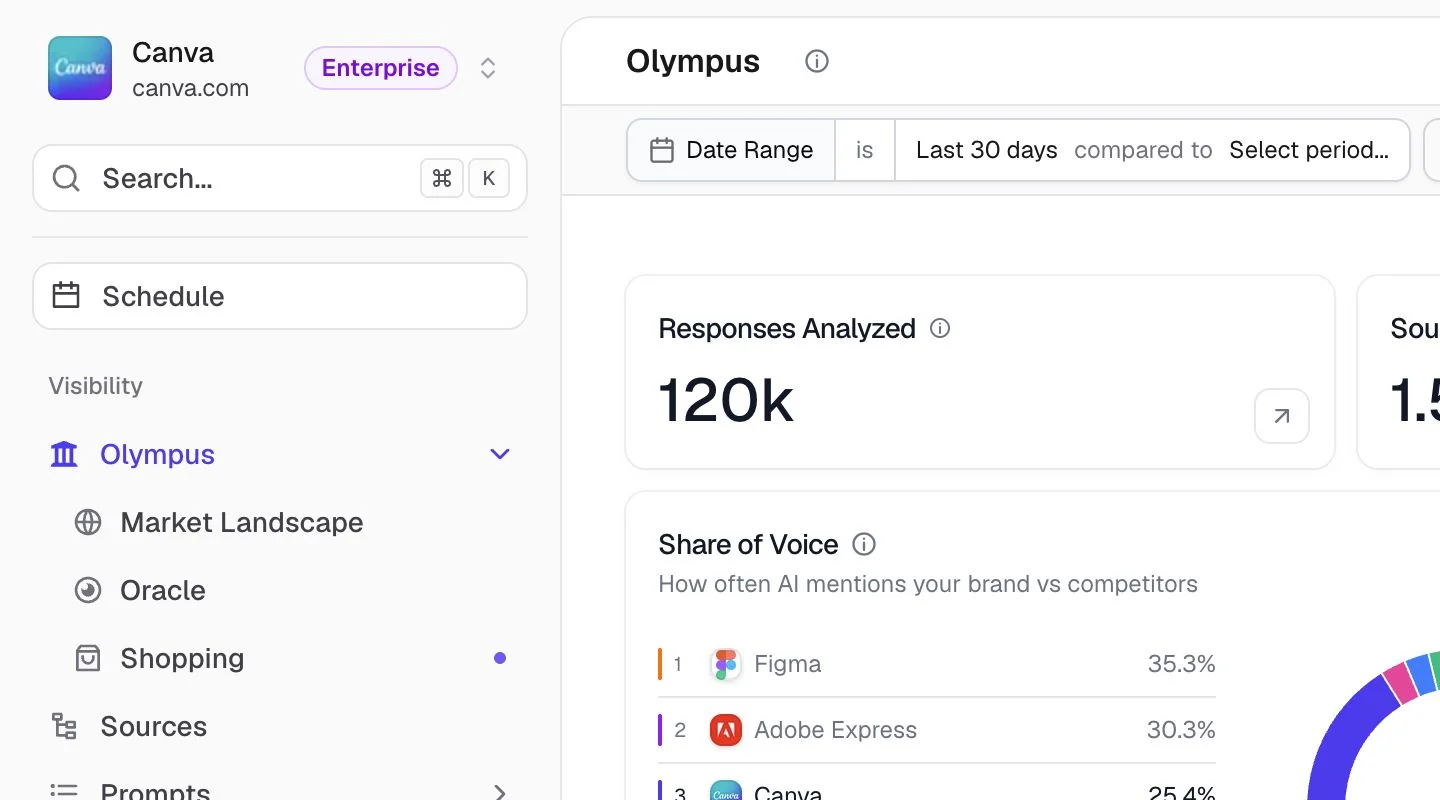
What AthenaHQ is built to improve
The platform connects AI visibility data to measurable changes in discoverability and team efficiency. Customer results include:
- 40 % increase in brand mention rate
- 10 x increase in citation rate
- 2.5 x increase in AI-driven organic traffic
- 50 % less time spent on AI visibility tracking
Customer Response
Customers across technical, regulated, and multi-location categories consistently highlight visibility depth, usability, and a bias toward action.

Computer Software
–Verified Customer Review, G2“Our buyers are technical and increasingly skeptical of traditional marketing. They research tools by asking Claude or ChatGPT for recommendations before they ever visit our site.
AthenaHQ gave us that visibility without requiring a dedicated analyst. The competitive benchmarking revealed that a smaller open-source competitor was being cited more frequently than us for our core use case.
What I appreciate most is the bias toward action. AthenaHQ tells us specifically which content to create or update, with context on why it matters.”

Financial Services
–Verified Customer Review, G2“AthenaHQ costs less and actually gets used. It surfaces what matters without forcing us to dig. It identified that we were completely absent from prompts about a core line of business, even though we had content on the topic.
The platform showed us exactly which pages needed work, and the team responded quickly when we raised a sentiment-classification issue.”

Real Estate
–Verified Customer Review, G2“We manage multiple residential real estate brands across thousands of franchise locations. AthenaHQ helped us understand how our brands perform in AI conversations.
The regional tracking has been particularly valuable. We can segment visibility by metro area and give regional marketing teams data they can act on, which is exactly how it should be.”
What Is AirOps?
AirOps
Content operations and workflow automation for AI searchAirOps describes itself as a growth platform for AI search. Its strongest orientation is content production and workflow automation: it helps teams turn an objective into governed content work, then create, refresh, review, and publish at scale.
The platform is organized around capabilities such as content refresh, content creation, offsite visibility, Brand Kits, Grids, and Workflows. These are coordinated through Quill, an AI agent that can execute repeatable content playbooks. Think of AirOps as an operating system for production: AI search signals can inform the work, but the product’s center of gravity is orchestration and execution.
That workflow orientation is genuinely useful for teams that already know what they need to produce and want the throughput to ship it faster. AirOps’ official pricing page lists 35,000 content tasks on Solo and 100,000 on Pro, reinforcing the platform’s production-led model.
The important distinction is not that one platform does everything while the other does nothing. They automate different parts of the GEO process. AirOps is stronger when the bottleneck is governed content throughput. AthenaHQ is stronger when the bottleneck is understanding visibility, prioritizing the next move, and proving whether it worked.
Feature Breakdown: AI Search Visibility and GEO
Visibility Analytics vs. Workflow Automation
One of the biggest differences is the primary question each platform was designed to answer.
AthenaHQ asks: “How visible is my brand across AI engines, why am I gaining or losing ground, and what should I improve next?” Its platform is organized around responses, citations, prompts, competitors, sentiment, prompt volume, and prioritized actions.
AirOps asks: “How do I turn an AI search or content objective into a repeatable production system?” Its platform is organized around Insights, Page360, Quill, Grids, Workflows, Brand Kits, content tasks, and publishing integrations.
AirOps gives hands-on teams more control over workflow logic. AthenaHQ reduces the analytical lift by scanning visibility data, diagnosing gaps, and handing the team prioritized work. The right model depends on whether the team needs to discover the strategy or operationalize one it already understands.
AI Engine and Platform Coverage
AthenaHQ tracks visibility across 11 models on Starter, including ChatGPT, Perplexity, Claude, Gemini, Copilot, Grok, Google AI Overviews, Google AI Mode, DeepSeek, Meta AI, and Mistral. Broad coverage matters because each engine has different sourcing patterns, audiences, and preferences. A brand may be prominent on one platform and largely absent from another.
AirOps takes a tiered approach. Its Solo plan includes ChatGPT insights. Pro expands to multi-engine insights, while Enterprise offers custom limits, regions, personas, and languages.
The entry-tier distinction is practical: a team buying AthenaHQ Starter receives the wider cross-engine view immediately, while an AirOps buyer must move beyond Solo for multi-engine analysis. A team focused mainly on production tasks may accept that tradeoff; a team using visibility as its primary KPI should weigh it carefully.
Dashboard, Reporting, and API Capabilities
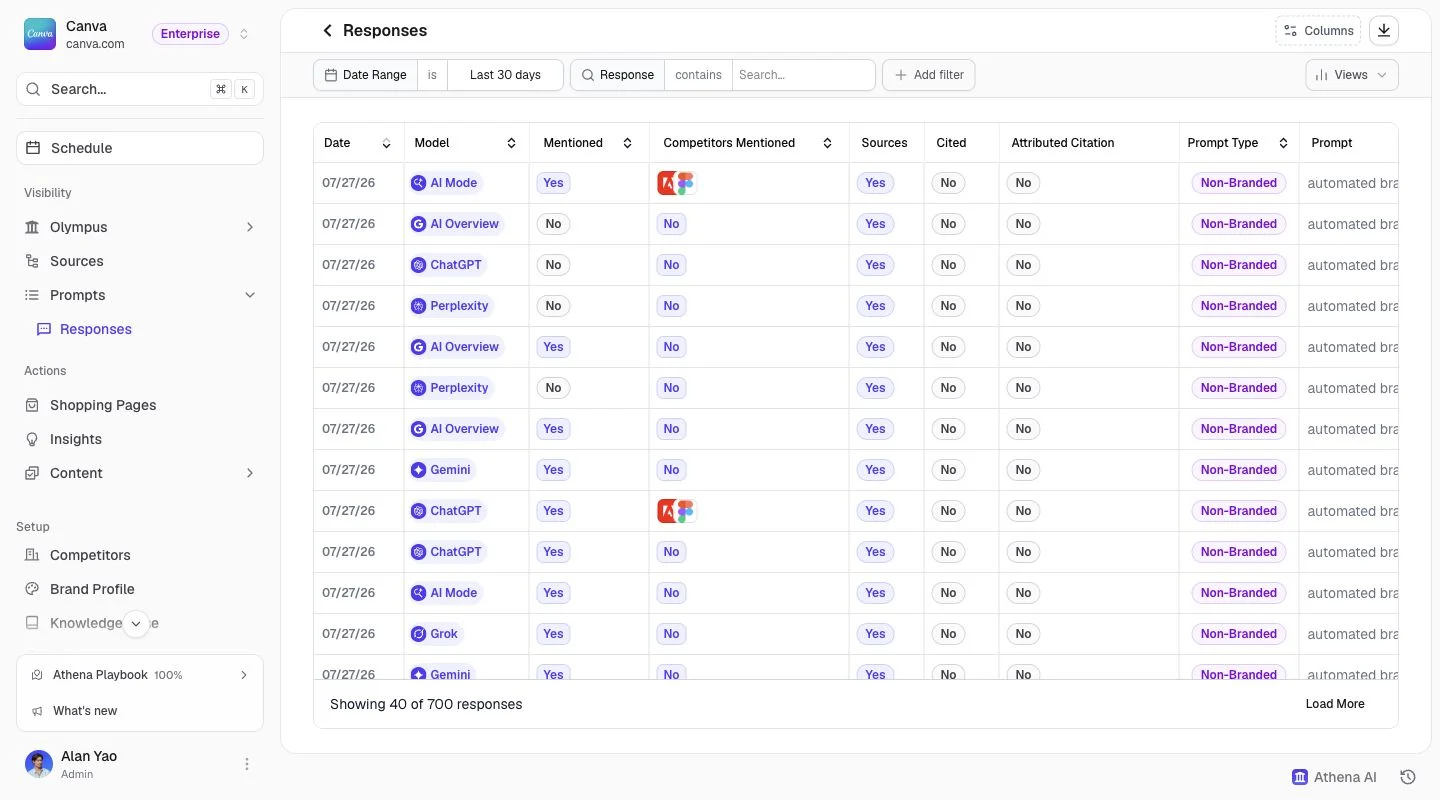
AthenaHQ’s Olympus dashboard consolidates AI responses, prompts, citations, sources, competitor mentions, sentiment, and share of voice. Teams can export data and connect visibility work to reporting and business intelligence workflows. Enterprise capabilities include SAML and OIDC single sign-on, role-based controls, multi-region and multi-language support, and executive dashboards.
AirOps connects visibility data to content operations. Insights and Page360 help teams identify opportunities, while Quill, tasks, Grids, and Workflows carry those opportunities into execution. AirOps supports CSV export, enterprise API access, native integrations, and an MCP connector for bringing platform capabilities into external AI tools.
For enterprise buyers, the deciding factor is how the data will be used. AthenaHQ is optimized for deep GEO analysis, portfolio reporting, executive visibility, and a clear chain from evidence to action. AirOps is optimized for moving insight into an operating workflow that creates and publishes content.
Content Optimization and Automation
Both platforms optimize content, but they enter the workflow at different points.
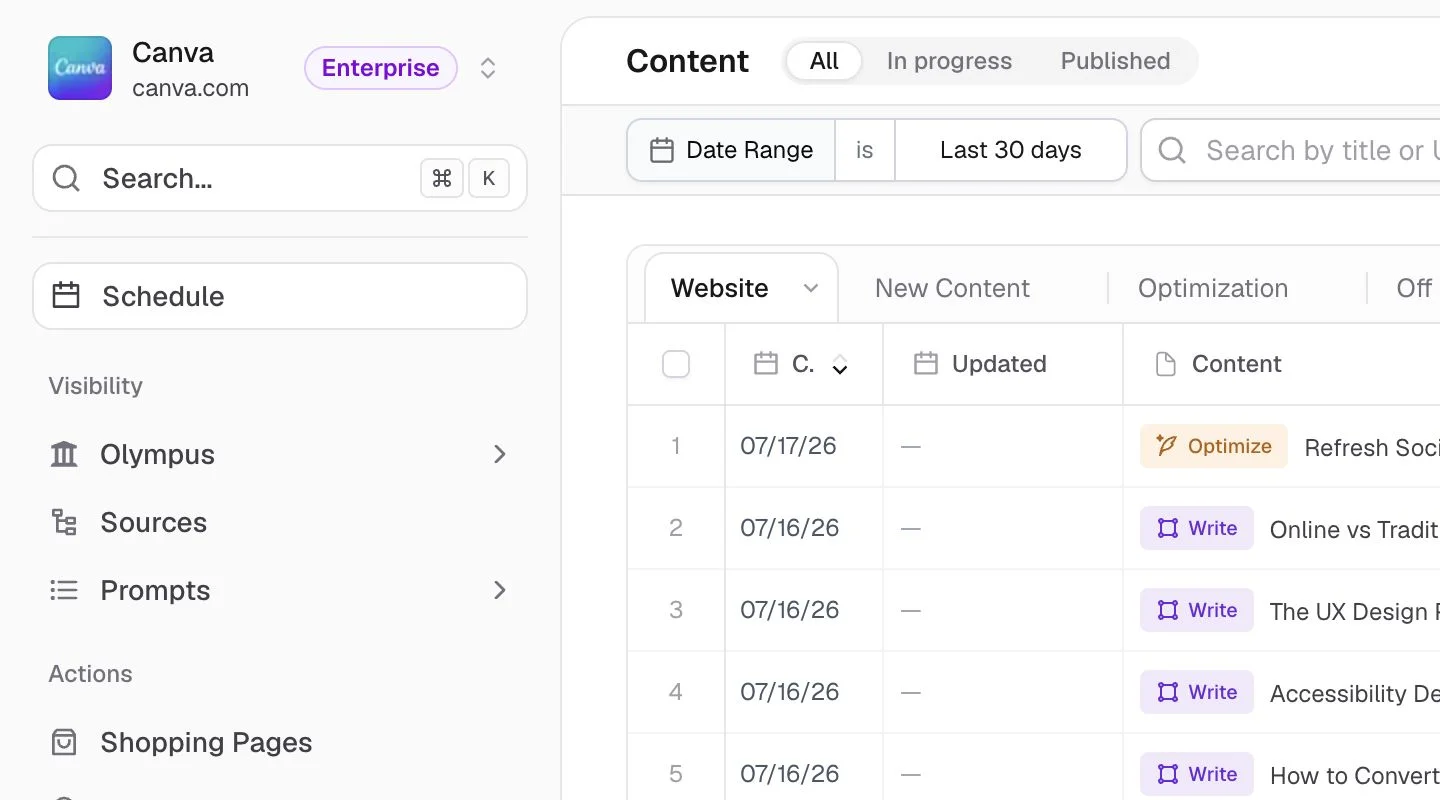
AthenaHQ translates monitoring data into specific, prioritized tasks backed by evidence such as response snapshots, citations, competitor movement, and visibility deltas. Its content tools can identify an underperforming page, recommend or draft changes, preserve brand messaging, and re-run the relevant prompt set to measure whether the update improved results.
AirOps starts with production. Quill and configurable workflows can generate or refresh high volumes of content, apply Brand Kit rules, route work through review, and publish through connected systems. This is a strong fit for teams that already understand the opportunity and need reliable execution capacity.
Ideal Use Cases: Who Is Each Platform For?
When to Choose AthenaHQ
Choose AthenaHQ when AI answer visibility is the primary goal. It is built for marketing leaders, data-driven agencies, and enterprise teams that need to understand how AI engines describe their brand, track citations, benchmark competitors, prioritize the next action, and prove GEO impact to leadership.
AthenaHQ is especially strong for multi-brand and multi-market programs. Teams can manage 3 to 50+ brands from one instance, segment performance by geography and persona, and share consolidated portfolio reporting without stitching together multiple dashboards.
AthenaHQ is the better fit when you need:
- A complete view across major AI engines
- Citation, mention, sentiment, and competitor intelligence
- Prompt-volume estimation to prioritize demand
- Prioritized on-page and off-page GEO actions
- Multi-brand, multi-market, and executive reporting
- A measurable loop from visibility gap to verified improvement
When to Choose AirOps
Choose AirOps when the bottleneck is content operations rather than visibility diagnosis. It is suited to production-led growth teams, content operations groups, and SEOs that already have a clear strategy and need to scale creation, automate refreshes, enforce brand rules, and manage complex publishing workflows.
AirOps is the better fit when you need:
- High-volume content creation and refresh workflows
- Configurable logic through Grids and Workflows
- Brand governance embedded in production
- Human review gates and CMS publishing integrations
- Task-based scale for a content operations team
- Quill to coordinate repeatable content playbooks
The platforms are not necessarily mutually exclusive. Some organizations may use a dedicated GEO intelligence platform for measurement and a content operations platform for production. But if the goal is to consolidate spend, choose based on the more expensive bottleneck: missing visibility intelligence or insufficient execution capacity.
Pricing and Plans Compared
Pricing transparency is one of the clearest differences. The figures below reflect the plans published by each company at the time of writing.
| Plan | AthenaHQ | AirOps |
|---|---|---|
| Entry / Free | Essential: $0/month with an initial free credit allowance | Solo and Pro: start for free; confirm trial and ongoing terms |
| Individual Plan | Starter: $295/month, 3,600 credits, visibility across 11 models, integrations, exports, and content actions | Solo: ChatGPT insights, 35,000 content tasks, 1 Brand Kit, and 1 user; dollar price not public |
| Small Team | Unlimited members on Starter and Enterprise | Pro: multi-engine insights, 100,000 tasks, and unlimited seats; dollar price not public |
| Enterprise | Custom: ACE, SAML/OIDC SSO, multi-region and multi-language support, personas, executive dashboards, and RBAC | Custom limits, multiple regions and personas, custom agents and tasks, unlimited Brand Kits and Knowledge Bases, and dedicated support |
| Starter / Solo Engines | 11 models | 1 model on Solo (ChatGPT) |
Checked September 9, 2026. Sources: AthenaHQ plans and AirOps pricing. Plan details can change; confirm current limits before purchasing.
AthenaHQ publishes a free entry point and a $295/month Starter price. AirOps describes Solo, Pro, and Enterprise and offers a free starting point for Solo and Pro, but does not display their recurring dollar prices. A start-for-free CTA does not establish an indefinitely free plan. Teams that need a fully modeled cost before starting a trial will have more information available from AthenaHQ on day one.
The engine count is equally important. AthenaHQ Starter includes visibility across 11 models. AirOps Solo is limited to ChatGPT insights, with broader coverage reserved for Pro. Compare total scope—not only the lowest visible price—against the questions your team actually needs the platform to answer.
The Verdict: Which Platform Is Better for AI Visibility?
AthenaHQ is the stronger choice when the goal is measuring and improving AI search visibility. It was designed around the metrics that define performance in answer engines: mentions, citations, share of voice, sentiment, prompt demand, competitive movement, and verified changes after optimization.
AirOps is a strong platform built for a different center of gravity. If the primary need is scaling content creation, automating refreshes, applying brand governance, and running high-volume publishing workflows, its Quill agent and workflow system provide a capable execution engine.
Choose AthenaHQ if: you need deep analytics to diagnose AI visibility, determine what to prioritize, manage GEO across brands and markets, and prove impact with data.
Choose AirOps if: your GEO strategy is already clear and the main constraint is governed content production, workflow orchestration, and publishing throughput.
The simplest buying rule is to choose the platform that solves your primary bottleneck. For AI visibility intelligence and measurable GEO improvement, that is AthenaHQ. For content operations at scale, that is AirOps.
FAQs
AthenaHQ is a dedicated Generative Engine Optimization platform focused on diagnosing and improving brand visibility across AI search engines. AirOps is a content automation platform designed to help teams generate, refresh, govern, and publish content at scale, with AI visibility features connected to those workflows.
Become the Brand AI Trusts
See, Act, and Win on AI Search and Beyond
See It In Action
AthenaHQ Cozy Earth
The Most-Cited Sleepwear Brand in AI Search
Cozy Earth used AthenaHQ to protect its lead in sleepwear, identify a loungewear opportunity, and give its two-person content team a clearer way to prioritize what to publish next.
AthenaHQ Rootly
10x Increase in Citation Rate
GEO became Rootly's #1 growth pillar. With ~10x citation rate growth and +126% mention rate on non-branded prompts, Rootly transformed AI Search into an executive-level operating channel.
AthenaHQ Lago
Lago50% Increase in Demos from AI Search
Lago achieved a 50% increase in demos from AI Search after implementing Athena. With 11x growth in AI Overview impressions and exploding citations, Athena became their command center for GEO.