AthenaHQ vs Clearscope:
Which Platform Is Better for AEO/GEO?

Andrew Yan
Co-Founder, CEO of AthenaHQ

 VS
VS
Summary
Summary
 AthenaHQ is an AEO / GEO platform intentionally designed for the AI search era, tracking brand mentions and citation probability across 8+ LLMs, including ChatGPT, Perplexity, Claude, and Gemini. It uncovers whether specific AI models are reading, trusting, and citing your content, determines what to fix or scale, and executes prioritized action items to ultimately improve AI search visibility. Clearscope is a content optimization tool built to rank brands in traditional Search Engine Results Pages (SERPs), with no capability to monitor or enhance how they appear in AI answer engines.
- AthenaHQ moves teams from passive monitoring to active optimization, automatically improving content to support Answer Engine Optimization (AEO) strategy and Generative Engine Optimization (GEO) tactics. Clearscope's workflow is entirely manual and produces recommendations designed for SERP performance, not AI citation.
- AthenaHQ doesn't just identify content gaps but predicts the likelihood of specific content being surfaced in an AI answer, based on real citation pattern data across multiple LLMs. Clearscope helps writers craft well-structured articles, but can't tell you whether these efforts are actually influencing AI-generated recommendations in your category.
- AthenaHQ's native Shopify integration enables e-commerce brands to measure direct revenue attribution from AI search.
Clearscope has no equivalent outcome tracking. - B2B teams use AthenaHQ to leverage AI search in evolving buyer's journeys, where prospects query ChatGPT and Perplexity for vendor shortlists long before filling out a demo form. AthenaHQ tells you exactly where you stand in those conversations and what it actually takes to improve your position. Clearscope has no visibility into that part of the funnel.
So here’s the thing about AI search. You know you want to improve visibility, but evaluating tools can be tough. Traditional SEO solutions built for keyword research, content grading, or SERP analysis are frequently retrofitting with AI features. Then there are purpose-built AEO and GEO platforms, specifically designed to help brands navigate AI-generated answers and cited sources.
Clearscope is a content optimization tool geared around good, ol’ fashioned SEO, while AthenaHQ is the leading AEO / GEO tool for teams specifically looking to improve their AI search visibility. Both were built to earn more eyeballs for your brand, but are fundamentally different in architecture and approach. This guide will break it all down so you can more effectively determine the best choice for your team.
Let’s jump right in!
Head-to-Head Feature Comparison: AthenaHQ vs. Clearscope
| Feature | AthenaHQ | Clearscope |
|---|---|---|
| Primary Focus |  AEO / GEO AEO / GEO | Traditional SEO content optimization |
| AI Engine Monitoring | Yes (8+ LLMs including ChatGPT, Perplexity, Gemini, and Claude) |  Not supported Not supported |
| Citation Source Analysis | Yes | Not supported |
| Autonomous Content Optimization | Yes | Not supported |
| Structured Data Automation | Yes | Not supported |
| Revenue Attribution | Yes (Shopify & GA4) | Not supported |
| Competitor Analysis | AI Search Share of Voice | Traditional SERP comparison |
| Prompt Volume Estimation | Yes (QVEM) | Not supported |
| Starting Price | $295/month (Self-Serve) | ~$189/month (Essentials) |
| Ideal Use Case | Enterprise, B2B, agency, e-commerce | Content teams optimizing blog articles for Google |
AthenaHQ
AthenaHQ
The leading AEO / GEO platform for AI searchAthenaHQ is the leading AEO / GEO platform that enables growing and enterprise teams to effectively leverage AI search to increase visibility, pipeline, and revenue. How? Whenever someone queries an AI assistant in your category, AthenaHQ determines whether your brand actually shows up in the answer. It also quantifies how often relevant prompts are actually being asked, analyzes citation patterns of each model to determine impactful content improvements and autonomously executes to spin those insights into action.
Built by experts from Google Search and DeepMind, AthenaHQ’s key capabilities include:
- Comprehensive AI Engine Tracking: AthenaHQ provides a unified view of your brand’s presence across all major AI search platforms, including ChatGPT, Gemini, Claude, and Perplexity.
- Actionable Insights: AthenaHQ isn’t a passive dashboard. It translates raw monitoring data into prioritized optimization tasks to dramatically improve AI search visibility.
- Autonomous Agents (ACE): AthenaHQ’s proprietary Athena Citation Engine (ACE) agent independently analyzes content gaps, optimizes assets, and executes multi-step workflows for even the most robust, enterprise-scale AEO playbooks.
- Integrated Workflows: AthenaHQ seamlessly connects insights to actions, surfacing prompts and automating content production and optimization to increase citation probability.
- Business Outcome Focus: Through native integrations with Shopify and Google Analytics, AthenaHQ can directly attribute AEO efforts to actual revenue. Customers have achieved 1,561% ROI using AthenaHQ to convert AI visibility into quantifiable leads and sales pipeline.
- Enterprise Scalability: With flexible pricing and unlimited seats, AthenaHQ scales with organizations, instead of locking teams into per-user restrictions.
AthenaHQ has a 4.9 star rating on G2 and serves leading teams and enterprise customers like SoFi, Wix, and ZoomInfo.
Results in AthenaHQ
AthenaHQ customers have seen dramatic results in their AI search visibility, including:
- 50 % increase in demos from AI search
- 38 % MoM increase in leads from AI search
- 40 % increase in brand mention rate
- 85 % faster response to brand mentions
- 50 % reduction in time spent on AI visibility tracking
- 2.5 x increase in AI-driven organic traffic
- 5 x increase in AI content citations
- 10 x increase in citation rate
Customer Response
Customers have praised AthenaHQ across multiple industries and verticals, citing depth of insights, usability, and exceptional value.

Computer Software
–Verified Customer Review, G2“We're a software company in the developer tools space. Our buyers are technical and increasingly skeptical of traditional marketing. They research tools by asking Claude or ChatGPT for recommendations before they ever visit our site. We knew this was happening but had no visibility into it.
AthenaHQ gave us that visibility without requiring a dedicated analyst to interpret results. The prompt tracking shows exactly what questions potential customers are asking and whether we appear in the answers. The competitive benchmarking revealed that a smaller open-source competitor was being cited more frequently than us for our core use case, despite having less than half our feature set.
What I appreciate most is the bias toward action. Other tools we tried gave us beautiful charts and left us wondering what to do. AthenaHQ's Action Center tells us specifically which content to create or update, with context on why it matters.”

Financial Services
–Verified Customer Review, G2“We were paying nearly $6k/month for another AI visibility platform that our team dreaded using. The dashboards were so dense that extracting a single insight for leadership took hours. Exporting data for our monthly reports required workarounds involving screenshots and manual transcription. It felt like the tool was built for data scientists, not marketers.
AthenaHQ costs less and actually gets used. The Action Center surfaces what matters without forcing us to dig. Last month it identified that we were completely absent from prompts about retirement planning for high-net-worth individuals, which is literally our core business. We had content on the topic, but it wasn't structured in a way AI models could parse. The platform showed us exactly which pages needed work.
I also appreciate that the team responds to feedback quickly. We reported an issue with how sentiment was being categorized for financial terms, and they adjusted the model within two weeks.”

Healthcare
–Verified Customer Review, G2“In healthcare tech, we can't just plug in any SaaS tool and hope for the best. Our legal and compliance teams scrutinize everything. AthenaHQ passed their review faster than most vendors we evaluate, partly because the team was transparent about data handling and partly because the platform doesn't require us to expose sensitive systems to get value.
The prompt tracking gives us visibility into how AI models discuss our category, which matters when misinformation could have real consequences. We caught ChatGPT recommending a competitor's product for a use case where it's actually contraindicated. That's not just a marketing problem. AthenaHQ helped us identify it, and we worked with our medical affairs team to publish clarifying content.
The dashboard is genuinely intuitive. Our marketing ops person picked it up in a day. No dedicated analyst required.”

Real Estate
–Verified Customer Review, G2“We manage multiple residential real estate brands across thousands of franchise locations. The way consumers find agents is shifting fast. Five years ago it was referrals and yard signs. Then it was Zillow and Realtor.com. Now we're seeing buyers and sellers ask ChatGPT things like “best real estate agent for luxury homes in Scottsdale” or “which brokerage has the lowest commission fees” before they ever visit a brand website. AthenaHQ helped us understand how our brands perform in those conversations.
We discovered that AI models were recommending competitors for specific property types and price points where we have strong market share. Worse, some responses contained outdated information about our commission structures that made us look less competitive than we actually are. The regional tracking has been particularly valuable. Real estate is hyperlocal, and AI models respond differently by market. We can now segment visibility by metro area and give our regional marketing teams data they can act on. A brand manager in South Florida sees different insights than someone covering the Pacific Northwest, which is exactly how it should be.”

Retail
–Verified Customer Review, G2“We operate 200+ retail locations across North America. What works for brand visibility in California doesn't necessarily work in Texas or Quebec. AI models respond differently by region, and most tools we evaluated treated the US as a monolith.
AthenaHQ's regional segmentation was a differentiator for us. We discovered that our AI visibility in the Southeast was half what it was on the West Coast, even though our store density is similar. The platform identified specific content gaps around product categories that index higher in Southern markets. Our regional marketing teams now have data to act on instead of guessing.
The reporting is also clean enough to share with franchise owners who are not marketers. They can understand the visibility scores and see why certain content investments matter.”
Clearscope
Clearscope
A legacy content optimization platformClearscope is a legacy content optimization platform. Its core product analyzes the highest-ranking pages for a given keyword, identifies the terms and topics those pages cover, and generates a content grade to help writers understand how comprehensive their draft is relative to what Google already rewards.
For a team producing regular blog content aimed at Google rankings, Clearscope reduces guesswork and improves output quality in a measurable way.
The limitation is structural. Clearscope’s entire analytical framework is built around what content ranks well in the SERPs. It has no mechanism for understanding what AI models cite, no way to track whether your content is appearing in AI-generated answers, and no data on how your brand is being discussed in AI search. For teams whose customers are increasingly starting their research on ChatGPT or Perplexity rather than Google, that is a significant gap. According to G2, 51% of B2B buyers now begin their software research with an AI chatbot more often than Google search.
Category Breakdown
Now that we’ve covered the basics, let’s take a closer look at how AthenaHQ and Clearscope stack up across the following categories:
- Core Focus and Methodology
- AI Platform Coverage
- Content Optimization and Automation
- Analytics and Reporting
- E-commerce Capabilities
- B2B Considerations
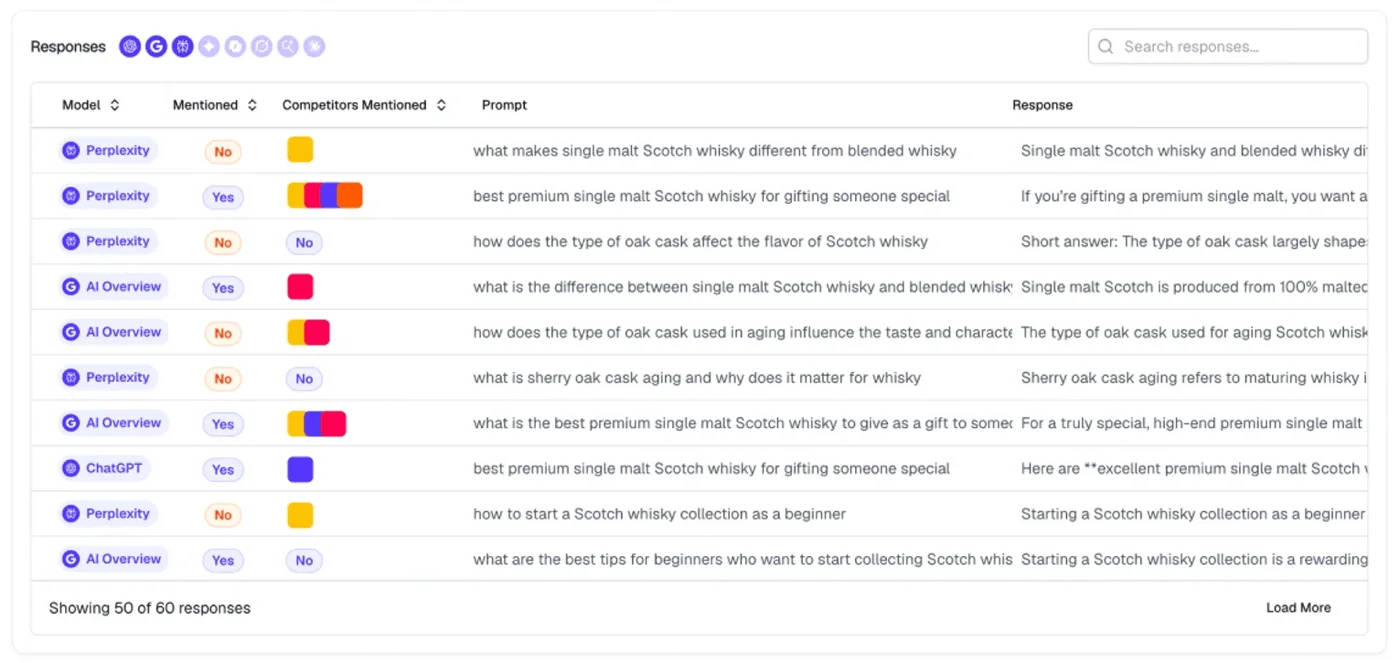
AthenaHQ: AthenaHQ starts with citation probability or the likelihood that an AI model will reference your content when answering a relevant question. That’s the north star metric everything else is built around. Rather than determining what keywords your competitors rank for, AthenaHQ analyzes what sources AI models trust, how often they cite them, and what content characteristics predict citation. It’s a fundamentally different analytical lens from traditional SEO tools like Clearscope and unlocks a serious competitive advantage for teams shifting their focus from 10 blue links in Google search to references and citations in AI answers.
Clearscope: Clearscope’s methodology is anchored in traditional keyword relevance scoring. It examines the top ranking pages for a particular keyword and identifies the terms and topics that appear most frequently among them. The logic is straightforward: if the top-ranking pages cover these topics, your content should too. That logic holds well for traditional search but breaks down when it comes to answer engines, where the criteria for being cited as a trusted source are drastically different.
Verdict: AthenaHQ wins on methodology. Citation probability is the metric that determines visibility in AI search, which Clearscope was simply never designed to measure or improve.
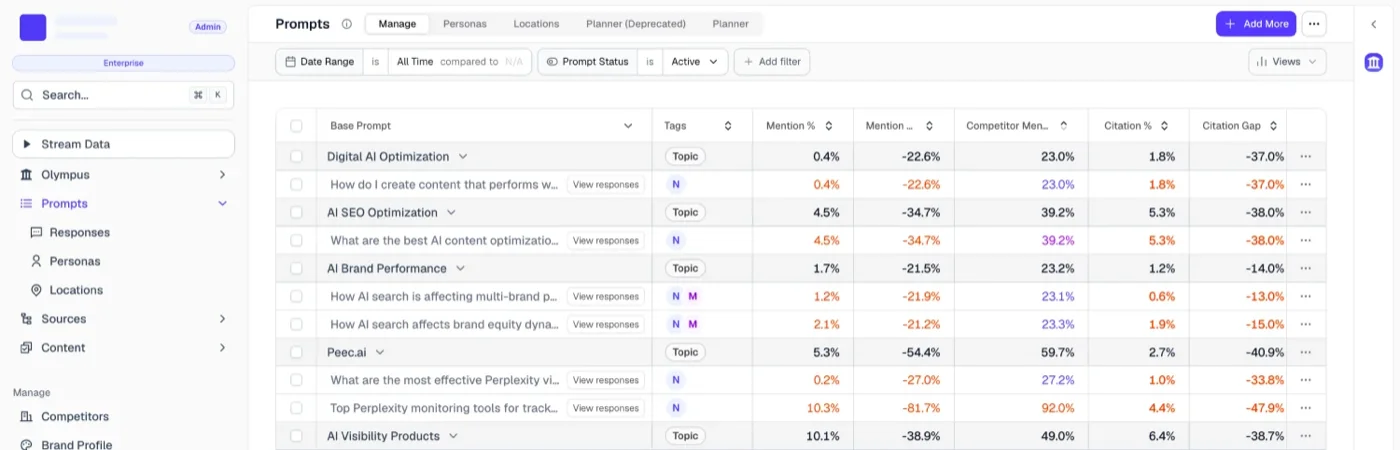
AthenaHQ: Coverage breadth is one of AthenaHQ’s key structural advantages. AI engines behave differently, each favoring a particular blend of source types and content formats and updating citation patterns at different rates. A brand that is well-cited on Perplexity may be largely absent from Gemini, and vice versa. AthenaHQ tracks performance across all major engines simultaneously, giving teams a unified view of their AI search footprint rather than a snapshot of a single LLM. That matters because your customers are not using just one platform.
Clearscope: Clearscope doesn’t monitor AI search at all. There is no dashboard for citation rates, no tracking for brand mentions in AI-generated answers, and no data on which LLMs are or are not surfacing your content. This is not a missing feature so much as a reflection of what Clearscope was built to do. Its world is the traditional SERP, and it operates entirely within that boundary. For teams that need visibility into what is happening on the AI side of search, Clearscope simply cannot help.
Verdict: AthenaHQ wins. Multi-engine AI coverage is the foundation of any AEO / GEO strategy, and it is absent from Clearscope entirely.
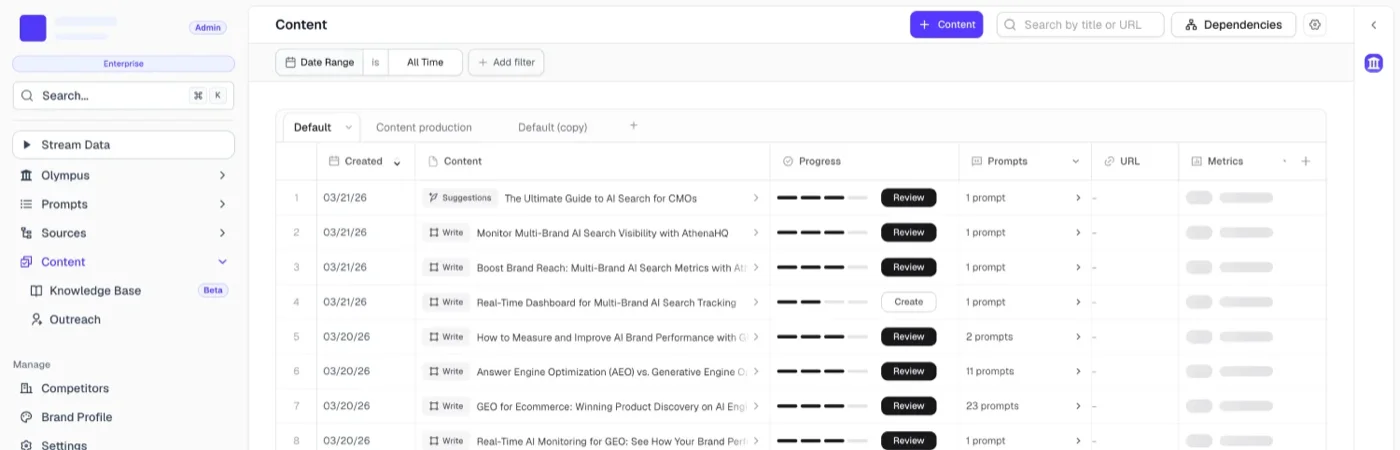
AthenaHQ: AthenaHQ treats optimization as a continuous, data-driven process rather than a one-time editorial task. Its autonomous agents monitor citation performance across your tracked prompts, flag where your content is falling short, and generate specific recommendations for improvement. The platform also handles structured data and schema markup automatically, removing a layer of technical work that typically slows down content teams. For enterprise organizations managing content across multiple brands or topic libraries, the ability to run these workflows without proportionally scaling headcount is a significant operational advantage.
Clearscope: Clearscope’s approach to optimization is built for the individual article. A writer targets a particular keyword, receives a report, and uses the term recommendations to manually refine their draft until the content grade hits an acceptable level. While this can help improve the quality of a single article, the process wasn’t built to scale, especially at the enterprise level. There is no way to run Clearscope across an entire content library to determine which pages need attention. And because Clearscope lacks AI search data, you also can’t connect editorial improvements to better citation outcomes.
Verdict: AthenaHQ wins. Automation at scale is essential for any team serious about GEO, and Clearscope’s manual, single-article workflow was not designed for it.
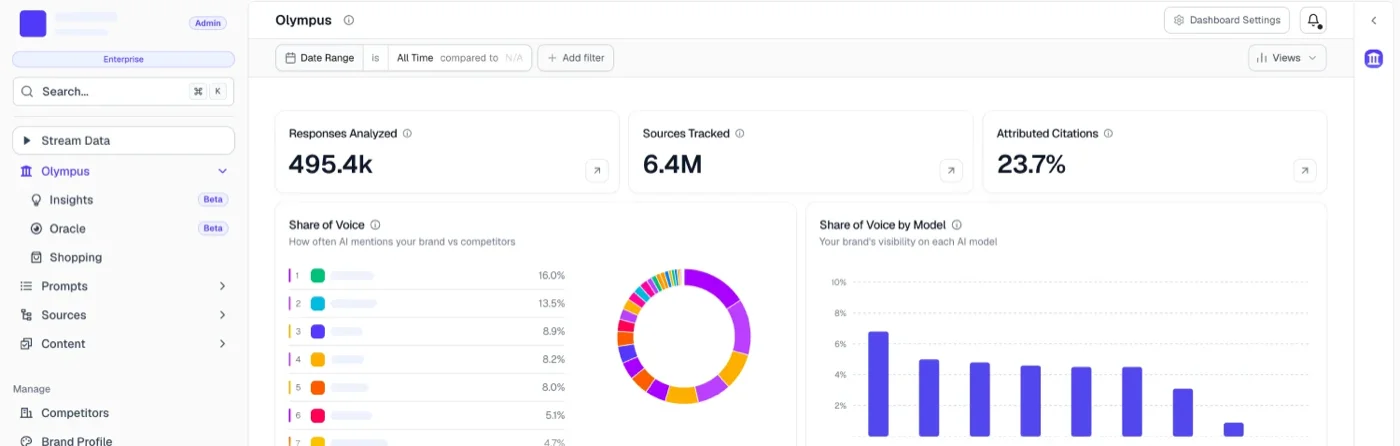
AthenaHQ: AthenaHQ captures share of voice across AI engines, citation rate trends, prompt volume estimates, sentiment analysis within AI answers, and competitive benchmarking in the AI channel. This gives teams a nuanced and granular view of how their brand is actually performing in AI search. AthenaHQ’s reporting also connects to revenue via Shopify and GA4 integrations, so you can measure if your AEO / GEO efforts are actually driving business outcomes.
Clearscope: Clearscope’s reporting focuses solely on content: how thoroughly a given article covers a target keyword relative to its competitors on the SERP. That may be a useful signal for editorial quality, but tells you nothing about organic traffic, conversion, and how your content is performing in AI search. Teams using Clearscope as their primary reporting tool will find it difficult to make a data-driven case for content investment to stakeholders who care about pipeline and revenue.
Verdict: AthenaHQ wins. Its analytics connect AI search visibility to outcomes that matter at the business level, which is the standard any modern marketing tool should be held to.
AthenaHQ: With AthenaHQ’s direct Shopify integration, teams can see which AI visibility improvements correlate with traffic increases and purchases, and report on AEO / GEO performance with the same rigor they apply to paid search or email. The ability to publish GEO-optimized content directly from the platform without a separate workflow also reduces the time between insight and execution.
Clearscope: Clearscope helps e-commerce content teams write better blog posts and category pages for Google, and that is a legitimate use case. But the moment a potential customer starts their product research by asking an AI assistant for recommendations, Clearscope’s usefulness ends. It has no tooling for AI-driven product discovery, no way to measure whether your brand is showing up in those recommendations, and no integration with any e-commerce platform.
Verdict: AthenaHQ wins for e-commerce. Revenue attribution from AI search is a real capability, not a roadmap item, and it changes what e-commerce teams can report and optimize for.
AthenaHQ: Buyers do significant research before they ever contact a vendor, and a growing share of that research now happens through conversational AI: 71% of B2B buyers rely on chatbots for software research and 84% of CMOs now use AI/LLMs for vendor discovery. AthenaHQ identifies which category prompts your brand is appearing in, which competitors are being cited more frequently, and what content changes would most improve your standing.
Clearscope: Clearscope remains a solid tool for B2B teams creating content to rank in traditional search. What it can’t do is tell you whether that content is actually influencing how AI models position your brand in category conversations, from the procurement lead asking ChatGPT to compare enterprise data platforms to the marketing director prompting Perplexity for a shortlist of analytics vendors.
Verdict: AthenaHQ wins for B2B. Visibility into the AI-assisted research phase of the buyer journey is now a strategic necessity, and AthenaHQ is the only platform here that provides it.
Pros & Cons
| AthenaHQ | Clearscope |
|---|---|
PROS
| PROS
|
CONS
| CONS
|


Verdict: Who Wins for AI Search Visibility?
Clearscope improves your content for traditional Google search. AthenaHQ was built to help you do more: become the brand that AI models trust, surface, and cite in your category. Traditional search is not disappearing overnight, and Clearscope will continue to add value for teams that publish at volume for Google. But the trajectory of where buyers, searchers, and AI-assisted researchers are spending their attention points clearly in AthenaHQ’s direction.
Choose AthenaHQ if: You need to understand and improve how your brand performs in AI-generated answers, across multiple engines, with reporting that ties back to revenue. That describes most forward-looking marketing teams in 2026.
Choose Clearscope if: Your strategy is built around Google organic search, your team produces high-volume blog content, and you need a tool that integrates cleanly into a writing workflow. Clearscope is still the right tool for that job.
A mature content organization may find a place for both: Clearscope to maintain quality in traditional search, AthenaHQ to build visibility in the AI channel. But if the question is which platform wins at AI search visibility specifically, AthenaHQ is the clear choice.
How to Replicate These Results
Frequently Asked Questions (FAQ)
AthenaHQ is the stronger choice for e-commerce by a significant margin. The ability to attribute revenue directly to AI search visibility, through a native Shopify integration, is a capability that changes how e-commerce teams measure and justify their content investment. Clearscope can help optimize product-related blog content for Google, but it has no tooling for AI-driven discovery, no citation tracking, and no revenue attribution. For any e-commerce team that wants to understand and grow its presence in AI product recommendations, AthenaHQ is the only option here that is built for that goal.
Become the Brand AI Trusts
See, Act, and Win on AI Search and Beyond
See It In Action
AthenaHQ Rootly
10x Increase in Citation Rate
GEO became Rootly's #1 growth pillar. With ~10x citation rate growth and +126% mention rate on non-branded prompts, Rootly transformed AI Search into an executive-level operating channel.
AthenaHQ Lago
Lago50% Increase in Demos from AI Search
Lago achieved a 50% increase in demos from AI Search after implementing Athena. With 11x growth in AI Overview impressions and exploding citations, Athena became their command center for GEO.
AthenaHQ Nuvadermis
3x Share of Voice in 3 Months
Nuvadermis grew Share of Voice 3x in 3 months, with on-page citation rate climbing to 20%+ against a 4% category average, taking share from scar treatment heavyweights.