Enterprise GEO Platform Comparison:
AthenaHQ vs Profound

Andrew Yan
Co-Founder, CEO of AthenaHQ

 VS
VS
Key Takeaways
Summary
 For enterprise buyers, the core decision isn't which platform has more features, it's which operating model matches your team. AthenaHQ pairs monitoring with autonomous workflows, turning visibility findings into content and positioning recommendations so teams can execute in a single tool. Profound's Monitor, Create, and Operate structure interprets dense prompt-level data before routing it to other teams.
- Enterprise governance is where the two platforms diverge most sharply. AthenaHQ publishes SOC 2 Type I and Type II, GDPR compliance, NIST Cybersecurity Framework 2.0 alignment, and SAML/OIDC SSO on its enterprise materials. Profound reserves SSO/SAML, SOC 2, and dedicated Slack support for its Enterprise tier specifically, with Starter and Growth carrying narrower coverage and email-only support.
- Multi-brand and multi-company management aren't interchangeable, and enterprise procurement teams should treat them as separate contract questions. AthenaHQ centers portfolio-wide benchmarking across brands under one workspace. Profound Enterprise is published as supporting multiple companies with tailored prompt tracking.
- Enterprise pricing requires usage modeling, not headline comparison. AthenaHQ runs on credit-based subscriptions (Self-Serve starts at $295/month for 3,600 credits, Enterprise is custom), while Profound uses fixed yearly-billed tiers (Starter $99/month, Growth $399/month, Enterprise tailored) with separate Agent-credit allowances.
- Published performance benchmarks should never substitute for an enterprise proof of concept. Enterprise procurement teams need their own controlled pilot, with fixed prompts, engines, and scoring definitions, before any number from either vendor enters a business case.
Generative Engine Optimization, or GEO, measures whether products and subsidiaries appear accurately and favorably inside AI-generated answers. For enterprise teams, however, it’s not quite as simple as tracking mentions and citations across ChatGPT, Perplexity, Claude, Gemini, and other platforms. It also means measuring AI visibility across multiple brands, business units, product lines, and regions. For all the GEO platforms on the market, not all are equipped to keep up with enterprise demands.
That’s where this guide comes in. We’re taking a look at two leading GEO tools, AthenaHQ and Profound, to see how they stack up specifically when it comes to enterprise. We’re going beyond feature comparison and diving into procurement, security, multi-entity management, and total cost of ownership, so you can more easily assess which one will be the better fit for your team.
AthenaHQ vs Profound for Enterprise: At a Glance
AthenaHQ is a purpose-built GEO platform designed to help enterprises dramatically improve their AI search visibility. It combines monitoring with autonomous workflows to create and optimize content across brands and portfolios. Profound organizes its product around three core capabilities, Monitor, Create, and Operate, which suits organizations with dedicated GEO or SEO analysts who know how to translate granular prompt and answer data into recommendations to other teams for execution.
Generally speaking:
- Lean toward AthenaHQ if your enterprise needs deep and broad answer engine coverage and portfolio-wide benchmarking across multiple brands or business units, as well as content and positioning recommendations generated directly from visibility data and revenue attribution wired into Shopify and GA4.
- Lean toward Profound if prompt-volume data and dedicated Slack support is sufficient.
Let’s break this down in more detail.
AthenaHQ for Enterprise
AthenaHQ
Monitoring, benchmarking, attribution, and autonomous workflows in one workspaceAthenaHQ combines unparalleled insights with autonomous workflows spanning content creation, optimization, and nuanced recommendations that actually yield results. Built by experts from Google Search and DeepMind, its key capabilities include:
- Comprehensive AI Engine Tracking: AthenaHQ provides a unified view of multiple brands and products across all major AI search platforms, including ChatGPT, Gemini, Claude, and Perplexity.
- Actionable Insights: AthenaHQ isn’t a passive dashboard. It translates raw monitoring data into prioritized optimization tasks to dramatically improve AI search visibility.
- Autonomous Agents (ACE): AthenaHQ’s proprietary Athena Citation Engine (ACE) agent independently analyzes content gaps, optimizes assets, and executes multi-step workflows for even the most robust, enterprise-scale AEO playbooks.
- Integrated Workflows: AthenaHQ seamlessly connects insights to actions, surfacing prompts and automating content production and optimization to increase citation probability.
- Business Outcome Focus: Through native integrations with Shopify and Google Analytics, AthenaHQ can directly attribute AEO efforts to actual revenue. Customers have achieved 1,561% ROI using AthenaHQ to convert AI visibility into quantifiable leads and sales pipeline.
- Enterprise Scalability: With flexible pricing and unlimited seats, AthenaHQ scales with organizations, instead of locking teams into per-user restrictions.
AthenaHQ has a 4.9 star rating on G2 and serves enterprise customers like SoFi, Wix, and ZoomInfo.
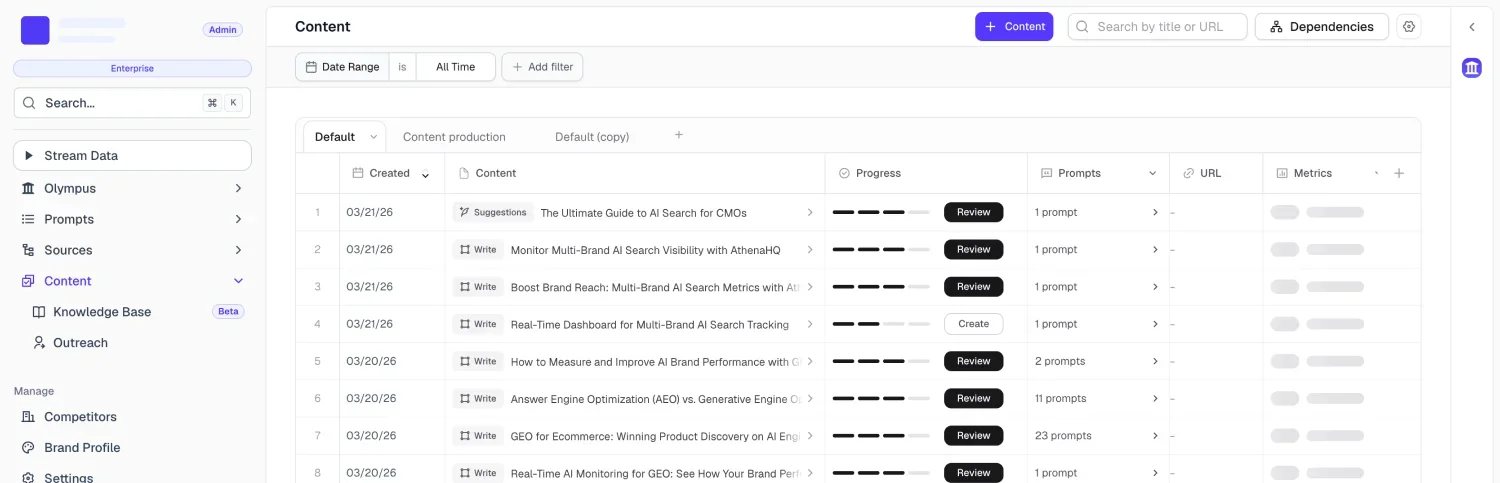
AthenaHQ is best suited to enterprises that want one shared workspace for GEO, content, growth, and executive reporting, rather than a monitoring tool content teams then have to manually translate into a separate action plan. Pairing brand monitoring with concrete recommendations cuts down on the handoffs, while a unified dashboard lets enterprise teams track AI visibility and benchmark against named competitors in one view.
For multi-brand enterprises specifically, portfolio-wide benchmarking captures performance across business units while preserving brand-specific details, which matters for holding companies, franchise networks, and organizations running several product lines or regional brands under one leadership structure.
In terms of engine coverage, AthenaHQ offers broader documented AI platform support than Profound, spanning eleven models (including ChatGPT, Gemini, Claude, and Perplexity).
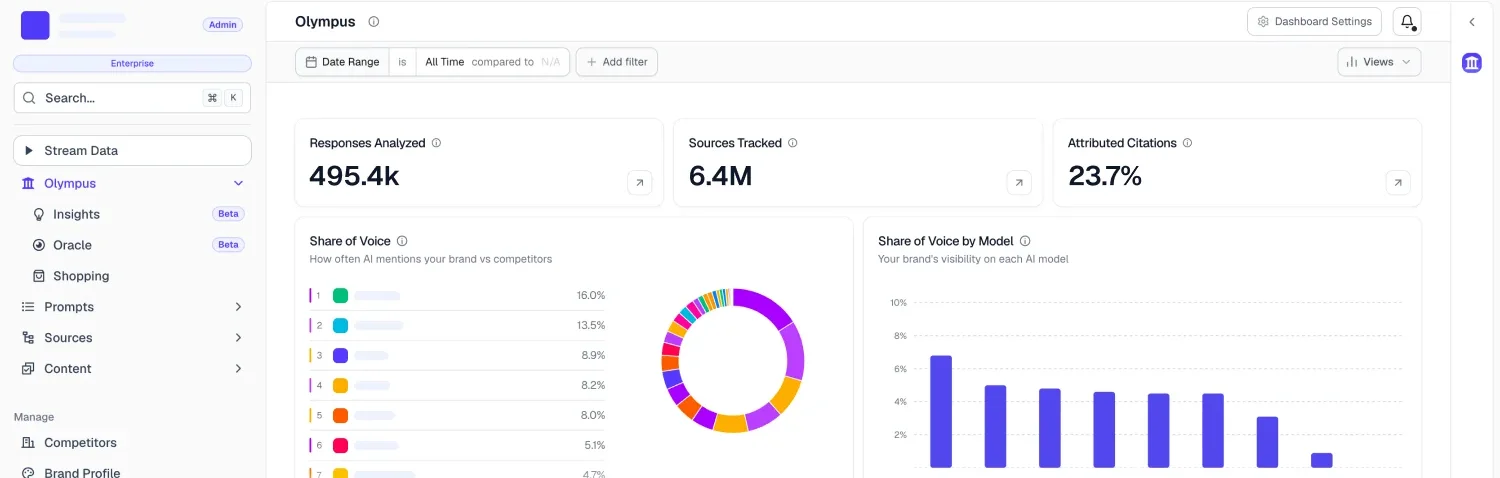
Core AthenaHQ Capabilities for Enterprise GEO Programs
AthenaHQ’s documented measurement and workflow capabilities relevant to enterprise programs include:
- Competitor benchmarking across a defined set of named rivals, trackable per business unit
- Share of Voice measurement, tracked over time
- Prompt-level analytics tied to real buyer questions across markets
- Sentiment analysis on how the brand is described inside AI-generated answers
- Multi-engine monitoring across major AI search platforms
- Competitor visibility tracking at both aggregate and answer level
- Unified brand and portfolio reporting built specifically for multi-brand enterprise organizations
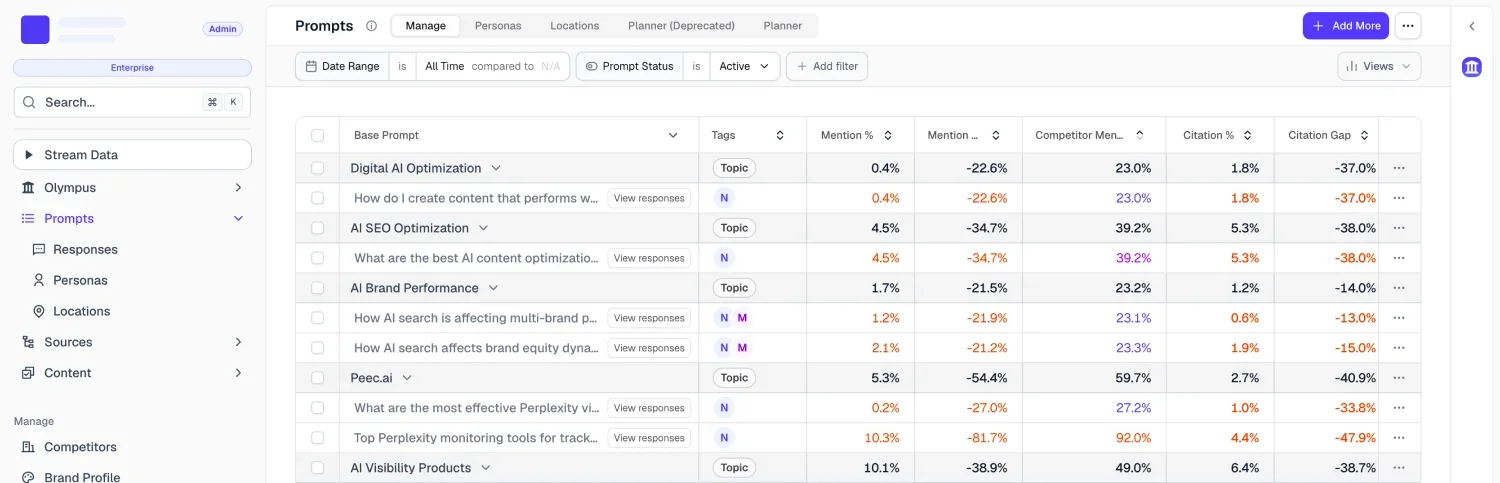
AthenaHQ offers robust, enterprise-grade security, with SOC 2 Type I certification and Type II, GDPR compliance, alignment with the NIST Cybersecurity Framework 2.0, and coverage tracked across more than 90 countries and six continents. Enterprise customers include Coinbase, SoFi, Indiana University, Apryse, Paperless Post, Nextiva, and Opella.
Results in AthenaHQ
AthenaHQ customers have seen significant results when it comes to improving their AI search visibility, including:
- 50 % increase in demos from AI search
- 38 % MoM increase in leads from AI search
- 40 % increase in brand mention rate
- 85 % faster response to brand mentions
- 50 % reduction in time spent on AI visibility tracking
- 2.5 x increase in AI-driven organic traffic
- 5 x increase in AI content citations
- 10 x increase in citation rate
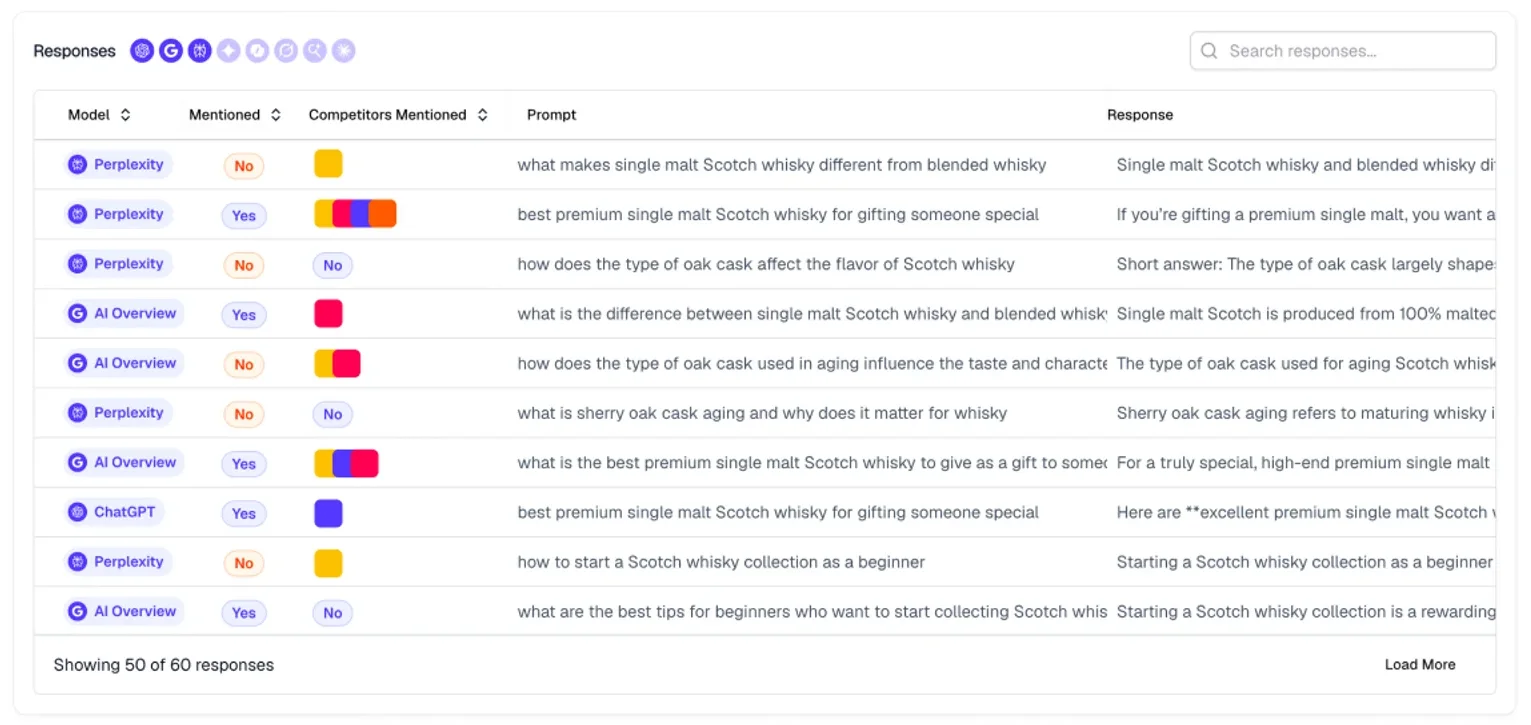
Customer Response
Customers have praised AthenaHQ across multiple industries and verticals, citing depth of insights, usability, and exceptional value.

Computer Software
–Verified Customer Review, G2“We're a software company in the developer tools space. Our buyers are technical and increasingly skeptical of traditional marketing. They research tools by asking Claude or ChatGPT for recommendations before they ever visit our site. We knew this was happening but had no visibility into it.
AthenaHQ gave us that visibility without requiring a dedicated analyst to interpret results. The prompt tracking shows exactly what questions potential customers are asking and whether we appear in the answers. The competitive benchmarking revealed that a smaller open-source competitor was being cited more frequently than us for our core use case, despite having less than half our feature set.
What I appreciate most is the bias toward action. Other tools we tried gave us beautiful charts and left us wondering what to do. AthenaHQ tells us specifically which content to create or update, with context on why it matters.”

Healthcare
–Verified Customer Review, G2“In healthcare tech, we can't just plug in any SaaS tool and hope for the best. Our legal and compliance teams scrutinize everything. AthenaHQ passed their review faster than most vendors we evaluate, partly because the team was transparent about data handling and partly because the platform doesn't require us to expose sensitive systems to get value.
The prompt tracking gives us visibility into how AI models discuss our category, which matters when misinformation could have real consequences. We caught ChatGPT recommending a competitor's product for a use case where it's actually contraindicated. That's not just a marketing problem. AthenaHQ helped us identify it, and we worked with our medical affairs team to publish clarifying content.
The dashboard is genuinely intuitive. Our marketing ops person picked it up in a day. No dedicated analyst required.”

Real Estate
–Verified Customer Review, G2“We manage multiple residential real estate brands across thousands of franchise locations. The way consumers find agents is shifting fast. Five years ago it was referrals and yard signs. Then it was Zillow and Realtor.com. Now we're seeing buyers and sellers ask ChatGPT things like “best real estate agent for luxury homes in Scottsdale” or “which brokerage has the lowest commission fees” before they ever visit a brand website. AthenaHQ helped us understand how our brands perform in those conversations.
We discovered that AI models were recommending competitors for specific property types and price points where we have strong market share. Worse, some responses contained outdated information about our commission structures that made us look less competitive than we actually are. The regional tracking has been particularly valuable. Real estate is hyperlocal, and AI models respond differently by market. We can now segment visibility by metro area and give our regional marketing teams data they can act on. A brand manager in South Florida sees different insights than someone covering the Pacific Northwest, which is exactly how it should be.”

Retail
–Verified Customer Review, G2“We operate 200+ retail locations across North America. What works for brand visibility in California doesn't necessarily work in Texas or Quebec. AI models respond differently by region, and most tools we evaluated treated the US as a monolith.
AthenaHQ's regional segmentation was a differentiator for us. We discovered that our AI visibility in the Southeast was half what it was on the West Coast, even though our store density is similar. The platform identified specific content gaps around product categories that index higher in Southern markets. Our regional marketing teams now have data to act on instead of guessing.
The reporting is also clean enough to share with franchise owners who are not marketers. They can understand the visibility scores and see why certain content investments matter.”
Profound for Enterprise
Profound
Monitor, Create, and Operate for analyst-led teamsProfound combines AI visibility measurement with agentic content and operational capabilities. It tends to fit enterprises that want detailed monitoring data, prompt-volume intelligence, and governance controls explicitly published for Enterprise. That model works best when there’s real internal analyst capacity available to interpret dense findings and then coordinate workflows across content, SEO, and brand teams.
Profound tracks Perplexity, ChatGPT, Claude, Gemini, Grok, Microsoft Copilot, DeepSeek, and Google AI Overviews, though actual coverage varies meaningfully by plan tier. Enterprise buyers should confirm exactly which environments are included in their contract.
Core Profound Capabilities for Enterprise Programs
Profound’s published product structure includes:
- Monitor: Answer Engine Insights, Prompt Volumes, Shopping, and Agent Analytics
- Create: Agents, for AI-assisted content generation and optimization
- Operate: AI Marketer, for operational execution tied to visibility findings
Before committing, be sure to test how these three pillars actually operate in daily use, which capabilities draw down separate credit pools, and what’s included versus gated behind additional cost.
Feature Matrix: AthenaHQ vs Profound for Enterprise
| Comparison area | AthenaHQ | Profound |
|---|---|---|
| Core product orientation | Monitoring, benchmarking, attribution, recommendations, and content-production tools | Monitor, Create, and Operate product structure |
| Answer-engine coverage | Multi-engine coverage across 11 models, including ChatGPT, Gemini, Claude, and Perplexity | Starter: ChatGPT only; Growth: three engines; Enterprise: up to nine engines |
| Prompt tracking and volume data | Prompt-level analytics | Starter: 50 prompts; Growth: 100 prompts; Enterprise: tailored tracking with proprietary volume data |
| Responses or queries | Self-Serve includes 3,600 monthly credits (one credit per AI response); unlimited topics | Prompt-based limits vary by plan |
| Citations and competitor visibility | Citation intelligence and named competitor benchmarking | Not established in available published materials |
| Share of Voice and sentiment | Share of Voice metrics and sentiment analysis included | Reporting depth varies by configuration |
| Content and agent workflows | Actionable recommendations plus content-production and optimization workflows | Agents and AI Marketer |
| Revenue attribution | Shopify and GA4 integrations tie visibility to revenue analysis | Not established in available published materials |
| Multiple companies | Portfolio-wide benchmarking and multi-brand reporting | Enterprise documentation reports supporting multiple companies |
| Reporting | Unified dashboard, portfolio reporting, brand-level dashboards, and custom BI dashboards on enterprise plans | Not established in available published materials |
| Integrations | Shopify, GA4, API access, and custom BI options | Not established in available published materials |
| SSO/SAML | Enterprise materials list SAML and OIDC SSO | Enterprise includes SSO/SAML |
| SOC 2 | SOC 2 Type I (Oct 2025) and Type II (Jun 2026) | Enterprise includes SOC 2 compliance |
| Support | Dedicated customer support included | Starter and Growth: email; Enterprise: dedicated Slack |
| Pricing model | Credit-based subscription; Self-Serve and custom Enterprise pricing | Fixed yearly-billed tiers for Starter and Growth; tailored Enterprise pricing |
Sources: AthenaHQ plans, AthenaHQ enterprise, and Profound pricing. "Not established in available published materials" means the capability was not documented in the vendor's public materials at time of review; confirm directly with the vendor.
How to Run a Fair Enterprise GEO Proof of Concept
An enterprise proof of concept should measure three things together: data quality, operational effort, and business relevance. The protocol should be locked in and circulated to stakeholders before either vendor touches the test environment.
Set a Reproducible Enterprise Test Protocol
- Define one approved prompt set. Use identical prompts, worded identically, across both platforms and hold that wording constant for the whole baseline period, including prompts specific to each business unit in scope.
- Match the testing environment. Align on the same answer engines, markets or locations, languages, competitor set, date range, and tracking cadence across every brand being tested.
- Record a baseline. Capture starting mentions, citations, Share of Voice, sentiment, and answer-level results before making any content changes or activating agents.
- Define every score in writing. Document exactly what counts as mention rate, citation rate, citation quality, Share of Voice, sentiment, prompt coverage, content delivery time, workflow completion, traffic, conversions, and revenue attribution, and circulate the definitions to every enterprise stakeholder involved.
- Control the change window. Give each platform equivalent content access, approval rights, execution time, and ownership over what gets published.
- Preserve dated evidence. Export reports as you go and hold onto answer-level records wherever the platform makes them available, for later audit or legal review.
- Test operational effort separately. Track prompt configuration time, analyst hours, approval steps, content or agent execution, and the ongoing work of recurring enterprise reporting.
- Review exceptions as they come up. Investigate missing answers, duplicate records, engine failures, sentiment calls that don’t make sense, and gaps in attribution.
- Compare published vendor claims last. Only weigh benchmark numbers after confirming equivalent prompts, engines, markets, dates, competitors, baselines, and score definitions between the two runs.
- Run a joint post-test review. Bring in security, analytics, SEO, content, procurement, legal, and finance stakeholders to document unresolved questions before entering commercial negotiations.
Enterprise evaluation checklist:
- Same approved prompts across every business unit tested
- Same named answer engines
- Same markets and languages
- Same competitor set
- Same start and end dates
- Same tracking cadence
- Documented baseline
- Shared metric definitions circulated to all stakeholders
- Comparable content-change windows
- Comparable approval ownership
- Dated report exports
- Answer-level records where available
- Recorded analyst and execution hours
- Documented integration requirements
- Agreed acceptance criteria before the test starts, signed off by procurement
Score Enterprise Results Beyond Visibility
Beyond visibility, a useful enterprise scorecard should also weigh:
- Evidence quality: Can an analyst inspect the underlying answer and tell a mention apart from a citation?
- Coverage: Does the platform consistently run the approved prompt set across every required engine, market, and business unit?
- Interpretation effort: How much analyst time does it take to explain why a number moved, across a distributed enterprise team?
- Workflow completion: Can a team actually move from a finding to an approved piece of content or agent action within existing approval chains?
- Attribution: Can the organization tie AI visibility to traffic, conversions, or revenue under its own analytics rules and finance definitions?
- Governance: Do access controls, audit requirements, and security documentation satisfy internal enterprise policy?
- Reporting: Can teams produce executive, board, brand, and operational views without manually rebuilding the data every cycle?
- Cost predictability: Can finance model expected usage confidently under the platform’s prompt, response, credit, or agent-based pricing as usage scales across brands?
Weight these categories before the test starts and get sign-off from every stakeholder.
Enterprise Pricing, Plans, and Investment Value
AthenaHQ’s Self-Serve plan is listed at $295 per month, per third-party pricing tracker Trakkr. AthenaHQ’s own published plans note that Enterprise pricing is custom and that Self-Serve includes 3,600 monthly credits, with one credit representing one AI response. Profound publishes Starter at $99 per month billed yearly and Growth at $399 per month billed yearly, with Enterprise on tailored pricing.
Since AthenaHQ and Profound operate on fundamentally different pricing logic, it’s important for enterprise buyers to evaluate both against real usage rather than headline numbers. Start from expected operating volume across the entire enterprise portfolio, accounting for:
- Number of tracked prompts across every brand and business unit
- Frequency of response collection
- Required answer engines by market
- Target countries and languages
- Likely additional AthenaHQ response credits
- Likely additional Profound Agent usage
- Analyst hours needed for interpretation across a distributed team
- Implementation and integration work, including SSO and data-residency setup
- Content production and approval resources across brands
- Governance and security review time
- Executive and board-level reporting needs
- Data export and BI requirements
Build low, expected, and high usage scenarios for each platform, factoring in seasonal campaigns, international expansion, new brands or acquisitions added mid-contract, and repeated prompt runs.
Enterprise Governance, Multi-Brand Management, and Support
Governance requirements deserve review before workflow preferences do in any enterprise evaluation, since a GEO platform that can’t clear identity, compliance, or company-separation requirements shouldn’t advance to a full proof of concept, regardless of how strong its dashboard or feature set looks.
Which Platform Supports Multiple Companies and Brands?
AthenaHQ supports unified visibility monitoring and portfolio-wide benchmarking built specifically for multi-brand enterprise organizations. It also offers consolidated portfolio reporting, brand-specific dashboards, custom BI dashboards, targeting across more than 90 countries, plus SAML and OIDC SSO, SOC 2 Type II, and API access.
Profound Enterprise is published as supporting multiple companies, tailored prompt tracking, dedicated Slack support, SSO/SAML, and SOC 2 compliance.
Note: Enterprise buyers should confirm directly with each vendor whether “multi-brand” and “multiple-company” rights mean the same thing contractually. Separate legal entities can require distinct workspaces, retention controls, user groups, or data-processing terms that a generic multi-brand feature set doesn’t automatically cover, a question legal should own before signature.
AthenaHQ Pros and Cons for Enterprise GEO
AthenaHQ’s strengths include platform coverage, multi-brand oversight, attribution, and workflows that translate findings directly to action.
Advantages for Enterprise Buyers
- Broader AI platform support than Profound (AthenaHQ covers 11 in total)
- Unlimited team seats and unlimited monthly response analysis
- Full suite of content-production tools built into the same workflow as monitoring, reducing enterprise tool sprawl
- Agentic workflows turn visibility findings directly into content and positioning recommendations, cutting internal handoffs across brand teams
- Unified monitoring supports both brand-level and competitor-level comparison in one view, useful for executive and board reporting
- Portfolio-wide benchmarking helps multi-brand enterprises compare business units side by side
- Shopify and GA4 integrations support analysis connecting AI visibility to revenue and conversion data, strengthening the enterprise business case
- Prompt analytics, Share of Voice, sentiment, and competitor benchmarking
- SOC 2 Type I and Type II timelines, GDPR compliance, and NIST CSF 2.0
Trade-Offs Enterprise Buyers Should Validate
- Credit-based model may require more nuanced forecasts at high enterprise response volumes
Profound Pros and Cons for Enterprise GEO
Profound’s lower-tier engine and prompt limits are worth weighing carefully against the real cost of reaching enterprise scale.
Advantages for Enterprise Buyers
- Enterprise supports up to nine answer engines
- Enterprise includes multiple-company support and tailored prompt tracking
- Dedicated Slack support is published specifically for the Enterprise tier
- SSO/SAML and SOC 2 compliance are listed for Enterprise
Trade-Offs Enterprise Buyers Should Validate
- Enterprise pricing is tailored and not published, so enterprise buyers should budget time for a full negotiation cycle rather than assuming Growth pricing scales linearly.
- Agent credits introduce a separate allowance to model on top of prompt tracking, so budget accordingly for enterprise volume.
- Data-heavy monitoring may require dedicated analyst capacity to turn findings into content or operational changes, which adds real headcount cost to the total enterprise investment.
A pilot should measure both the quality of the analysis and how long it takes an enterprise team to turn that analysis into approved, published work across multiple brands.
Verdict: Which Platform Is Better for Enterprise GEO?
The better platform depends entirely on the operating model behind the enterprise purchase. AthenaHQ is the stronger fit for enterprises prioritizing action, attribution, and portfolio-level workflows across distributed teams. Profound suits organizations with dedicated analyst capacity to interpret prompt-volume data and coordinate execution across other teams.
Whichever direction your evaluation leans, run the controlled proof of concept outlined above before any vendor number enters your business case. Talk to the AthenaHQ team to scope an enterprise pilot.
Frequently Asked Questions
Enterprise readiness comes down to a handful of specific capabilities: multi-brand or multi-company workspace separation, published SSO/SAML and SOC 2 compliance, data residency and retention controls, dedicated support with defined SLAs, and pricing that scales predictably across a large prompt and brand footprint. A platform can be excellent for a single-brand mid-market company and still fail an enterprise procurement review on governance alone.
Become the Brand AI Trusts
See, Act, and Win on AI Search and Beyond
See It In Action
AthenaHQ Cozy Earth
The Most-Cited Sleepwear Brand in AI Search
Cozy Earth used AthenaHQ to protect its lead in sleepwear, identify a loungewear opportunity, and give its two-person content team a clearer way to prioritize what to publish next.
AthenaHQ Rootly
10x Increase in Citation Rate
GEO became Rootly's #1 growth pillar. With ~10x citation rate growth and +126% mention rate on non-branded prompts, Rootly transformed AI Search into an executive-level operating channel.
AthenaHQ Lago
Lago50% Increase in Demos from AI Search
Lago achieved a 50% increase in demos from AI Search after implementing Athena. With 11x growth in AI Overview impressions and exploding citations, Athena became their command center for GEO.