Top 10 Generative Engine Optimization Tools To Try in 2026
The best GEO tools to get your brand mentioned when AI search engines answer questions in your industry. Search traffic is predicted to drop 25% by 2026.

AthenaHQ
Action on AI Search
Updated October 19, 2026
Generative engine optimization (GEO) tools help brands understand where they appear in AI-generated answers, which sources get cited, and what to improve. But choosing a platform involves more than comparing dashboards or starting prices. Buyers need to understand how vendors collect data, which AI engines they cover, how their reporting supports decisions, and whether the tool fits their team’s workflow.
This guide compares ten GEO platforms and explains how to evaluate, implement, and measure AI search optimization. The right choice depends on whether you need visibility monitoring, content optimization, enterprise governance, or a combination of capabilities.
GEO vs. SEO vs. AEO vs. LLMO: What’s the Difference?
These terms overlap, but they emphasize different parts of search and discovery:
- SEO (search engine optimization) improves a site’s discoverability in traditional search results, including organic listings. Technical accessibility, useful content, and authority still matter for AI search.
- GEO (generative engine optimization) focuses on how brands, pages, and sources appear in AI-generated answers, recommendations, and citations.
- AEO (answer engine optimization) emphasizes providing clear, reliable answers that search engines and assistants can retrieve or summarize.
- LLMO (large language model optimization) focuses on visibility in LLM-powered experiences. In practice, many vendors use LLMO and GEO interchangeably.
- AI SEO, AI visibility, AI search optimization, and citation tracking are related buying terms. A citation tracker may only measure linked sources; a broader GEO platform may also discover prompts, benchmark competitors, and recommend changes.
The distinction is practical rather than absolute. A strong GEO strategy builds on SEO fundamentals while adding measurement for AI-generated answers, which may mention a brand without linking to its website.
When Do You Need a GEO Tool?
Manual spot checks are useful when a team is exploring AI search, but they become unreliable as the number of prompts, products, competitors, markets, and AI engines grows. A dedicated platform is worth evaluating when:
- Prospects increasingly discover or compare products through ChatGPT, Google AI Overviews or AI Mode, Perplexity, or other assistants.
- You need a repeatable baseline for brand mentions, citations, and competitor presence rather than isolated screenshots.
- Content, SEO, PR, and demand-generation teams need to prioritize the same opportunities.
- Leadership expects regular reporting on AI visibility and its potential contribution to traffic, leads, or revenue.
- Manual tracking can no longer cover your priority prompts, markets, and products consistently.
A startup may only need a small monitored prompt set. An enterprise may require regional sampling, access controls, historical exports, and integration with its analytics stack.
GEO Tool Comparison: Best Fits and Starting Prices
Prices are indicative public entry points or figures in the supplied draft, not like-for-like quotes. Plan limits, annual billing, add-ons, and enterprise contracts can materially change total cost. Confirm current terms with each vendor.
| Tool | Best for | Starting price | Primary use |
| AthenaHQ | Content-rich brands and enterprise organizations; cross-engine tracking and optimization | $295/mo plus free starter plan | 11 models including ChatGPT, Claude, and Perplexity |
| Profound | Enterprise analytics and governance | $99/mo billed annually | Plan-dependent; Starter tracks ChatGPT |
| Otterly AI | Startups and small teams | From $29/mo | Core engines; some paid add-ons |
| KAI Footprint | Low-cost analytics pilot | Free; paid ~$500+ | Confirm with vendor |
| Semrush AI Visibility | SEO teams expanding into AI search | $99/mo billed annually | ChatGPT, Google AI, Gemini, Perplexity |
| BrightEdge | Enterprise entity/content programs | Custom | Confirm with vendor |
| Writesonic | High-volume content teams | $199/mo | Confirm with vendor |
| Addlly AI | Agent-led GEO workflows | Custom | Confirm with vendor |
| InLinks | Publishers and content networks | Varies | Not primarily an AI-engine tracker |
| Gumshoe.AI | Persona-oriented experiments | Beta | Confirm with vendor |
.
Choose by Use Case, Not Just Vendor Rank
The best GEO tool depends on your organization's size, resources, and priorities. Use the following recommendations to narrow your options based on what your team needs to accomplish:
Enterprise analytics and governance
Consider AthenaHQ, Profound, Semrush Enterprise, or BrightEdge. Prioritize multi-brand reporting, security documentation, export access, and consistent methodology.
Content teams and on-page optimization
Consider AthenaHQ, Writesonic, BrightEdge, and InLinks. Determine whether you need measurement, editorial recommendations, content production, technical structure, or several of these.
Agencies
Look for multi-client workspaces, white-label reporting, permission controls, and efficient onboarding. Evaluate Profound, Semrush, AthenaHQ, and lightweight monitoring tools against actual client counts and prompt volumes.
Startups and small teams
Otterly AI and entry-level monitoring plans can establish a baseline without an enterprise contract. Start with a focused set of commercially relevant prompts.
Ecommerce and retail brands
Prioritize product and retailer queries, shopping-oriented AI experiences, competitive comparisons, and connections to product and sales data. Verify each vendor’s coverage of the engines and markets your shoppers use.
B2B SaaS
Focus on problem-aware, category, alternative, and vendor-comparison prompts. Compare mention quality, cited sources, and AI-assisted visits with lead and pipeline data.
Experimentation and proof of concept
Use free tiers, trials, or a narrowly scoped pilot to validate prompt coverage and data consistency before expanding.
The 10 Leading GEO Tools: Strengths and Trade-Offs
1. AthenaHQ
Combines AI visibility tracking, competitor intelligence, prompt analysis, and optimization workflows. The starter plan ($295/month) includes visibility across 11 models, and optional paid API access.
Best fit: Brands that want to operationalize GEO across content and measurement teams, including enterprise organizations with complex reporting needs.
2. Profound
AI visibility analytics with prompt-level tracking, citations, and competitor analysis. Useful for teams that need repeatable reporting and more advanced controls. Its current public pricing lists a $99/month annual-billing Starter tier with ChatGPT-only tracking; broader engine coverage and API/SSO depend on higher tiers.
Best fit: Marketing organizations and agencies
Watch for: Engine coverage, prompt limits, export access, and governance features vary by plan.
3. Semrush AI Visibility
Extends familiar search workflows into AI mentions, prompt research, competitive benchmarking, and AI-readiness checks. Its current AI Visibility offering starts at $99/month per domain on annual billing.
Best fit: SEO and SEM teams that want to incorporate AI search into existing research and reporting.
Watch for: Additional domains, seats, prompt capacity, and enterprise features can increase costs.
4. BrightEdge
Enterprise-oriented content and entity optimization capabilities, with an emphasis on structuring and managing large content programs.
Best fit: Large organizations with established SEO, editorial, and technical processes.
Watch for: Ask for a demonstration of AI answer measurement rather than assuming all SEO features extend to GEO.
5. Writesonic
A content-production and optimization option for teams that need to publish or refresh substantial volumes of material.
Best fit: Content teams that need faster editorial execution.
Watch for: Content generation is not a substitute for independent visibility measurement or editorial review.
6. Addlly AI
Uses AI-agent workflows for recurring tasks such as monitoring and optimization suggestions, according to the supplied draft.
Best fit: Teams seeking to automate repeatable GEO processes.
Watch for: Review workflow approval, human oversight, and integration requirements before deployment.
7. Gumshoe.AI
Uses persona-oriented analysis to explore how different audience segments may encounter AI answers. The supplied draft describes it as a beta product.
Best fit: Teams testing audience-specific research methods.
Watch for: Confirm current availability, sample construction, and whether modeled journeys represent actual user behavior.
8. InLinks
Focuses on semantic internal linking and entity relationships across content-heavy websites.
Best fit: Publishers and teams improving internal content architecture.
Watch for: It is a tactical optimization tool, not a direct substitute for broad AI visibility tracking.
9. KAI Footprint
An analytics-oriented entry point for teams establishing a baseline and evaluating whether more extensive tracking is warranted, based on the supplied draft.
Best fit: Teams conducting an initial GEO pilot.
Watch for: Confirm the free tier, model coverage, export limits, and enterprise pricing.
10. Otterly AI
Provides accessible prompt and brand mention monitoring. Its published documentation describes daily tracking, plan-based prompt quotas, and paid add-ons for some engines.
Best fit: Startups and small teams prioritizing ease of setup.
Watch for: Compare the cost of additional prompts and AI engines before selecting a plan.
How to Evaluate a Generative Engine Optimization Tool
Ask vendors to demonstrate the same representative prompts and reporting tasks. A checklist is more useful than a long feature inventory when it forces clear answers about methodology and operational fit.
- Citation tracking accuracy: Can the tool distinguish a linked citation from an unlinked brand mention? Does it preserve the answer, source URL, timestamp, and engine?
- Prompt coverage and discovery: Can you track branded, nonbranded, comparison, and purchase-intent prompts? How are suggested prompts selected and weighted?
- AI engine and market coverage: Which engines, modes, countries, languages, and devices are actually sampled in your plan?
- Competitor benchmarking: Can you compare the same prompts, periods, and geographies against a stable competitor set?
- Workflow automation: Can teams assign fixes, monitor changes, and approve content recommendations?
- Reporting and exports: Are raw observations, CSV exports, API access, BI connectors, and scheduled reports available?
- Integrations: Can you connect GA4, Search Console, a CMS, CRM, or data warehouse? Are connectors native or custom?
- Governance and security: Ask about SSO, roles, audit logs, data retention, subprocessors, and relevant compliance documentation.
- Software versus services: Does the subscription include onboarding, consulting, content production, or technical implementation?
For enterprise procurement, request a sample export, a methodology document, security materials, a full cost estimate, and a short proof of concept using your own prompt set.
How GEO Tools Collect Data: Questions That Affect Trust
Not all visibility scores measure the same thing. Some products run scheduled synthetic prompts and record the answers returned, while others may use additional observed, panel, or front-end datasets. Each method has distinctive strengths, sampling biases, and access constraints, so don’t treat a synthetic prompt sample as a complete record of what every user saw.
- Sampling: Are prompts fixed, discovered, weighted by estimated demand, or personalized? How many runs support each reported trend?
- Refresh frequency: Are results collected daily, weekly, or on demand? Can you compare identical conditions over time?
- Answer variability: Can results change by model version, location, account context, and phrasing? How does the vendor quantify this?
- Citation definitions: Does “citation” mean a clickable source, an attributed domain, or any textual reference?
- Data retention: How long are raw responses stored, and can customers export or delete them?
- Compliance: What customer information enters prompts or agent workflows, and which access controls apply?
A credible vendor should explain limitations clearly and let your team inspect examples behind summary scores.
What Metrics Matter in GEO?
A GEO dashboard should connect visibility metrics to business questions. Track leading indicators alongside downstream outcomes, and keep definitions consistent across reporting periods.
- Share of answers / share of voice: Percentage of sampled answers in which your brand appears, or your share relative to a defined competitor set. State the denominator.
- Mention rate: Share of tracked prompt responses that mention the brand, whether or not a source link appears.
- Citation rate: Share of sampled answers that cite your domain or content. Distinguish citations from mentions.
- Attributed citation rate: Share of citations assigned to your brand’s domains or content under a documented attribution rule; verify the vendor’s definition.
- AI-assisted visits: Sessions or referrals identifiable from AI sources in analytics. Treat this as a partial measure because some influence is unlinked or unattributed.
- Conversion influence: Leads, purchases, or pipeline associated with identifiable AI-assisted sessions, interpreted alongside other channels and attribution limitations.
A Practical Before-and-After Measurement Framework
Measuring GEO performance requires a consistent approach to tracking visibility, evaluating optimization efforts, and connecting results to business outcomes.
- Establish a baseline: Choose a stable set of priority prompts and record brand mentions, citations, competitors, and cited pages for several weeks.
- Define the intervention: Update one content cluster, improve product information, strengthen supporting evidence, or fix a technical issue. Log the change date.
- Compare consistently: Keep the prompt set, engine, location, and reporting window as stable as possible; use comparable untouched pages or topics when feasible.
- Connect to outcomes: Review AI referral traffic, engaged sessions, conversions, and pipeline in GA4/CRM alongside organic search performance.
- Interpret cautiously: A visibility change after an update does not prove causation. AI answer variability, seasonality, and other campaigns may contribute.
Use visibility to diagnose where your brand is being considered. Use experiments and business outcomes to decide whether additional GEO investment is warranted.
How to Implement a GEO Program in 90 Days
A phased 90-day rollout helps teams establish reliable GEO measurement, test targeted improvements, and build a repeatable process for monitoring and optimizing AI search visibility.
Days 1–30: Establish the Baseline
Assign an accountable owner, usually SEO or organic growth, with support from content, product marketing, analytics, and demand generation. Select priority products, competitors, engines, markets, and prompt categories. Audit tracking definitions and create an initial dashboard. Capture the current citations and source pages before making changes.
Days 31–60: Prioritize and Test
Identify prompts where competitors appear and your brand does not, or where the brand is mentioned but not cited. Review the sources AI systems use. Update a small set of high-value pages with clearer answers, evidence, product details, and appropriate technical fixes. Record every change and set a review cadence.
Days 61–90: Measure and Operationalize
Compare results with the baseline, investigate movement by engine, and review AI-assisted visits and conversions where observable. Establish monthly reporting, assign content owners, and document when teams should act on a signal. Expand prompt coverage only after validating the initial measurement process.
Expect measurement baselines within days or weeks, depending on setup. Meaningful visibility changes may take weeks or months and are not guaranteed. Refresh frequency, content indexing, model behavior, and competition all affect the timeline.
Three GEO Workflows to Try
Once you've established your GEO tracking and reporting processes, the next step is putting those insights to work. Here are three practical ways to get started:
1. Find competitor mentions without your citation
Filter commercially important prompts where a competitor is named or cited and your brand is absent. Examine the cited pages, identify missing facts or comparisons, and assign a content or PR response. Recheck the same prompt group after changes.
2. Improve one article for AI citations
Choose a page relevant to an underperforming prompt cluster. Add a direct answer, current evidence, clear product definitions, and credible references where appropriate. Confirm crawlability and internal linking. Track whether the page becomes a cited source, while monitoring organic search and engagement.
3. Report GEO progress to leadership
Show the number of tracked prompts and engines, mention and citation rates, competitor benchmarks, examples of newly cited pages, work completed, and identifiable AI-assisted business outcomes. Include limitations and avoid claiming that every visibility gain generated incremental revenue.
GEO Tool Pricing: What Buyers Should Budget For
Entry-level prices are not directly comparable, as vendors may charge by prompt volume, response credits, tracked domains, engine coverage, seats, workspaces, or enterprise contracts. Some capabilities are add-ons or reserved for higher tiers, which frequently include API access, additional models, higher refresh frequency, and security controls,
Ask for the full first-year cost: licenses, onboarding, integration work, data storage, services, content production, and internal staff time. A low-cost tracker may become restrictive when you need multi-market monitoring or automated exports; a large enterprise suite may be unnecessary for a focused pilot.
How We Compared These GEO Tools
This guide organized ten vendors by primary use case, publicly described capabilities, buyer fit, and available pricing information. The comparison also considers prompt and engine coverage, citation measurement, automation, reporting, integrations, and governance.
Editorial disclosure: AthenaHQ publishes this guide and is one of the vendors covered. Inclusion and positioning should not be interpreted as independent laboratory rankings. This revision used the supplied vendor descriptions and selected publicly available vendor documentation; it did not involve hands-on testing of all ten products or customer interviews. Features and prices may change. Review date: October 19, 2026.
Frequently Asked Questions
Are GEO tools different from traditional SEO software?
Yes, in emphasis. GEO platforms measure brand presence and source citations in AI-generated answers; SEO tools primarily assess conventional search performance. Some vendors now combine both.
What is the best GEO tool for a startup?
Start with an affordable monitoring plan and a narrow set of priority prompts. Otterly AI and entry-level options from broader vendors are reasonable candidates, subject to current pricing and engine limits.
Which GEO tools work for agencies?
Prioritize client workspaces, permission controls, reusable reports, exports, and prompt quotas. Test these workflows with more than one client account before signing.
What should ecommerce teams track?
Track category, product-comparison, retailer, and purchase-intent prompts, then connect visible AI referrals and cited product pages with available commerce analytics.
Can GEO tools measure ROI?
They can measure visibility and some identifiable AI-assisted traffic and conversions. Proving incremental revenue generally requires stronger experimental or causal analysis beyond a citation dashboard.
Are free GEO tools enough?
Free tiers and trials can establish an initial baseline, but often limit prompt volume, engine coverage, history, or exports.
Do GEO tools integrate with GA4, BI platforms, or a CMS?
Some do, but support varies by vendor and plan. Confirm the exact connector, fields, API access, refresh rate, and implementation effort.
How long does GEO take to work?
A baseline can be established quickly. Content-driven visibility changes may take weeks or months, and no tool can guarantee a citation or recommendation.
Who should own GEO internally?
SEO or organic growth commonly coordinates the program, while content, product marketing, PR, analytics, and demand generation contribute to execution and measurement.
Choose the GEO Tool That Fits Your Team
The best GEO software is the platform that answers your most important questions with trustworthy data and fits the way your team works. Start by defining the AI engines, prompts, markets, and business outcomes you need to monitor. Then test whether each vendor can provide usable evidence, practical recommendations, and reporting that supports decisions.
For teams seeking cross-engine visibility, competitive intelligence, and optimization workflows, AthenaHQ is one option to evaluate alongside the other platforms in this guide. Compare capabilities in a live demonstration before committing to a plan.
Explore AthenaHQ to review its current platform capabilities and pricing.
Become the Brand AI Trusts
See, Act, and Win on AI Search and Beyond
Keep Reading
Enterprise AEO 101: What You Need to Know to Boost AI Search Visibility in 2026
Learn how enterprise AEO and GEO can improve AI search visibility in 2026, from prompt measurement and citation-ready content to platform evaluation and attribution.
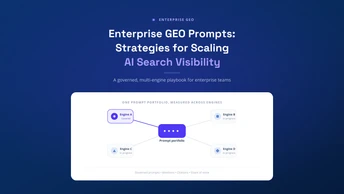
Enterprise GEO Prompts: Strategies for Scaling AI Search Visibility
Enterprise GEO provides a practical way for large teams to organize buyer questions, measure answers across engines, find citation gaps, invest in changes that carry real business value, and ultimately scale their AI search visibility.
How to Get Your Products Featured in AI Search Recommendations
Actually getting your products featured in AI search recommendations requires a repeatable process to sufficiently cover your grounds across product data, crawl access, third-party evidence, comparison content, and performance.
See AthenaHQ in Action
 AthenaHQ
 Cozy Earth
The Most-Cited Sleepwear Brand in AI Search
Cozy Earth used AthenaHQ to protect its lead in sleepwear, identify a loungewear opportunity, and give its two-person content team a clearer way to prioritize what to publish next.
AthenaHQ Rootly
10x Increase in Citation Rate
GEO became Rootly's #1 growth pillar. With ~10x citation rate growth and +126% mention rate on non-branded prompts, Rootly transformed AI Search into an executive-level operating channel.
AthenaHQ Lago
50% Increase in Demos from AI Search
Lago achieved a 50% increase in demos from AI Search after implementing Athena. With 11x growth in AI Overview impressions and exploding citations, Athena became their command center for GEO.