AthenaHQ vs Airops: Which GEO Platform is Better for AI Visibility?

AthenaHQ
Action on AI Search
AthenaHQ vs Airops: Which GEO Platform is Better for AI Visibility?
AthenaHQ vs. AirOps: At a Glance
If you're trying to figure out how your brand shows up inside ChatGPT, Perplexity, Gemini, and Claude, you've probably run into both AthenaHQ and AirOps. They get lumped together, but they solve different problems. This comparison walks through platform focus, feature sets, performance, ideal use cases, and pricing so you can pick the right tool for your goal. The short version: one is a dedicated AI visibility platform, and the other is a content engine with visibility layered on top.
One detail worth flagging early: two of the most-cited "best GEO tools" roundups, from SE Ranking's Visible blog and Profound, both rank AthenaHQ as a GEO platform. Neither includes AirOps in its list at all. That gap tells you a lot about how the two tools are categorized in the industry.
What is AthenaHQ?
AthenaHQ is a purpose-built Generative Engine Optimization (GEO) platform. Its whole job is to help your brand get discovered, cited, and accurately represented across AI search engines like ChatGPT, Perplexity, Claude, Gemini, and Google AI Overviews. Instead of treating AI visibility as an afterthought, the platform is engineered around measuring and improving it.
At the center of the platform is the proprietary Athena Citation Engine (ACE), an algorithm that predicts citation probability and tracks both on-page and off-page signals influencing how AI engines reference your content. AthenaHQ also runs autonomous agents inside its Action Center that scan visibility across multiple AI engines, spot content gaps, and draft fixes without waiting for manual input, as documented in GetMint's AthenaHQ review. A second proprietary model, the Query Volume Estimation Model (QVEM), estimates how often specific prompts get used so you can prioritize the ones that actually move the needle.
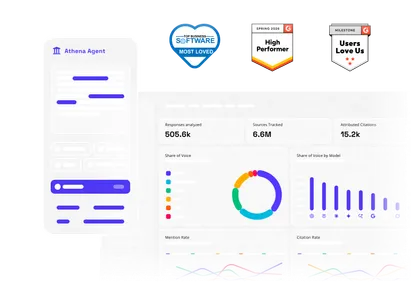
The platform was built for enterprise teams and data-driven agencies, and it shows in how it's structured. The Olympus dashboard gives you a user-friendly view of AI-native metrics like share of voice, citation sources, and sentiment, with real-time insights across the engines you track. It's scalable enough for multi-brand portfolio management, with current clients running anywhere from 3 to 50+ brands from a single instance across 30+ markets and multiple languages. And it delivers reliable visibility data, with QVEM claiming over 95% accuracy on prompt volume estimates. If you want a deeper look at where it sits among peers, AthenaHQ's comparison hub breaks down how it stacks up on visibility, competitive intelligence, and reporting depth.
What is AirOps?
AirOps is a growth platform for AI search, and it describes itself that way: "The growth platform for AI Search, Google, Gemini, Perplexity, Claude, ChatGPT" (airops.com). But its center of gravity is content production and workflow automation, not visibility measurement. The product is organized around four areas: Content Refresh, Content Creation, Offsite (building third-party citations), and Brand Governance.
These functions are executed through an AI agent called Quill, which handles the content-focused tasks across those areas (airops.com). If you think of AirOps as a factory that produces and updates content at scale, with some AI-search signals feeding the production line, you've got the right mental model. It leans toward orchestration and execution, giving teams a way to spin up workflows that generate and optimize pages quickly.
Here's the category tell again: neither SE Ranking's Visible blog nor Profound's roundup lists AirOps among ranked GEO tools, even though both name AthenaHQ, Semrush, Profound, Writesonic, Peec AI, and others. Independent comparison sites reach the same conclusion. Elmo flatly states "AirOps is a content generation tool, while AthenaHQ is an AI visibility tracking tool," and Tely frames it as "AirOps optimizes for optimize content for AI [1][2]. AthenaHQ optimizes for am I visible in AI?" None of that makes AirOps a weak product. It just means it's built for a different job.
Feature Breakdown: AI Search Visibility & GEO Capabilities
Platform Focus: Visibility Analytics vs. Workflow Automation
The cleanest way to separate these two is by asking what question each one answers. AthenaHQ answers "How visible is my brand across AI engines, and what should I fix?" AirOps answers "How do I produce and refresh content at scale?"
Scalenut's comparison puts it directly: AthenaHQ focuses on GEO analytics and AI visibility insights, while AirOps prioritizes automated execution and content workflows [3]. Dageno's guide reaches the same split, noting AthenaHQ is strongest when AI answer visibility itself is the KPI, whereas AirOps supports production-led growth teams [4]. GetMint sums up the philosophy with a useful line: AthenaHQ is better if you need to prove the value of GEO through revenue attribution, and AirOps is better if you need to control the process of GEO through custom workflows [5].
One practical difference in how they operate: AirOps gives you a no-code builder to construct custom logic grids where you define every step, while AthenaHQ relies on autonomous agents that scan your visibility, identify gaps, and draft the fix for you (GetMint) [5]. If you want hands-on control of every workflow step, that's AirOps. If you want the platform to do the diagnosis and hand you prioritized tasks, that's AthenaHQ.
AI Engine & Platform Coverage
This is where the gap gets wide, and it matters more than any single feature. AthenaHQ was built for GEO from day one, so it prioritizes broad engine coverage across all its plans. It tracks 8+ models immediately, including the long-tail engines, on the self-serve plan (GetMint) [5]. Coverage spans ChatGPT, Perplexity, Claude, Gemini, Copilot, and Google AI Overviews.
AirOps takes a tiered approach to coverage. Its entry "Solo" tier delivers ChatGPT insights only, and multi-engine insights unlock on the "Pro" tier (airops.com/pricing). For a team whose main goal is seeing where they stand across the full AI search environment, starting with a single engine is a real constraint. As GetMint notes, AirOps' entry tier monitors ChatGPT only and provides one user seat, whereas AthenaHQ's self-serve plan monitors 8+ engines and gives unlimited seats [5].
If you're weighing engine coverage across the broader market, AthenaHQ's own AI SEO tools comparison lays out how multi-platform monitoring separates dedicated GEO tools from adapted SEO software.
Dashboard and API Capabilities
Target keyword aside, this section deserves a straight look because the marketing pages of both tools foreground different things.
AthenaHQ centers on the Olympus dashboard, which consolidates AI responses, prompts, citations, and competitor mentions into a unified view with real-time tracking, sentiment analysis, and citation mapping. On the programmatic side, API access is available, and the platform's API and embed settings documentation shows customers can create and manage API keys for custom integrations or Looker Studio reporting, plus configure embed tokens to iframe the AthenaHQ dashboard into their own portals. API access sits at the Starter plan and above per AthenaHQ's pricing page, which lists "API access and add-on credits" as a Starter feature alongside data export to CSV.
AirOps foregrounds content workflows, "tasks," and the Quill agent rather than analytics dashboards or API-first access on its marketing pages (airops.com). Elmo's feature breakdown notes AirOps stands out for Data Export / API, while AthenaHQ adds Competitor Benchmarking and Sentiment Analysis [1]. Both platforms are closed-source and hosted, so neither exposes exactly how its scores are built. The takeaway for a GEO team: AthenaHQ's dashboard is designed around answering the visibility question, while AirOps' interface is designed around running content production.
Content Optimization & Automation Features
Both tools optimize content, but they arrive from opposite directions.
AthenaHQ's Action Center translates monitoring data into specific, prioritized tasks, each backed by supporting evidence like snapshots, citations, and visibility deltas (TryAnalyze). Its On-Brand Content Agents work like a refresh engine: point one at an underperforming page and it rewrites sections to target the citation logic of models like Perplexity or Claude, while holding your brand voice (GetMint). The platform then closes the loop by rerunning the same prompt set and comparing outcomes to a baseline, so you can see whether the fix worked (TryAnalyze). Native integrations with Shopify and Google Analytics tie those changes back to actual sales and traffic.
AirOps handles optimization through its four content areas and the Quill agent, giving production teams a way to generate, refresh, and govern content at high volume (airops.com). One important honest note: Scalenut's comparison observes that AthenaHQ stops at insights, while AirOps assumes prior GEO expertise [3]. In other words, AthenaHQ tells you what's wrong and drafts the fix; AirOps expects you to already know your GEO strategy and hands you the machinery to execute it fast.
Performance & Results: A Head-to-Head Look
Proof points matter, and the two tools publish very different kinds.
AthenaHQ's headline result comes from a 30-day GEO platform showdown across ChatGPT, Gemini, Perplexity, and Google AI Overviews. AthenaHQ delivered a +45% net gain in AI answer share, the best ROI, and the fastest time-to-content at 3.2 hours. In the same test, Peec.ai gained +8% and Profound declined 1%. Those numbers are tied directly to AI visibility metrics under competitive conditions, which is exactly what a GEO team wants to see. On top of that, AthenaHQ holds strong user ratings, with Rankability reporting consistent praise for proven ROI and users noting immediate positive impact after adoption.
AirOps publishes concrete customer proof too, but the outcomes point at content efficiency and channel-specific wins rather than head-to-head visibility tests. Its own site cites Chime with a 3x increase in AI search citations (going from being recommended in 24 to 68 priority questions), Docebo with a share-of-voice lead and a 50% cut in production costs, and Webflow with 5x content refresh velocity (airops.com). AirOps also states that content is "3x more likely to get cited if it's less than 3 months old" and that "up to 85% of your AI visibility is driven by content you don't own." Those are compelling numbers for a content-ops buyer. They demonstrate throughput and citation lift from production, not a controlled visibility benchmark against rival GEO platforms.
So the contrast is clean. AthenaHQ proves its value in visibility deltas measured against competitors. AirOps proves its value in content velocity and customer-specific citation gains. Which proof matters depends on what you're buying the tool to do.
Ideal Use Cases: Who Is Each Platform For?
When to Choose AthenaHQ
Pick AthenaHQ if AI answer visibility is your actual KPI. It fits marketing leaders, enterprise teams, and data-driven agencies who need to diagnose how AI engines describe their brand, track citations, benchmark against competitors, and prove the ROI of GEO to leadership. Dageno recommends choosing AthenaHQ when your priority is AI answer visibility diagnostics, and Scalenut points it at insight-led, client-facing teams [4][3].
It's especially strong for multi-brand portfolio management. Running 3 to 50+ brands from one instance, with reported +45% faster AI visibility gains and +22% reduced duplicated effort across brand teams, makes it a practical fit for agencies and large organizations juggling many brands at once. If you want the fuller enterprise picture, AthenaHQ's enterprise GEO platform buying guide covers what to look for at that scale.
When to Choose AirOps
Pick AirOps if your bottleneck is content, not measurement. It suits content operations, production-led growth teams, and SEOs who need to scale content creation, automate refreshes, and manage complex publishing workflows. Scalenut frames it for large-scale, execution-heavy content operations, and Dageno puts it with production-led growth teams who want workflow automation and scalable execution [3][4].
If you already have GEO strategy nailed down and mostly need horsepower to publish and refresh at volume, AirOps gives you that engine. Its strength is execution, not deep visibility analytics, and that's the right trade for teams whose primary pain is throughput.
Pricing & Plans Compared
Pricing transparency is one of the clearer differences here, so it's worth laying out plainly.
All AirOps figures come from airops.com/pricing. AthenaHQ figures come from AthenaHQ's plans page.
The practical difference: AthenaHQ publishes a concrete Starter price of $295/month and shows you what each tier includes up front. AirOps publishes $0/month for its base Insights tier and details the Solo tier, but does not display a public dollar price for its recommended Pro tier, its Pages tier, or Enterprise. Those require starting a trial or contacting sales (airops.com/pricing). If you want to compare real cost before committing, AthenaHQ gives you more to work with on day one.
And the entry-tier engine count is the number to circle. For $295/month, AthenaHQ tracks visibility across 9 models with API access built in. AirOps' individual tier watches ChatGPT alone, with broader engine coverage reserved for higher plans.
The Verdict: Which Platform is Better for AI Visibility?
For the specific goal of AI search visibility, AthenaHQ is the stronger choice, and the evidence points the same way from every angle. It's a dedicated GEO platform, not a content tool with visibility bolted on. It tracks 8+ AI engines on every plan while AirOps' entry tier watches one. It posted a +45% gain in AI answer share and the best ROI in a competitive 30-day test. And it's the tool that shows up in the industry's most-cited GEO roundups, while AirOps doesn't appear in either.
None of that means AirOps is a lesser product. It's a genuinely strong platform for a different job. If your primary need is scaling content creation, automating refreshes, and running high-volume publishing workflows, AirOps and its Quill agent give you a serious execution engine, backed by real customer wins in content velocity and citation lift.
So make the call based on your primary strategic goal. If you need deep analytics to diagnose and prove AI visibility, and you want a platform that hands you prioritized fixes with the data to back them, go with AthenaHQ. If you need scaled content execution and already have your GEO strategy set, AirOps fits. For most teams whose real question is "am I visible in AI, and what do I do about it?" the measurement-first platform wins. To see how AthenaHQ stacks up against the wider field before you decide, the 8 best AI SEO tools for 2026 and AthenaHQ's comparison hub are good next stops.
Citations
Become the Brand AI Trusts
See, Act, and Win on AI Search and Beyond
Keep Reading

What is Answer Engine Optimization? The Complete Guide to AEO
Learn Answer Engine Optimization (AEO) to get your brand cited in AI answers. This guide covers how to influence models like ChatGPT and win at AI search.

AEO-Optimized Landing Pages: Best Practices
Master AEO landing page best practices to get cited by AI engines. Learn to structure content, use schema, and target multiple buyer personas for success.
How to Optimize Content for AI Search Engines
Learn how to optimize content for AI search engines. Get cited by Google AI Overviews & ChatGPT with our step-by-step Generative Engine Optimization guide.
See AthenaHQ in Action
 AthenaHQ
 Rootly
10x Increase in Citation Rate
GEO became Rootly's #1 growth pillar. With ~10x citation rate growth and +126% mention rate on non-branded prompts, Rootly transformed AI Search into an executive-level operating channel.
AthenaHQ Lago
Lago50% Increase in Demos from AI Search
Lago achieved a 50% increase in demos from AI Search after implementing Athena. With 11x growth in AI Overview impressions and exploding citations, Athena became their command center for GEO.
AthenaHQ Nuvadermis
3x Share of Voice in 3 Months
Nuvadermis grew Share of Voice 3x in 3 months, with on-page citation rate climbing to 20%+ against a 4% category average, taking share from scar treatment heavyweights.