The Ultimate GEO & AEO Platform Buying Guide for Enterprise Teams
How to choose the right tool to win on AI search in 2026

AthenaHQ
Action on AI Search
Summary
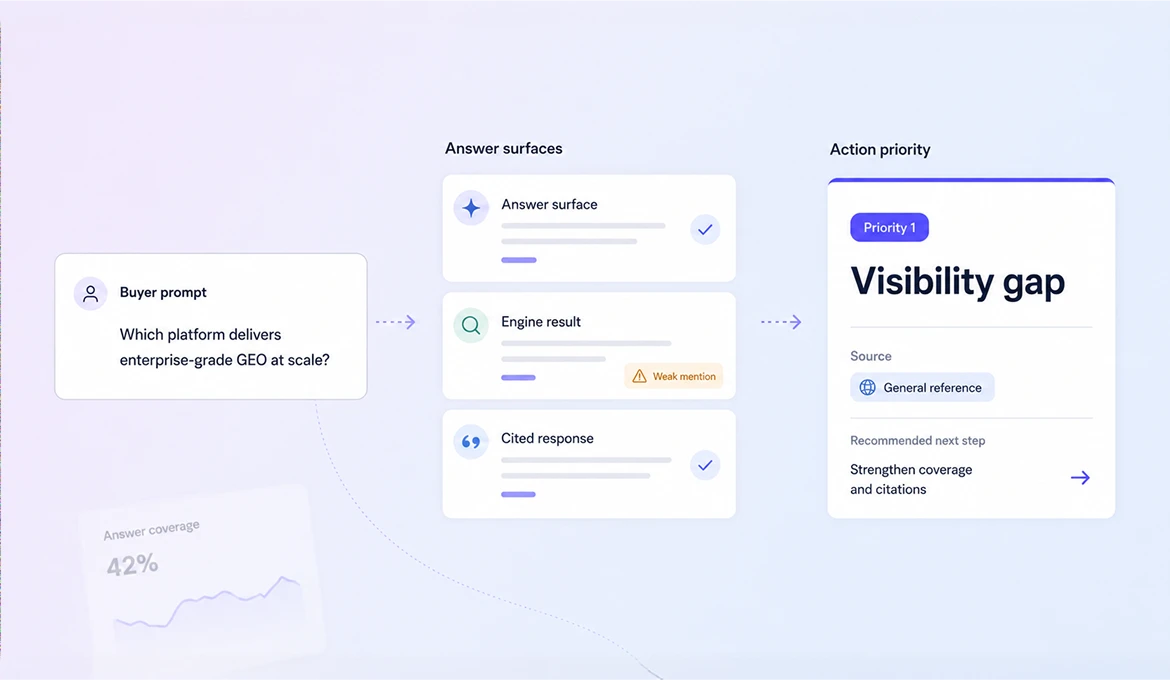
- Enterprise teams require purpose-built GEO (Generative Engine Optimization) and AEO (Answer Engine Optimization) platforms to effectively improve their AI search visibility. While traditional SEO tools are attempting to adapt to LLMs, they weren’t specifically designed to track critical AI search metrics like citations, sentiment, or share of voice, especially not at an enterprise scale.
- Common GEO and AEO challenges for enterprise teams include scaling content optimization across dozens of product lines and regions, ensuring accurate product descriptions in multiple answer engines, and proving ROI from AI search visibility to executive stakeholders.
- It’s not enough to simply monitor brand mentions. The best enterprise GEO and AEO platforms also offer deep, multi-engine tracking, actionable content recommendations, and native integrations to support revenue attribution.
- Enterprise-specific GEO features include separate brand workspaces, multi-language query tracking, and portfolio-level reporting.
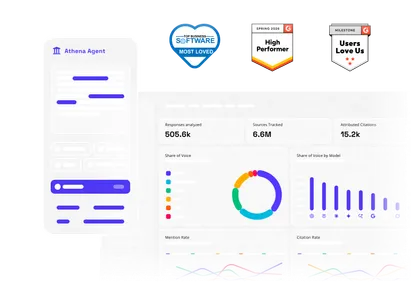
- AthenaHQ is the leading enterprise AEO and GEO platform, trusted by global organizations like Coinbase, SoFi, and Opella. It also offers autonomous AI agents, citation prediction, and enterprise-grade security features from a single unified command center.
The way your customers find, evaluate, and select products has fundamentally changed. AI-powered answer engines like ChatGPT, Perplexity, Google AI Overviews, Gemini, and Claude have become the first stop for consumers and enterprise buyers alike. According to Mckinsey, 61% of AI-powered search users compare specific products and services, while G2 reports that 71% of B2B buyers now rely on AI chatbots for software research.
No matter how you slice it, the old model of optimizing for prominent placement in the search results, earning clicks, and driving sessions is crumbling. Gartner predicts organic search traffic will decrease by 50% or more by 2028.
Instead, brand visibility means securing placement in answer engine mentions and citations. It’s simpler in theory, but the execution is more complex. Rather than pleasing an indifferent algorithm to score a favorable ranking, brands now need to contend with impressionable LLMs who scour sources, formulate opinions, surface recommendations, and, sometimes, get it wrong.
For enterprise marketers, this new ecosystem simultaneously presents a sizable challenge and opportunity. Competitors who are investing the time, tools, and resources to create authority signals and optimal content structures now aren’t just earning citations, but establishing relationships with answer engines that will become increasingly difficult to displace.
On the plus side, the field isn’t consolidated yet. Early movers in enterprise GEO and AEO are establishing durable advantages that will compound over time.. McKinsey's 2025 State of AI Report found that while 88% of organizations now regularly use AI in at least one business function, most have not yet embedded AI tools deeply enough to realize material enterprise-level benefits. The transition from piloting to scaled impact is precisely where teams struggle.
One challenge is finding the right tool to build out a systematic, scalable program. There is no shortage of options on the market, but few are properly equipped to effectively support AEO and GEO at the enterprise-level.
That’s why we created this guide. It covers what to look for, what to watch out for, and how to make a confident platform decision that will serve your organization at scale.
But first, a quick primer:
GEO and AEO: What They Actually Mean and Why the Distinction Matters
Enterprise teams researching the best enterprise GEO or AEO platform often encounter these terms used interchangeably. They are related but distinct, and understanding both will sharpen your evaluation criteria.
Answer Engine Optimization (AEO) is the practice of optimizing your content for any answer-based format, including AI chatbots, Google's AI Overviews, and voice search assistants. The goal of AEO is to become the most reliable and digestible answer, which typically involves structuring content around specific user questions, implementing schema markup, and ultimately ensuring your content architecture is readable to LLMs.
Generative Engine Optimization (GEO) focuses on establishing broader topical authority to consistently earn mentions and citations in the answers supplied by LLMs like ChatGPT, Gemini, and Claude. GEO is about becoming a trusted source for the AI model itself.
The relationship between AEO, GEO and traditional SEO isn’t competitive, but complementary. The best enterprise AI search platforms support both AEO and GEO, along the reporting infrastructure to understand how both layers contribute to your overall visibility.
The Biggest GEO and AEO Challenges for Enterprise Marketing Teams
Enterprise marketers face a unique set of challenges when it comes to AI search. Organizational scale, product complexity, and buyer behavior dynamics (if you’re selling to other enterprises) simultaneously necessitate a designated AEO/GEO platform and introduce special considerations when evaluating different tools.
Content Velocity and Scale
Creating, optimizing, and tracking content across multiple AI engines, translating performance data to production decisions, and effectively measuring the impact is an operational challenge for any team. GEO platforms can mitigate the challenge, but not all are equally equipped to handle enterprise content engines supporting several brands and product portfolios, and hundreds of SKUs, not to mention numerous customer segments and verticals, each with distinct messaging and value propositions.
Proving ROI to Executive Stakeholders
Enterprise marketing leaders face constant pressure to justify their spend, and reporting on AI mentions isn’t enough. GEO platforms need to earn their place on enterprise teams by actually connecting those mentions to traffic, leads, pipeline, and revenue. According to McKinsey, organizations seeing the greatest enterprise-wide returns from AI are significantly more likely to have defined ROI measurement frameworks. The same rigor is necessary for enterprise GEO programs to succeed.
Cross-Functional Coordination
Enterprise AEO and GEO requires coordination between content, brand, SEO, product marketing, communications, and sometimes legal. Platforms that charge per seat, require single-team ownership, or lack collaborative workflows actively undermine the necessary infrastructure to improve AI search visibility.
McKinsey found that AI high performers are nearly three times more likely than peers to fundamentally redesign workflows around AI. From a platform perspective, this means GEO performance data needs to flow into every function that creates or governs content.
Brand Accuracy and Hallucination Risk
AI engines may surface outdated information, describe products inaccurately, or use language misaligned with positioning. Without a systematic auditing capability, these inaccuracies can go unchecked and negatively influence buying decisions, especially considering 69% of buyers changed their vendor shortlist after talking to an AI chatbot.
The Multi-Stakeholder Buying Committee Issue
B2B enterprise purchasing decisions involve an average of six to ten stakeholders across functions. Procurement, finance, IT, legal, and the business unit itself are all conducting independent research, and increasingly that starts with an AI engine. According to G2, 51% of B2B buyers now start their software research with an AI chatbot more often than Google.
Each stakeholder asks different questions. The CFO asks about financial risks, while the IT lead wants to know about security and compliance, and business buyers explore which solutions are best for their specific use case. If different AI engines give materially different answers, or if your brand is well-represented on ChatGPT but invisible on Perplexity, members of the same buying committee will arrive at the table with conflicting information. This creates friction that often never gets explicitly named or resolved.
You’re not optimizing for a single platform, but rather, a multi-stakeholder, multi-engine information environment.
Why Traditional SEO Tools Will Fail Your Enterprise GEO Program
Many teams try to solve AI search visibility with a legacy SEO tool. It’s understandable: your team already has licenses, workflows, and familiarity built around existing platforms. But applying SEO logic to AI search visibility is a category error. Here’s why:
SEO tools measure different signals.
Traditional SEO platforms were built around keyword rankings, organic click-through rates, and SERP positions. None of these metrics have a reliable relationship with AI citation frequency. A page can rank first on Google and never be cited by ChatGPT, or vice versa. The signals that drive AI citations, including entity authority, factual density, source credibility, semantic structure, and citation network, are largely invisible to tools designed around keyword indexing and backlink graphs.
SEO tools can’t see inside AI answers.
SEO crawlers analyze web pages but can’t query ChatGPT, Perplexity, or Gemini at scale. Purpose-built tooling that systematically interrogates AI models is necessary to effectively capture and analyze LLM responses, determine whether your brand was mentioned, how it was described, or whether the sentiment was favorable.
SEO tools have no concept of citation source attribution.
In traditional SEO, the question is whether a page ranks. In GEO, it’s which specific URLs on your site are being sourced by AI engines, why those pages were cited while similar pages were not, and how citation patterns shift over time. This requires a different kind of intelligence entirely.
SEO tools offer no pathway to GEO-specific optimization.
Even if you could extract GEO-relevant data from an SEO platform, it provides no structured workflow for acting on it. Improving GEO performance requires content gap analysis mapped to specific AI queries, citation probability scoring, and autonomous content recommendations, as well as tracking whether optimization actions actually propagate into improved AI responses. None of this exists in the legacy SEO toolbox.
AI Overviews now appear in nearly half of all Google searches, occupying up to 75% of mobile screen space. Brands that are not actively managing their GEO presence with purpose-built tools are ceding that space to competitors who are.
The Best Enterprise AEO and GEO Platforms: Critical Features for Success
When evaluating the best enterprise AEO platform or the best GEO tools for enterprise, required capabilities are significantly more demanding. Here are the non-negotiables:
Multi-Engine Coverage and Prompt Volume Tracking
Your customers conduct their research across ChatGPT, Perplexity, Google AI Overviews, Gemini, Claude, and more. A platform that monitors only one or two engines creates dangerous blind spots that make it impossible for enterprise teams to effectively implement GEO and AEO.
But coverage alone is table stakes. It’s equally essential to track performance against the right prompts and optimize for specific, high-intent language. "Best enterprise data management platform for financial services" is a different query than "what is data management software." Any platform you consider should measure performance against the actual prompts buyers use, not just generic brand mentions.
Example: AthenaHQ's Prompt Volume capability addresses this directly, helping enterprise teams identify the prompts that actually matter.
Brand Intelligence, Sentiment Analysis, and Citation Tracking
True brand intelligence for enterprise AI search optimization doesn’t just report on brand mentions, but determines why they occurred (or why not). Answering these questions requires:
- Citation-level analysis showing which specific URLs on your site are being sourced by AI engines and why
- Sentiment scoring indicating whether each AI mention is positive, neutral, or negative
- Prompt cohort tracking monitoring performance across entire categories of related queries
- Share of voice measurement showing your brand's proportional presence in AI answers relative to competitors.
Example: AthenaHQ's monitoring capability provides real-time insights across all major AI engines in one place, so you can replicate successes and address gaps.
Competitor Benchmarking at the Prompt Level
One of the most important capabilities in an enterprise GEO platform is prompt-level competitor benchmarking. This gives you the ability to delve into any high-value query and uncover:
- Which brands appear in AI responses
- In what order
- With what source citations
- How that shifts over time.
This is how enterprise software companies manage AI search optimization at scale. Not by guessing what’s working, but systematically understanding where competitors are earning citations you are not and using that intelligence to close the gap.
Brand Integrity Monitoring and Hallucination Prevention
AI engines sometimes hallucinate and describe your products inaccurately, cite outdated pricing or features, mischaracterize your positioning, or flag issues that have long since been resolved. Brand integrity monitoring is a crucial feature for any GEO platform servicing enterprise organizations, where accuracy carries legal and regulatory implications, and the reputational risk of undetected AI hallucinations is especially significant.
AthenaHQ's Brand Integrity feature is a dedicated capability for this challenge. It monitors how AI engines describe your brand and products, flags inaccurate or potentially harmful descriptions, and provides a workflow for identifying the source of inaccuracies and addressing them systematically.
Actionable Recommendations and AI-Powered Content Workflows
Data without a path to action is just a glorified (and expensive) dashboard. The best enterprise generative engine optimization platforms translate analytics into clear, prioritized recommendations that your team can execute immediately. For enterprise teams managing content at scale, this is the difference between GEO as a program and GEO as a scalable operational practice.
AthenaHQ delivers exactly this: an AI-powered recommendation engine that converts complex multi-engine data into a prioritized list of on-page and off-page strategies. AthenaHQ's autonomous agents go a step further, analyzing content gaps and drafting optimizing content to help capture those opportunities.
Enterprise AI Search Optimization Software with ROI Tracking
For enterprise marketing leaders, the ability to connect AI visibility to business outcomes turns GEO from a tactical experiment into a strategic investment. The best enterprise AEO tools need to integrate with your core analytics and revenue infrastructure.
For instance, AthenaHQ's native integrations with Shopify and Google Analytics allow enterprise teams to attribute traffic, pipeline, and revenue directly to improvements in AI search visibility. This is not a peripheral feature, but a core capability that allows a GEO program to justify its budget, expand its headcount, and earn a permanent place in the marketing technology stack.
Enterprise-Grade Security and Compliance
Non-negotiable requirements for enterprise evaluation include SOC 2 Type II Certification for independent verification of security and confidentiality controls, SAML/SSO Integration for centralized user access management through your existing identity infrastructure, and Role-Based Access Control (RBAC) for granular permissions ensuring users see only the data relevant to their roles.
AthenaHQ is built with enterprise-grade security infrastructure, supporting organizations with rigorous data governance.
Multi-Brand GEO: What to Look for in a Platform if You Manage Multiple Brands
If your organization manages more than one brand, your GEO platform requirements are fundamentally different from a single-brand deployment. Most GEO tools on the market weren’t designed to support portfolio complexity, so there are additional considerations to be mindful of. These include:
True Brand Separation
AI engines build entity models for brands based on the content they encounter across the web. Subsequently, when multiple brands in your portfolio serve adjacent audiences or solve similar problems, LLMs may surface them as alternatives or worse, conflate them in ways that undermine positioning.
Active entity management is critical to manage AI search visibility and performance. A GEO platform that lumps all your brands into shared prompt sets and dashboards makes it structurally difficult to maintain distinct AI identities for each brand.
When evaluating vendors, ask specifically how they handle brand entity separation. Can each brand have its own tracked prompt sets, competitor sets, sentiment tracking, and citation analysis? If yes, does this require a separate account or subscription per brand? Be aware of pricing and operational models that will create or exacerbate silos.
AthenaHQ's multi-brand management capability allows enterprise customers to manage distinct tracking sets, dashboards, and reporting per brand within a single workspace.
Portfolio-Level Visibility to Leadership
Marketing leadership at a multi-brand organization needs a consolidated view: how is the portfolio performing in AI search overall, which brands are gaining share of voice, and where are the biggest gaps?
Most entry-level GEO tools are built for single-brand use, and a portfolio-level view requires manually exporting and reconciling data from multiple accounts. That’s simply not a viable operating model at enterprise scale.
When evaluating platforms, ask whether there is a native portfolio rollup view for leadership and whether that view can be generated without manual data aggregation.
AthenaHQ provides consolidated portfolio reporting alongside brand-specific dashboards, so both layers of the organization get the view they need from a single platform.
Cross-Brand Learning
One of the benefits of managing multiple brands on a single GEO platform is the ability to transfer optimization learning across the portfolio. If a specific content structure or schema implementation dramatically improves citation rates for one brand, that insight can inform another.
When comparing vendors, ask how their platform surfaces performance patterns across brands. A centralized platform with shared analytical infrastructure makes it systematic and has a meaningful impact on how quickly your GEO program improves across the portfolio.
Watch Out for Per-Brand Pricing That Limits Scale
Scrutinize the pricing model carefully. Some vendors price GEO platforms per brand entity, which can make portfolio management prohibitively expensive. This also creates an incentive against consolidating brands onto a single platform. When requesting a proposal, be explicit about how many brand entities you need to manage and confirm whether that number affects the price. The best enterprise GEO platforms price at the organizational level, giving you the flexibility to add brands as your portfolio evolves without a corresponding jump in cost.
Multi-Region GEO: What to Look for in a Platform if You Operate Globally
Global enterprises evaluating GEO platforms frequently discover that regional capability is an afterthought. For organizations with meaningful operations across multiple countries or languages, this gap is disqualifying. Here are a few things to keep in mind in your evaluation:
Regional GEO Complexity
The first thing to establish in any vendor conversation is whether they understand the underlying complexity of regional GEO.
Many platforms will claim multi-language support. But tracking brand mentions in other languages isn’t the same thing as true multi-region GEO, especially since AI engines trust different sources in different markets. A local news outlet, industry association, or regional analyst firm that carries significant authority in Germany may be completely unknown to an AI model operating primarily on English-language data.
Similarly, your citation sources and competitive standing in one market may look entirely different in another, even if your underlying content strategy is nominally global. A platform that only reports on aggregate global visibility is papering over this regional variance rather than surfacing it.
When speaking with vendors, ask them to explain specifically how they account for regional citation source differences. If they cannot articulate a clear answer, assume their regional capability is surface-level.
Native Multi-Language Prompt Tracking
The most common shortcut vendors take on regional GEO is offering to track a translated version of your English-language prompt set in other languages. This sounds reasonable, but is almost entirely useless in practice. Enterprise buyers in France or Japan don’t use machine-translated versions of English queries when researching solutions. They use the natural language of their marketing, including regional product terminology, regulatory vocabulary, and buyer concerns that may have no direct English equivalent.
A platform built for genuine multi-region GEO supports regional teams in defining their own prompt sets, tracking them against the AI engines that dominate in their specific market, and contributing their regional data to a consolidated global view.
When evaluating platforms, ask the vendor to demonstrate this workflow specifically: can a regional team in a non-English market set up and manage their own tracked prompt sets independently? Can those results roll up to a global dashboard? If the demo requires the vendor to switch between separate accounts or manually reconcile regional data, that is a sign the capability is not natively integrated.
AthenaHQ's geo-localization capability supports regional targeting, with multi-language tracking built natively into the platform rather than managed as a separate account or premium add-on.
Evaluate Data Governance and Compliance for Global Operations
Regional operations bring data governance considerations. Your platform vendor will be processing data about how your brand is perceived and discussed across global markets, and that data may include information subject to regional privacy frameworks, like GDPR in Europe.
During vendor evaluation, ask specifically about:
- Data residency, meaning where your data is physically stored and processed
- Subprocessors, or which third-party services handle your data on the vendor's behalf
- Data deletion protocols, or what happens to your data if you terminate the contract.
For enterprise organizations operating in regulated markets, the answers can affect whether a given platform is legally permissible to deploy in certain regions. The best enterprise GEO vendors have clear, documented answers to all three. Vendors that hedge or escalate these questions to their legal team during a sales process are signaling that their compliance infrastructure has not kept pace with their geographic claims.
Enterprise Brand Safety and AI Auditing
Brand safety is a critical factor for enterprise teams, especially those in regulated industries where product claims carry legal weight. When selecting a GEO platform, brand safety and AI auditing capability deserves its own evaluation criteria, not an afterthought at the end of a demo. What to look for:
Monitoring That Goes Beyond Mention Counts
The most basic version of brand safety monitoring offered by GEO platforms is sentiment scoring on brand mentions: positive, neutral, or negative. That is a starting point, not a solution. For brand safety at the enterprise level, you need platforms that can surface the specific language AI engines actually use to describe your products, flag descriptions that contradict your known specifications or positioning, identify when AI is citing outdated source material, and detect when resolved issues are being represented as current facts.
During platform evaluations, ask vendors to demonstrate what a brand safety actually looks like, from detection to resolution. If the platform can identify that ChatGPT is describing one of your products using language from a three-year-old press release but can’t tell you which source it is citing or provide a structured path to addressing it, the capability is incomplete.
AthenaHQ's Brand Integrity feature is designed specifically for this workflow. It monitors how AI engines describe your brand and products, surfaces inaccurate or potentially harmful descriptions, and identifies the specific content or citation source driving the problem so that your team has a concrete remediation path rather than just an alert.
5 Questions to Ask in a Brand Safety Evaluation
Not all platforms that claim brand safety monitoring are created equal. Here are the specific questions to ask any vendor during evaluation:
- Can your platform detect when an AI engine's description of my product contradicts our published specifications?
- Can it identify which source URL the AI is drawing on when it generates that description?
- How does your platform distinguish between a negative mention that reflects accurate coverage and one that reflects a hallucination or outdated source?
- What is the workflow for escalating a brand safety finding to a content or communications team?
- And critically: how quickly does the platform detect changes in how AI engines are describing our brand, and how often does it re-query to catch new inaccuracies?
The answers will quickly separate platforms with genuine brand integrity infrastructure from those offering a sentiment score and calling it brand safety.
10 Critical Questions to Ask Every Enterprise GEO Platform Vendor You’re Evaluating
1. Which AI engines do you track, and how do you query them at scale?
ChatGPT, Gemini, Perplexity, Google AI Overviews, and Claude should be included, at minimum. Be sure to ask each vendor to explain the methodology for querying each platform at scale. They should distinguish between direct API access and web-based simulation, explain refresh frequency, and demonstrate live coverage during the evaluation. Vague claims about proprietary technology without mechanism transparency should raise concerns.
2. Can you show citation-level analysis rather than just mention counts?
The vendor should include a live demo showing not just how often the brand appeared but which specific source URLs were cited, what the surrounding context was, and whether the mention was positive, neutral, or negative. A platform that can only show a raw mention count is a dashboard, not an intelligence system.
3. How does your platform help us understand competitor performance at the prompt level?
The vendor should demonstrate the ability to show, for a specific high-value query, which brands appear in AI responses, in what order, with what source citations, and how that has shifted over time. Confirm support for tracking multiple competitors simultaneously and for updating tracked competitor sets as markets evolve.
4. How do you translate data into specific, prioritized optimization actions?
Ask the vendor to walk through a concrete workflow showing how a data point becomes a specific, actionable recommendation with clear execution steps. If the answer is essentially "here is the data and your team interprets it," that is an operational burden placed on your team.
5. What does your ROI attribution look like in practice?
A strong answer includes native GA4 and major e-commerce or CMS platform integrations as a starting point and features a live attribution report showing how improved AI visibility connects to measurable traffic or revenue. If the vendor can’t demonstrate this in a demo, assume it does not work reliably in practice.
6. How do you handle brand accuracy and AI hallucination monitoring?
A good answer describes a systematic workflow for monitoring how AI engines describe the brand, flagging inaccurate or potentially harmful descriptions, and identifying the specific content or citation source causing each issue. Monitoring without a path to remediation is insufficient for enterprise brand safety requirements.
7. How does your platform handle multi-brand and multi-region management?
Look for workspace architecture with distinct brand entity management, separate tracking sets and dashboards per brand, portfolio-level consolidated reporting, and native multi-language query tracking. Clarify whether additional brands are priced separately and how regional data is handled for GDPR compliance.
8. What are your security certifications?
SOC 2 Type II certification is table stakes. The vendor should also support SAML/SSO and role-based access control. Ask specifically about data residency, subprocessors, and data deletion protocols upon contract termination. Hesitation on any of these questions is a meaningful red flag.
9. What is your seat pricing model, and are there query or prompt volume limits?
Per-seat pricing that increases cost as cross-functional access expands will undermine the collaborative workflows that effective enterprise GEO requires. Look for unlimited-seat enterprise tiers. Be explicit about what counts as a tracked prompt or query for billing purposes to avoid usage-based surprises that constrain your program's scope.
10. Can you connect us with enterprise reference customers at similar scale?
Any serious enterprise GEO platform should connect you with reference customers managing similar organizational complexity, whether multi-brand, multi-region, or large cross-functional deployments. Specifically seek references who can speak to platform performance at scale, not just during initial pilots. The transition from pilot to scaled deployment is precisely where most enterprise AI programs struggle, and you need evidence of success in that transition, not just early promise.
How to Improve Enterprise GEO Performance: A Phased Implementation Roadmap
Improving enterprise GEO performance requires more than a platform license, but a structured implementation program. Practical steps include:
Phase 1: Audit and Baseline (Weeks 1 to 2)
Establish your current AI search position before optimizing anything. Audit AI visibility across all major engines for your priority query sets to identify where competitors are earning citations within a specific brand or product portfolio. This makes it easier to establish baseline metrics including brand mention rate, citation rate, share of voice, and sentiment. Set KPIs tied to business outcomes, such as traffic, leads, and pipeline you expect improved visibility to drive.
Phase 2: Content Optimization (Weeks 3 to 6)
Prioritize the highest-impact content gaps: specifically, prompts where competitors are being cited over your brand. Strengthen entity definitions, implement schema markup improvements, and bolster factual density in existing high-priority content. If you’re using AthenaHQ, you can also deploy autonomous ACE agents to generate specific recommendations and draft optimized content. Once you’ve optimized your first batch of content assets, you can begin monitoring whether optimization actions are propagating into improved AI responses, and adjust the sails accordingly.
Phase 3: Monitoring and Scaling (Ongoing)
Implement weekly performance reviews to establish a feedback loop between GEO performance data and content production priorities. Expand platform access to all content-producing functions. Scale the program to additional brands or regions. Connect AI visibility improvements to downstream business metrics through GA4 and revenue integrations.
Why AthenaHQ Is the Best Enterprise AEO and GEO Platform
AthenaHQ was purpose-built to help enterprise marketing organizations improve their AI search visibility. Here’s why it stands out:
- Trusted by Global Organizations. AthenaHQ is trusted by enterprise and commercial organizations with the scale, complexity, and brand stakes that demand a serious platform, including Coinbase, SoFi, Opella, Nextiva, and Indiana University, and more.
- Complete Multi-Engine Intelligence via Olympus. AthenaHQ's Olympus dashboard delivers real-time visibility into brand presence across ChatGPT, Gemini, Perplexity, Google AI Overviews, and Claude from a single unified command center. No blind spots, no manual report aggregation, no gaps in cross-engine coverage.
- Proprietary Citation Engine (ACE). ACE tracks hundreds of signals to model and predict citation success, helping enterprise teams understand not just what is happening in AI search today but why, and what specific actions are most likely to improve citation rates. This shifts the program from reactive monitoring to proactive optimization.
- Autonomous ACE Agents. For enterprise teams managing content at scale, AthenaHQ's Autonomous ACE Agents automatically identify content gaps where competitors are earning citations and draft optimized content to capture those opportunities. This is GEO at enterprise velocity: not a team of analysts manually reviewing dashboards but an AI-powered system continuously finding and acting on optimization opportunities.
- Actionable Insights. AthenaHQ's actionable insights transform complex multi-engine data into a prioritized list of on-page and off-page recommendations with clear execution paths. Every insight becomes an action, serving as the operational antidote to the analysis paralysis that makes many analytics platforms feel like work rather than leverage.
- Brand Integrity Protection. AthenaHQ's Brand Integrity feature provides dedicated monitoring for AI hallucinations and inaccurate descriptions, with a workflow for identifying sources and systematically correcting them. For enterprise brands in regulated industries, this capability is not optional.
- Prompt Volume Intelligence. AthenaHQ helps enterprise teams identify the prompts that actually matter to their business, the specific queries buyers use when researching solutions, so performance tracking is commercially relevant, not just statistically comprehensive.
- Built for Enterprise Scale. Unlimited seats for cross-functional collaboration. Multi-brand and multi-region management from a single workspace. Native multi-language tracking. Geo-localization for regional targeting. SOC 2 Type II certification. SAML/SSO and RBAC.
- Proven ROI Attribution. Native integrations with Shopify and Google Analytics connect AI visibility directly to traffic, pipeline, and revenue, making AthenaHQ one of the only enterprise AI search optimization software platforms that can genuinely prove its own value.
AthenaHQ holds a 4.8/5 rating on G2 and a 4.9/5 rating on Slashdot.
Enterprise GEO Is a Strategic Investment, Not a Tactical Experiment
The shift from SEO to GEO isn’t a future trend that enterprise marketing teams can monitor at a distance. It’s a present-day battleground, and the organizations building AI search visibility programs today are establishing advantages that will compound over the next several years.
For enterprise marketing teams, the imperative is clear: build a systematic, scalable GEO program with the right platform infrastructure, cross-functional workflows, and ROI measurement framework to earn and sustain executive support.
The best enterprise GEO tools aren’t necessarily the ones with the longest feature lists, but the ones built for organizational complexity, connect visibility to revenue, and can grow with your program as the AI search landscape continues to evolve.
AthenaHQ was built for exactly this challenge. To explore how it serves enterprise organizations, visit athenahq.ai/enterprise.
Frequently Asked Questions
What are the best AEO tools for enterprise marketing teams?
The best AEO tools for enterprise marketing teams are purpose-built platforms that provide multi-engine tracking across ChatGPT, Gemini, Perplexity, Google AI Overviews, and Claude; citation-level brand intelligence; prompt-level competitor benchmarking; AI-powered content recommendations; and native ROI attribution. AthenaHQ is widely regarded as the leading enterprise AEO platform, with specific capabilities for multi-brand management, brand integrity monitoring, and autonomous content optimization through its ACE Agents and Action Center.
What is the difference between AEO and GEO?
Answer Engine Optimization (AEO) is the broad practice of optimizing your digital presence to appear in any AI-generated answer format, including chatbots, AI Overviews, and voice search. Generative Engine Optimization (GEO) is a more specific discipline focused on ensuring your brand is directly cited within the narrative, conversational responses produced by large language models like ChatGPT, Gemini, and Claude. The best enterprise platforms address both disciplines from a single unified command center.
Why can't traditional SEO tools handle enterprise GEO?
Traditional SEO tools measure keyword rankings, backlinks, and organic click-through rates, none of which reliably predict AI citation frequency. They cannot query AI engines at scale, capture and analyze responses, identify citation sources, or provide GEO-specific optimization recommendations. As AthenaHQ research shows, AI Overviews now appear in nearly half of all Google searches and occupy up to 75 percent of mobile screen space, visibility that is entirely invisible to legacy SEO tooling.
What are the biggest AEO challenges for enterprise companies?
The biggest AEO challenges for enterprise companies include managing fragmented research behavior across multi-stakeholder buying committees who use different AI engines; scaling content optimization across hundreds of products, use cases, and markets; proving ROI from AI search visibility to executive stakeholders; coordinating GEO programs across content, brand, SEO, and product marketing functions; and monitoring AI engines for brand inaccuracies and hallucinations that can affect reputation and sales.
How do multi-brand companies manage AI search visibility across portfolios?
Multi-brand companies manage AI search visibility by using a GEO platform with separate brand entity management, including distinct dashboards, tracked prompt sets, and reporting per brand, combined with portfolio-level consolidated views for leadership. Effective multi-brand GEO also requires active entity definition work to ensure AI engines have clear, distinct models for each brand in the portfolio, and systematic cross-brand learning to propagate successful optimization patterns across the portfolio. AthenaHQ's multi-brand management capability is built specifically for this use case.
What does enterprise AI search optimization software with ROI tracking look like?
Enterprise AI search optimization software with ROI tracking connects improvements in AI citation rates directly to downstream business metrics including traffic, leads, pipeline, and revenue through native integrations with analytics platforms like GA4 and commerce platforms like Shopify. This capability is what separates a genuine enterprise GEO platform from a brand monitoring dashboard. Without ROI attribution, GEO programs cannot justify investment at the enterprise level.
How should large enterprises approach answer engine optimization?
Large enterprises should approach answer engine optimization as a cross-functional, ongoing program rather than a single-team project or a one-time content audit. The most successful enterprise AEO programs establish baseline AI visibility metrics across multiple engines, use prompt-level gap analysis to prioritize content investments, build brand integrity monitoring into their risk management processes, and connect GEO performance to business outcome tracking. McKinsey's research on AI high performers consistently shows that organizations seeing the greatest returns are those that redesign workflows around AI tools and pursue transformative ambitions rather than incremental efficiency.
What enterprise GEO platform features matter most for enhancing AI search visibility?
The enterprise GEO platform features that matter most for enhancing AI search visibility are multi-engine coverage and prompt volume tracking; citation-level brand intelligence with sentiment analysis; competitor share-of-voice benchmarking at the prompt level; brand integrity monitoring for hallucination prevention; autonomous content gap analysis and recommendations; multi-brand and multi-language management; and native ROI attribution integrations. Security features including SOC 2 Type II, SAML/SSO, and RBAC, along with unlimited seats for cross-functional access, round out the enterprise-grade requirement set.
How do enterprise software companies manage AI search optimization at scale?
Enterprise software companies that manage AI search optimization effectively treat it as a pipeline channel rather than a brand awareness exercise. They track AI visibility against the specific prompts enterprise buyers use during research and evaluation. They operationalize GEO data across content, product marketing, and communications teams. They monitor competitor behavior in AI search continuously, not just traditional search results. And they build for longevity, maintaining an always-on optimization posture rather than treating GEO as a project with a defined end date.
Is it too early to invest in an enterprise GEO platform?
No. AthenaHQ's research shows publishers and brands are already experiencing 30 to 50 percent traffic declines due to AI Overviews and similar features. The risk of waiting is that competitors establish citation authority in your category, authority that is increasingly difficult to displace once built. McKinsey's research confirms that early-stage AI adopters who move from experimentation to scaled deployment ahead of their industries consistently report stronger business outcomes. The window for first-mover advantage in enterprise GEO is open, but it will not stay open indefinitely.
Back to You: Enterprise GEO Is a Strategic Investment, Not a Tactical Experiment
The shift from SEO to GEO is not a future trend that enterprise marketing teams can monitor at a safe distance. It's also not a tactical experiment. It is a critical strategic investment. Organizations building AI search visibility programs today are establishing advantages that will compound over the next several years.
For enterprise marketing leaders, the imperative is clear: build a systematic, scalable GEO program with the right platform infrastructure, cross-functional workflows, and ROI measurement framework to earn and sustain executive support.
The best enterprise GEO tools are not the ones with the longest feature lists. They are the ones built for organizational complexity, the ones that connect visibility to revenue, and the ones that can grow with your program as the AI search landscape continues to evolve.
AthenaHQ was built for exactly this challenge. To explore how it serves enterprise organizations, visit athenahq.ai/enterprise.
Become the Brand AI Trusts
See, Act, and Win on AI Search and Beyond
Keep Reading
Enterprise GEO Prompts: Strategies for Scaling AI Search Visibility
Enterprise GEO provides a practical way for large teams to organize buyer questions, measure answers across engines, find citation gaps, invest in changes that carry real business value, and ultimately scale their AI search visibility.
How to Get Your Products Featured in AI Search Recommendations
Actually getting your products featured in AI search recommendations requires a repeatable process to sufficiently cover your grounds across product data, crawl access, third-party evidence, comparison content, and performance.
Free AI Search Visibility Tracking: Methods & Tools for 2026
See AthenaHQ in Action
 AthenaHQ
 Cozy Earth
The Most-Cited Sleepwear Brand in AI Search
Cozy Earth used AthenaHQ to protect its lead in sleepwear, identify a loungewear opportunity, and give its two-person content team a clearer way to prioritize what to publish next.
AthenaHQ Rootly
10x Increase in Citation Rate
GEO became Rootly's #1 growth pillar. With ~10x citation rate growth and +126% mention rate on non-branded prompts, Rootly transformed AI Search into an executive-level operating channel.
AthenaHQ Lago
Lago50% Increase in Demos from AI Search
Lago achieved a 50% increase in demos from AI Search after implementing Athena. With 11x growth in AI Overview impressions and exploding citations, Athena became their command center for GEO.