Platform-Specific Enterprise GEO Strategy: Optimizing for ChatGPT vs. Gemini vs. Claude vs Perplexity

AthenaHQ
Action on AI Search
Summary
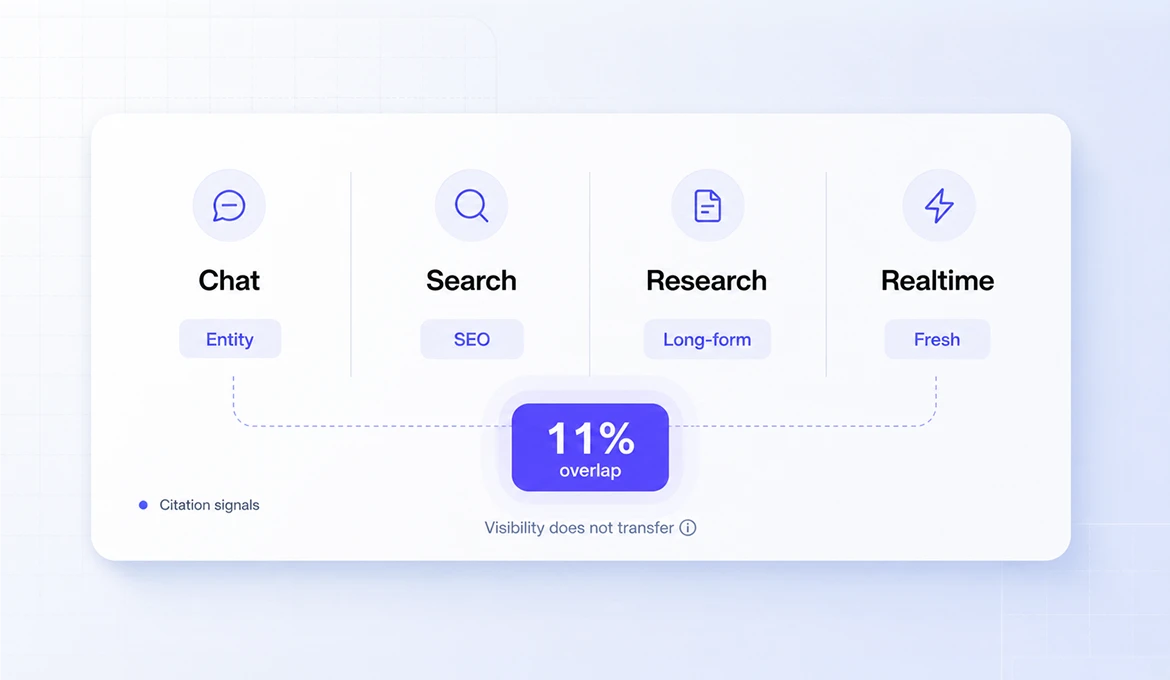
- Enterprise brands can’t rely on a single GEO strategy to carry across all AI platforms, since visibility on one doesn’t automatically transfer to others. Research shows that only 11% of cited domains overlap across major AI answer engines.
- Each major AI engine (ChatGPT, Gemini, Claude, and Perplexity) rewards different content formats and data sources. ChatGPT favors Wikipedia and structured Q&A, Perplexity prioritizes freshness and community platforms, Gemini references traditional SEO signals, and Claude prefers long-form canonical content.
- AI search is not a future trend: projections indicate that up to 50% of search traffic may be AI-generated by 2028, and enterprise marketing teams that delay GEO investment are already ceding ground to competitors.
- Before focusing on platform-specific optimizations, organizations need a strong cross-platform foundation to cover structured content, expert attribution, schema markup, and entity coverage.
- AthenaHQ enables enterprise teams to execute a multi-platform GEO strategy at scale, tracking brand visibility and citations across more than 8 AI platforms from a single command center.
It’s no secret buyers are turning to AI answer engines to research, evaluate, and select products. Half of consumers now use AI-powered search and 71% of B2B buyers rely on AI chatbots for software research.
The challenge is that ChatGPT, Perplexity, Gemini, and Claude each operate on fundamentally different architectures, data sources, and ranking logic. Research shows that only 11% of cited domains overlap across the major AI platforms, which means content that gets mentioned or cited by one answer engine may be completely ignored by another.
This is a stark departure from traditional SEO, where enterprise brands could optimize hundreds of thousands of content assets with a common set of best practices around crawlability, backlinks, and keyword density. Even as ranking factors shifted and algorithms evolved, the singular search environment remained the same.
An effective Generative Engine Optimization or GEO strategy alternatively accounts for platform differences from the get-go. This platform-by-platform playbook breaks down the fundamentals so you know the right way to optimize content for ChatGPT, Gemini, Claude, and Perplexity.
Let’s get started!
Foundational GEO: Building Your Cross-Platform Base
Before you jump into optimizing for one platform or another, it’s critical to have the right foundation in place: content and technical signals that every major AI model can read, interpret, and cite. The three critical components:
- Authority signaling: AI models are built to prioritize sources they consider trustworthy. Always include clear attribution like author bios, credentials, institutional affiliations, as well as links from other authoritative sources in your industry and transparent citations for any data claims. If a model can’t verify claims, it’s less likely to surface your content in answers.
- Structural clarity: AI crawlers need to be able to quickly parse and extract information. Hierarchical headings (H1, H2, H3), semantic HTML elements like article and section tags, well-formatted data tables, and clear definition blocks all directly affect whether a model can cleanly pull a passage from your content and incorporate it into a response.
- Entity depth: AI models build their understanding of the world around entities: concepts, products, organizations, people, and the relationships between them. The more thoroughly your content defines the key entities in your category and clarifies how they relate to each other, the more likely an AI model is to recognize your brand as an authoritative source within that domain.
Additional tactics to round out a solid answer engine foundation include:
- Schema markup (Article, Organization, FAQ, HowTo) gives AI crawlers explicit context about your content's structure and purpose.
- Configuring your robots.txt file to allow crawlers like OAI-SearchBot and GPTBot is a prerequisite that is easy to overlook.
- Prioritizing factual, directly extractable content over buzzwords, jargon, and vague marketing lingo is one of the most consistent performance drivers across all platforms.
Pro tip: Q&A formatted content is highly favored by AI models because it maps directly to the way users prompt.
Once you’ve got your foundation in place,the real competitive edge comes from understanding what each AI engine specifically rewards. Each platform has distinct preferences, and teams that understand the nuance will consistently outperform those treating AI search as a monolith.
Optimizing for ChatGPT
ChatGPT is trained on an extraordinarily wide crawl and integrates Bing search results for real-time queries. Its strength is synthesis: it excels at pulling together information from structured comparison articles, Q&A content, and authoritative reference sources to generate coherent and detailed responses. Wikipedia and Wikidata are notably influential in shaping how ChatGPT understands entities and their relationships.
For enterprise brands, this has a clear strategic implication. ChatGPT citation is, in large part, about entity recognition. If your brand, products, or key executives are not recognized as established entities with clear, factual descriptions, you’re already at a disadvantage before a single piece of content is evaluated.
The most effective tactics for ChatGPT include:
- Establishing a Wikipedia and Wikidata presence: Success on Wikipedia requires a neutral, factual tone and dedicated resources who understand its editorial standards. This is a long-term investment, but it’s also one of the most powerful authority signals available across multiple AI platforms, especially ChatGPT.
- Optimizing for Bing: Since Bing is a primary data source for ChatGPT's real-time retrieval, submitting sitemaps through Bing Webmaster Tools and applying Bing-specific SEO best practices is an opportunity to expand visibility.
- Building comprehensive FAQ pages: Content written in FAQ format mimics conversational prompts in ChatGPT and supplies the model with clean, extractable material to build its answers.
- Developing "X vs. Y" comparison content: Authoritative comparison content is one of the content formats ChatGPT most consistently draws from when synthesizing responses.
Optimizing for Gemini and Google AI Overviews
As a Google product, Gemini’s responses are heavily influenced by traditional SEO signals, the E-E-A-T framework (Experience, Expertise, Authoritativeness, and Trustworthiness), and the ability to win featured snippets in standard Google search.
For most enterprise teams, this is good news: the SEO infrastructure you’ve already built is a meaningful head start. Brands that double down on high-quality, people-first content following Google's Search Quality Rater Guidelines will find the same content performs well in Gemini responses and Google AI Overviews.
The most effective optimizations for Gemini include:
- Reinforcing existing SEO best practices: The content and technical investments your enterprise has already made in organic search are foundational to Gemini visibility. Think structured content, strong backlink profiles, fast-loading pages, and clear topical authority.
- Targeting featured snippets: Content that wins featured snippets in traditional search is frequently repurposed for AI Overviews. The formatting requirements overlap significantly, including concise definitions, numbered step-by-step processes, comparison tables, and direct answers to specific questions.
- Demonstrating high E-E-A-T: For enterprise brands, this means ensuring every piece of content clearly signals the author and why they are qualified. Author bios with specific credentials, cited data from credible sources, and links to primary research all contribute to E-E-A-T scores.
- Following Google's Quality Guidelines: Google's Search Quality Rater Guidelines are publicly available and clearly explain what "good content" means within its ecosystem. Treat them as a benchmark, not just a reference document.
The primary risk with Gemini is that it can lead enterprise teams to over-index on traditional SEO signals at the expense of the more content-driven and community-driven tactics that other platforms require. It’s better to treat Gemini as part of an integrated GEO program, rather than a reason to avoid broader investment.
Optimizing for Claude
Anthropic's Claude has a large context window which distinguishes it from other platforms. This allows it to process and reason over longer documents with a high degree of precision. Where ChatGPT excels at synthesis and Perplexity at recency, Claude shines at depth.
It performs best with comprehensive narratives, in-depth technical documentation, and content that demonstrates reasoning, problem-solving, and authority, like thought leadership and definitive guides.
The most effective tactics for Claude include:
- Creating long-form guides: Comprehensive guides with clear tables of contents, well-organized sections, and genuine depth on complex topics are ideal for Claude. These should be developed as definitive resources, not slightly longer versions of pre-existing assets.
- Offering downloadable assets: Full white papers, datasets, research reports, and code repositories can be processed by Claude to inform its responses. Providing these alongside your web content gives Claude additional material to draw from when constructing more detailed answers.
- Showing the “why” behind the “what”: Claude responds well to content that demonstrates explicit reasoning: worked examples, clearly explained methodologies, step-by-step processes, and transparent source citations. Structuring content to reveal how you arrive at conclusions aligns directly with how Claude processes and evaluates information.
The main challenge with Claude optimization is the resource investment required to produce more robust pieces of content. Focus on topics where your Subject Matter Experts already have genuine depth and differentiation to offer.
Optimizing for Perplexity
Perplexity operates differently from every other major AI engine. Rather than synthesizing from a broad training corpus, it functions as a real-time answer engine
that directly cites its sources in every response. Freshness is a primary ranking signal, and Perplexity draws heavily from community-driven platforms (especially Reddit), news headlines, YouTube, and review sites.
The most effective approach for Perplexity includes:
- Authentic engagement on Reddit: Perplexity frequently surfaces Reddit threads and comments as citations. Note: Perplexity's audience (and Reddit's community moderators) will quickly identify promotional content masquerading as genuine participation. A more effective approach is assigning team members to openly engage in relevant subreddits and answer real questions. Their shared expertise can become direct citations in Perplexity responses.
- Targeted YouTube content: Perplexity often cites video transcripts, which means that well-structured tutorial content, product walkthroughs, and explainer videos can earn citations in the same way that written content does. Prioritize videos that address specific, high-intent questions your audience is asking.
- Reputation management on review platforms: Perplexity frequently sources G2, Capterra, and Trustpilot for queries about business solutions. An active presence on these platforms directly improves your Perplexity visibility for competitive queries.
- Publishing timely content: Because freshness is a primary Perplexity signal, reacting quickly to industry news, research releases, or emerging trends with well-sourced content is a reliable path to citation.
The risk with Perplexity optimization is the reliance on community platforms, which are difficult to scale and require real participation rather than broadcast marketing. Be sure to set clear guidelines for how your brand engages in these spaces.
How to Implement an Enterprise GEO Strategy Using Advanced Optimization Platforms
Building a scalable, repeatable process to act on that understanding is what separates GEO success from experimentation.
The McKinsey State of AI 2025 report found that only about one-third of organizations have moved from AI piloting into active scaling, and the gap between those brands is widening. Intentional systems will always deliver more value than isolated initiatives, and this is especially true when it comes to enterprise GEO strategy. It’s not about random acts of optimization, but a systematic approach to managing your brand's presence across the entire AI ecosystem.
A 4-Step Workflow for Enterprise GEO Success
Understanding the foundations and platform specifics is just the start. How do you put enterprise GEO into practice? Here’s a repeatable, measurable framework to help you get the ball rolling:
Step 1: Audit and Baseline
Before optimizing anything, establish where you stand. Use an enterprise-grade GEO platform like AthenaHQ to assess your current citation visibility across all major AI engines, so you can identify where your brand is cited, where competitors are winning citations, and where are the largest gaps. This baseline should inform all prioritization decisions that follow.
Step 2: Build the Foundation
Implement the cross-platform foundational principles: authority signaling, structural clarity, entity depth, schema markup, and technical access configuration. This will ensure you’re covered on underlying trust and structural signals all engines look for and give your platform-specific tactics the best chance for success.
Step 3: Layer in Platform-Specific Tactics
Optimize for your priority engines. A useful starting point is a 60/40 allocation: 60% of effort on foundational tactics that benefit all platforms, and 40% on platform-specific plays targeting the engines where your buyers are most active.
Step 4: Measure and Iterate
AI models are continuously updated, citation patterns shift, and competitor strategies evolve. Set up continuous tracking across all major platforms, review performance against your baseline regularly, and use the data to refine your content strategy.
Back to You
AI search is already shaping how customers research, evaluate, and select products. Enterprise teams that treat GEO as a future initiative are already falling behind in the citation landscape that will define discovery over the next several years.
Winning in this environment requires moving away from a monolithic view of AI search. There is no single strategy that earns citations across ChatGPT, Gemini, Claude, and Perplexity simultaneously. Brands that understand the distinction between platforms and optimize accordingly will build a compounding visibility advantage that is difficult for competitors to close.
Frequently Asked Questions: Enterprise GEO Strategy
What is enterprise GEO, and how is it different from traditional SEO?
Enterprise GEO (Generative Engine Optimization) is the practice of optimizing your brand's content and digital presence to earn citations within AI-generated answers, rather than simply ranking in a list of search results. Traditional SEO is built around signals like backlinks, keyword density, and crawlability, all of which are designed to influence a ranked list of blue links. GEO is built around authority signals, structured content, entity coverage, and platform-specific content formats that influence whether an AI model surfaces your brand as a trusted source inside its response. The two disciplines overlap significantly at the foundational level, but GEO requires additional layers of optimization that SEO alone does not address.
Why does an enterprise brand need a platform-specific GEO strategy?
Because each major AI engine uses different data sources, ranking signals, and content formats to construct its responses. Research shows that only 11% of cited domains overlap across the major AI platforms, which means a brand earning strong citations on ChatGPT is unlikely to be earning the same visibility on Perplexity or Gemini without deliberate, platform-specific investment. A single content strategy cannot serve all four engines simultaneously. Enterprises that fail to account for platform differences will have gaps in their AI search visibility that competitors can exploit.
Which AI platforms should enterprise marketing teams prioritize for GEO?
The right prioritization depends on where your buyers are most active, which varies by industry, buying stage, and query type. As a starting point: ChatGPT and Gemini tend to dominate general research and comparison queries; Perplexity is increasingly used for real-time, high-intent research (particularly in technical and B2B contexts); and Claude is frequently used for deep-dive document analysis and complex problem-solving. An audit of your current citation footprint across platforms is the most reliable way to identify where your gaps and opportunities are largest before committing resources.
What does a foundational GEO strategy include?
A strong GEO foundation covers five areas: authority signaling (expert attribution, transparent data citations, links from credible sources), structural clarity (hierarchical headings, semantic HTML, well-formatted tables), entity depth (comprehensive coverage of the key concepts, products, and relationships in your category), schema markup (Article, FAQ, HowTo, Organization), and technical access (ensuring AI crawlers like OAI-SearchBot and GPTBot are permitted in your robots.txt configuration). Content should be factual, directly extractable, and structured in Q&A formats wherever possible. The foundational layer delivers the highest leverage of any GEO investment because it benefits your visibility across all platforms simultaneously.
How does optimizing for ChatGPT differ from optimizing for Perplexity?
ChatGPT optimization centers on entity recognition and structured reference content. The most effective tactics include building a Wikipedia and Wikidata presence, optimizing for Bing (a primary ChatGPT data source), creating detailed FAQ pages, and publishing authoritative "X vs. Y" comparison content. Perplexity optimization is fundamentally different: it is a real-time answer engine that prioritizes recency and directly cites its sources. Tactics that work for Perplexity include authentic engagement on Reddit, targeted YouTube content, active presence on review platforms like G2 and Capterra, and timely content that reacts quickly to industry news and emerging trends. The two strategies require different team capabilities, different content formats, and different distribution channels.
Is traditional SEO still relevant in a GEO-first world?
Yes, and particularly for Gemini and Google AI Overviews. Gemini is a Google product and its responses are heavily influenced by existing SEO signals, E-E-A-T (Experience, Expertise, Authoritativeness, and Trustworthiness), and the ability to win featured snippets in standard Google search. Enterprise teams with a strong SEO foundation have a meaningful head start on Gemini optimization. The key shift in framing is to treat SEO as a subset of a broader GEO strategy rather than as a standalone discipline. Traditional SEO investments do not automatically translate to visibility on ChatGPT or Perplexity, which is why the platform-specific layer matters.
What kind of content performs best for Claude optimization?
Claude performs best with comprehensive, long-form content that demonstrates genuine depth and stepwise reasoning. Its large context window allows it to process and reason over long documents with a high degree of precision, which means definitive guides with clear tables of contents, well-sourced white papers, technical documentation, and content that shows its reasoning process (worked examples, methodology explanations, transparent citations) are all strong performers. Short, surface-level content tends to underperform with Claude relative to the other major platforms. The tradeoff is that Claude-optimized content requires significant investment to produce, so prioritization around topics where your brand has genuine differentiation is essential.
How do enterprise brands measure GEO performance?
GEO measurement requires tracking citation frequency, citation position, and brand mention rates across each major AI platform, not just traditional search rankings or organic traffic. The key metrics include: how often your brand is cited in responses to relevant queries, where in the response those citations appear, how your citation rate compares to competitors on each platform, and which specific pieces of content are driving citations. Manual tracking of these metrics at enterprise scale is not feasible, which is why platforms like AthenaHQ exist: to provide automated, cross-platform visibility into citation performance, competitive gaps, and content optimization opportunities.
How does AthenaHQ support enterprise GEO implementation?
AthenaHQ is the integrated platform for AI Search Optimization, providing the enterprise generative AI search optimization solutions enterprises need to manage a multi-platform GEO program efficiently. It tracks brand visibility and citations across more than 8 AI platforms from a single command center, including ChatGPT, Perplexity, Gemini, Claude, and Google AI Overviews. The AthenaHQ Citation Engine (ACE) surfaces which content is earning citations, why, and where the largest opportunities lie on each platform. The Action Center and workflow tools help enterprise teams translate those insights into prioritized optimization tasks, closing the gap between measurement and execution that stalls most enterprise GEO programs.
How long does it take to see results from an enterprise GEO strategy?
GEO timelines vary by platform and tactic. Foundational changes (schema markup, structural improvements, technical access configuration) can influence AI crawler behavior relatively quickly, often within weeks of implementation. Content-driven tactics (long-form guides, FAQ pages, comparison content) typically take longer to earn citations as AI models encounter and index the new material, often in the range of one to three months for meaningful movement. Community-driven tactics (Reddit engagement, review platform activity) are ongoing investments with compounding returns rather than discrete campaigns. Perplexity, which prioritizes recency, tends to show faster movement on fresh content than ChatGPT or Claude, which weight established authority more heavily. The most reliable approach is to set a clear baseline at the start of your program and track citation performance against it continuously rather than waiting for a fixed measurement window.
What is the recommended resource allocation for enterprise GEO?
A practical starting point is a 60/40 split: 60% of GEO effort directed at foundational tactics that benefit all platforms simultaneously, and 40% directed at platform-specific optimization targeting the engines most relevant to your buyers. Within that 40%, allocation should be driven by your citation audit data rather than assumptions about platform popularity. As your program matures and you have clearer signal on which platforms and content types are driving the most citation growth, you can refine the allocation accordingly. Enterprise teams that try to optimize all four platforms equally from the start typically spread resources too thin; prioritizing based on where your buyers actually spend time produces faster, more measurable results.
Become the Brand AI Trusts
See, Act, and Win on AI Search and Beyond
Keep Reading
Enterprise GEO Prompts: Strategies for Scaling AI Search Visibility
Enterprise GEO provides a practical way for large teams to organize buyer questions, measure answers across engines, find citation gaps, invest in changes that carry real business value, and ultimately scale their AI search visibility.
How to Get Your Products Featured in AI Search Recommendations
Actually getting your products featured in AI search recommendations requires a repeatable process to sufficiently cover your grounds across product data, crawl access, third-party evidence, comparison content, and performance.
Free AI Search Visibility Tracking: Methods & Tools for 2026
See AthenaHQ in Action
 AthenaHQ
 Cozy Earth
The Most-Cited Sleepwear Brand in AI Search
Cozy Earth used AthenaHQ to protect its lead in sleepwear, identify a loungewear opportunity, and give its two-person content team a clearer way to prioritize what to publish next.
AthenaHQ Rootly
10x Increase in Citation Rate
GEO became Rootly's #1 growth pillar. With ~10x citation rate growth and +126% mention rate on non-branded prompts, Rootly transformed AI Search into an executive-level operating channel.
AthenaHQ Lago
Lago50% Increase in Demos from AI Search
Lago achieved a 50% increase in demos from AI Search after implementing Athena. With 11x growth in AI Overview impressions and exploding citations, Athena became their command center for GEO.