What Is AI Share of Voice?
What is share of voice in AI search? Learn how this new metric measures brand presence in AI answers and discover how to calculate, track, and improve it.

Alan Yao
Co-Founder, CTO of AthenaHQ
What Is AI Share of Voice?
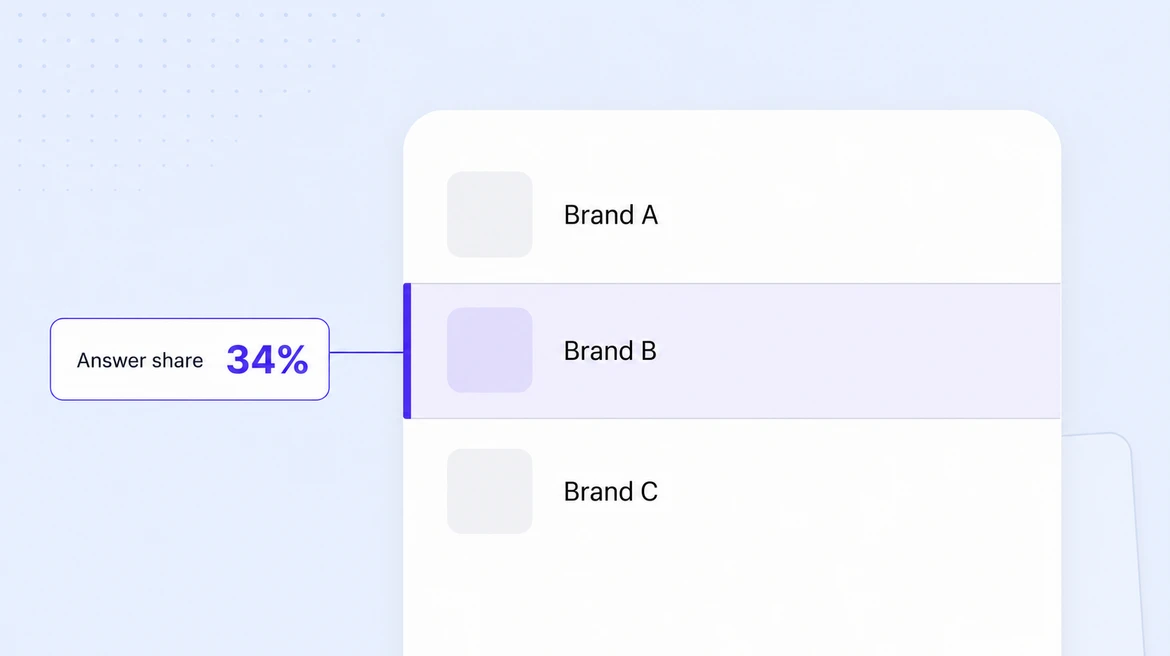
AI Share of Voice (AI SoV) is the percentage of AI-generated answers that mention or cite your brand, measured relative to all competitor mentions across a set of relevant prompts. It shows how often an AI names your brand when someone asks a relevant question.
Traditional metrics track clicks, impressions, and rankings. AI SoV tracks whether the model treats your brand as important enough to include in its answer. Birdeye calls it a measure of which brands AI engines trust enough to cite as authoritative. In AI search, the answer is the destination. The model names a few brands and moves on. Being one of those brands is the entire game. AI Share of Voice measures how often your brand appears in those answers compared to competitors across relevant prompts [2].
How AI SoV Differs From Traditional SoV
Traditional share of voice measures how much visibility your brand has compared with competitors. Arcalea defines it as the percentage of total market visibility your brand owns, calculated as your visibility divided by total market visibility [1]. In practice, that usually meant advertising spend or impressions on a search results page.
AI SoV measures something different: how often an AI model actively selects your brand to include in a single synthesized answer. Most AI responses name only a few brands, so each mention matters more.
This is the central focus of Answer Engine Optimization (AEO). The goal is not only to rank near the top of a results page, it is to become part of the answer itself. AthenaHQ describes itself as the command center for AEO and GEO because winning in AI search demands a different playbook than winning on a SERP.
Arcalea points to a useful rule: brands whose share of voice exceeds their market share tend to grow. Brands below it tend to shrink. This applies to AI search, where many brands still have no way to measure their visibility [1].
How to Calculate AI Share of Voice
The number is only useful if you measure it consistently. Use the same prompts, competitors, and AI platforms over time. Changing them will change the result.
The Core Formula and a Worked Example
The basic formula is simple:
"Total Brand Mentions" includes every brand mention across the prompts you measure, including yours. AthenaHQ frames the denominator as the share of all brand mentions, including your own.
Some methods give extra weight to brands mentioned first in an answer, since first position often gets more attention. You can add this later, but the simple mention-based formula is the best place to start.
Search Engine Land warns that a single percentage score can be misleading if the denominator is shifting [3]. Be clear about which prompts and competitors are included, and keep them the same.
Three Parts of AI SoV: Mentions, Citations, and Position
One score does not tell the whole story. Track AI SoV across three components for a clearer picture.
Mention SOV is how often your brand is named in AI answers. This is the primary metric and the main way brands measure their overall presence in AI-generated responses.
Citation SOV is how often your website is linked as a direct source. Citations are the leading indicator worth watching most closely, as they move first, often climbing weeks before visibility grows. The Lago case study saw citations jump before AI Overview impressions grew 11x.
Position SOV is how prominently your brand appears within an answer, for example, being named first rather than last. First mention carries disproportionate weight because readers anchor on it.
Mention SOV is the headline metric. Citation and position add the depth needed to understand why it is moving.
How to Track Your AI Share of Voice
Manual tracking falls apart fast. AI responses vary between users, shift day to day, and differ across platforms. Multiply that by several AI engines, dozens of prompts, and a full competitor set, and spreadsheet tracking becomes unreliable within a week.
Accurate measurement requires a purpose-built platform that runs prompts at scale, holds your test set steady, and turns raw answers into consistent metrics.
Using Specialized Tools for Accurate Measurement
AthenaHQ from a single platform. It monitorsmonitors brand presence across 8+ LLMs, including ChatGPT, Perplexity, Gemini, and Google AI Overviews, so your SoV reflects the full set of engines your buyers actually use. Tooliverse describes it as tracking how your brand appears across these platforms, then telling you exactly what to fix [4].
The dashboard consolidates mention, citation, and position data into a single view. AthenaHQ's reporting breaks this down into share of voice and AI model performance, which matters because a strong ChatGPT number can mask a weak Gemini one.
Two capabilities do the heavy lifting: unlimited competitor tracking across all plans, and real-time brand sentiment intelligence that tells you not just whether you're mentioned but how the AI frames you.
Benchmarking Against Competitors
AthenaHQ supports competitor share of voice comparison and sends alerts when competitors gain or lose ground. It also offers head-to-head AI recommendation tracking against any competitor, and helps you against any competitor, and helps you decode understand why AI prefers a rival for specific queries.
Other tools cover narrower slices. Otterly AI reports Brand Coverage %, Brand Mentions, and Average Brand Position across seven engines, though its stated limitation is that it tells you what's happening without recommending how to improve [5][6]. Peec AI focuses on Visibility, Position, and Sentiment, though costs rise quickly as you add queries or competitors [7]. An end-to-end approach covers all three dimensions together and pairs measurement with recommendations.
Strategies to Improve Your AI Share of Voice
Measurement tells you where you stand. These five strategies move the number.
1. Create authoritative, long-form content. AI models favor deep, well-structured content that fully answers a question. Write the definitive resource on the questions your buyers ask, cover the topic completely, and structure it so a model can extract clean, quotable passages.
2. Optimize for citation-worthiness. Earning citations is one of the highest-leverage moves you can make. Signal authority the way AI models look for it: clear sourcing, structured data and schema, verifiable facts, and specific numbers rather than vague claims.
3. Identify and fill competitor content gaps. Find the high-value prompts where competitors get cited and your brand is absent. AthenaHQ is built to identify content gaps and prioritize the prompts where competitors appear but you don't.
4. Audit for AI readiness. Technical issues quietly suppress AI visibility. Check for poor internal linking, missing schema, slow pages, and content an AI crawler can't parse. A page can be excellent and still be invisible if the model can't read or trust it.
5. Centralize your efforts. Monitoring, competitive intelligence, and content work belong in one place. A purpose-built platform ties them together and delivers automated content optimization recommendations so insight and action live in the same workflow.
AI Share of Voice FAQs
What is a good benchmark for AI Share of Voice?
There is no universal number. A healthy score depends on your category and competitor set. The useful benchmark is relative: compare your SoV to the category leader and to your own market share. Brands whose share of voice exceeds their market share tend to grow. For context, Nuvadermis grew its Share of Voice 3x in three months, with citation rate climbing to 20%+ against a 4% category average. Set your target against your specific competitors rather than an arbitrary percentage.
Which AI engines are most important to track?
Track the platforms your buyers actually use. AthenaHQ monitors ChatGPT, Perplexity, Google AI Overviews, Google AI Mode, Gemini, Claude, Copilot, Grok, and more. Because a brand can perform very differently across engines, measuring only one gives a distorted view.
How does AI SoV relate to Generative Engine Optimization (GEO)?
AI SoV is the scoreboard for your GEO and AEO efforts. GEO is the practice of optimizing content so AI-driven engines reference your brand. AI SoV is how you measure whether that work is paying off.
What other metrics should I track alongside AI SoV?
Pair mention-based SoV with citation rate, position, and sentiment. Citation rate is your leading indicator, as it rises before visibility does. Position tells you whether you're named first or buried at the end. Sentiment tells you whether the AI frames you favorably. AthenaHQ monitoring.
Citations
- https://arcalea.com/blog/share-of-voice-as-a-strategic-accelerator
- https://athenahq.ai/blog/the-ultimate-guide-to-ai-search-for-cmos
- https://searchengineland.com/ai-share-of-voice-metrics-that-matter-more-479611
- https://tooliverse.ai/tools/athenahq
- https://otterly.ai
- https://semrush.com/blog/llm-monitoring-tools
- https://peec.ai
Become the Brand AI Trusts
See, Act, and Win on AI Search and Beyond
Keep Reading
Enterprise AEO 101: What You Need to Know to Boost AI Search Visibility in 2026
Learn how enterprise AEO and GEO can improve AI search visibility in 2026, from prompt measurement and citation-ready content to platform evaluation and attribution.
Enterprise GEO Prompts: Strategies for Scaling AI Search Visibility
Enterprise GEO provides a practical way for large teams to organize buyer questions, measure answers across engines, find citation gaps, invest in changes that carry real business value, and ultimately scale their AI search visibility.

How to Get Your Products Featured in AI Search Recommendations
Actually getting your products featured in AI search recommendations requires a repeatable process to sufficiently cover your grounds across product data, crawl access, third-party evidence, comparison content, and performance.
See AthenaHQ in Action
 AthenaHQ
 Cozy Earth
The Most-Cited Sleepwear Brand in AI Search
Cozy Earth used AthenaHQ to protect its lead in sleepwear, identify a loungewear opportunity, and give its two-person content team a clearer way to prioritize what to publish next.
AthenaHQ Rootly
10x Increase in Citation Rate
GEO became Rootly's #1 growth pillar. With ~10x citation rate growth and +126% mention rate on non-branded prompts, Rootly transformed AI Search into an executive-level operating channel.
AthenaHQ Lago
Lago50% Increase in Demos from AI Search
Lago achieved a 50% increase in demos from AI Search after implementing Athena. With 11x growth in AI Overview impressions and exploding citations, Athena became their command center for GEO.